Loading...
Oduduwa vs Pachacuti
Pachacuti leads by 9.7 pts · 2 figures compared
…
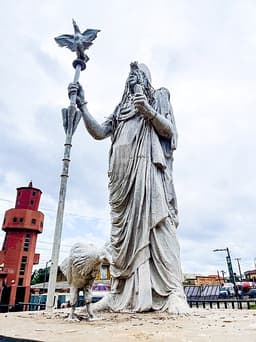
Oduduwa
Emperor · Medieval
59.7Total
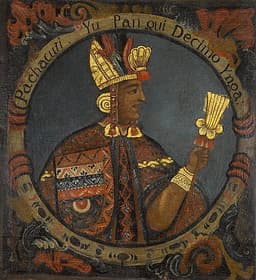
Pachacuti
Emperor · Medieval
69.4Total
Basic Information
Born
950
1418
Died
1020
1472
Era
Medieval
Medieval
Nationality
Ife
Inca Empire
Occupation
Emperor
Emperor
Civilization
Other
Other
Score Comparison
Military (10%)
50.0
78.5
Political (20%)
46.6
58.1
Influence (20%)
68.0
65.0
Legacy (20%)
68.0
72.0
Leadership (15%)
67.0
78.0
Strategy (15%)
36.8
69.2
TOTAL
59.7
69.4
Oduduwa — Complete Timeline
1000 AD
Foundation of the Yoruba civilization at Ile-IfeCultural
According to Yoruba oral tradition, Oduduwa descended from heaven at Ile-Ife and founded the Yoruba civilization. He is credited with establishing the first Yoruba kingdom and the sacred city of Ile-Ife, which became the spiritual and cultural heartland of the Yoruba people.
Impact: regionalconstructive
1010 AD
Establishment of the Yoruba royal dynastiesPolitical Action◆ Major
Oduduwa is said to have sent his sons and grandsons to found the various Yoruba kingdoms, including Oyo, Benin, and Ketu. This act established the royal lineages that ruled these states for centuries, creating a network of related kingdoms under the spiritual authority of the Ooni of Ife.
Impact: regionalconstructive
Pachacuti — Complete Timeline
1438 AD
Conquest of the Chanka KingdomWar
Pachacuti led the Inca army to defeat the Chanka, a powerful rival, in a decisive battle near Cusco. This victory secured his position as Sapa Inca and initiated a period of rapid expansion, transforming the Inca from a small kingdom into a vast empire.
ConquestInca ExpansionChanka
Impact: regional
1440 AD
Reconstruction of CuscoCultural◆ Major
Pachacuti rebuilt Cusco as the imperial capital, designing it in the shape of a puma and constructing massive stone structures like Sacsayhuam
Urban PlanningArchitectureInca Empire
Impact: regionalconstructive
1450 AD
Initiation of Machu Picchu's ConstructionCultural◆ Major
Pachacuti ordered the construction of Machu Picchu, a royal estate and ceremonial site high in the Andes. The complex featured sophisticated dry-stone masonry and terraced agriculture, serving as a symbol of Inca engineering and a retreat for the emperor.
ArchitectureRoyal EstateInca Engineering
Impact: regionalconstructive
Expert Analysis
Pachacuti vs Oduduwa
# The Mountain and the Sky: Two Founders of Empires
In the high Andes, a young prince rallies his father's broken army against a rampaging enemy, turning certain defeat into the birth of an empire. In the forests of West Africa, a divine figure descends from heaven on an iron chain, carrying a handful of earth and a five-toed rooster to create the solid ground of civilization. Both scenes are origin stories—one historical, one sacred—and both shaped the destinies of millions. But what separates a conqueror from a creator? Pachacuti, the ninth Sapa Inca, and Oduduwa, the legendary first king of Ife, built worlds from radically different materials: one from stone and blood, the other from myth and lineage.
Origins
Pachacuti was born in 1418 into a world of violent flux. The Inca were then a modest kingdom in the Cusco Valley, surrounded by hostile neighbors like the Chanka. His father, Viracocha Inca, named him Cusi Yupanqui—"happy" or "fortunate"—but the boy grew up in the shadow of a father who favored another son. The Andes were unforgiving: steep terraces, thin air, and constant warfare shaped a people who believed their ruler was the son of Inti, the sun god. Pachacuti learned early that survival required ruthlessness.
Oduduwa belongs to a different kind of time. Born around 950, he is less a man than a principle. Yoruba oral tradition places him at the dawn of the world: he came from the sky, sent by the supreme god Olodumare, carrying a calabash of earth and a chicken that scratched out the first land at Ile-Ife. There is no childhood, no apprenticeship, no struggle—only arrival. The Yoruba universe was one of spiritual forces and sacred kingship, where a ruler's legitimacy flowed not from conquest but from divine descent. Oduduwa's origin is not a biography but a cosmology.
Rise to Power
In 1438, the Chanka attacked Cusco with overwhelming force. Viracocha and his chosen heir fled the city, but Cusi Yupanqui refused to leave. He rallied the remaining warriors, reportedly turning stones into soldiers through a trick of the light, and crushed the Chanka in a battle that became the Inca founding myth. His father abdicated, and the young prince took the name Pachacuti—"Earth Shaker" or "Transformer of the World." He was thirty years old, and he had seized power not by inheritance but by audacity.
Oduduwa's rise is not a battle but a covenant. According to tradition, he first settled at Ile-Ife, where he became the first *Ooni* (king) and established the sacred city as the navel of the Yoruba world. He then sent his sixteen sons—and sometimes grandsons, depending on the version—to found new kingdoms: Oyo, Benin, Ketu, and others. These were not conquests but spiritual expansions. Each prince carried a piece of Ife's authority, making every Yoruba king a descendant of Oduduwa. His power came not from an army but from a bloodline that still defines Yoruba identity today.
Leadership & Governance
Pachacuti ruled through terror and genius. He reorganized the Inca army into disciplined units, built a network of roads and storehouses that stretched thousands of miles, and imposed a system of forced labor (*mita*) that turned conquered peoples into imperial subjects. He rebuilt Cusco in the shape of a puma—a sacred animal—with massive stone walls that fit together without mortar, so precisely that a knife blade could not slip between them. He also ordered the construction of Machu Picchu around 1450, a mountain retreat that blended architecture with astronomy. His strategy was total control: language, religion, and economy were standardized across the empire.
Oduduwa ruled through ritual and lineage. The Yoruba system was decentralized: Ife was the spiritual capital, but each kingdom governed itself under a king who traced his ancestry to Oduduwa. Leadership was about maintaining balance with the gods, not expanding borders. Oduduwa is credited with establishing the *Ogboni* society, a council of elders that advised kings and upheld justice, and with codifying the worship of the *orishas* (deities). Where Pachacuti built walls, Oduduwa built relationships. The Yoruba empire was not a single state but a web of kinship.
Triumph & Tragedy
Pachacuti's greatest triumph was the transformation of the Inca from a hill tribe into the largest empire in pre-Columbian America, stretching from modern Colombia to Chile. But his tragedy was that he created a system too rigid to survive without him. After his death in 1472, his son Tupac Inca Yupanqui continued expansion, but the empire's reliance on absolute central authority made it vulnerable to the Spanish conquest that came sixty years later. The stones of Machu Picchu stand as a monument to ambition, but also to fragility.
Oduduwa's triumph is that his civilization never fell. The Yoruba kingdoms endured centuries of warfare, the transatlantic slave trade, and British colonialism, yet the belief that all Yoruba kings descend from Oduduwa remains unbroken. His tragedy is that we know nothing of him as a person—no battles, no dates, no words. He exists only as a symbol, which makes him eternal but also silent. The Yoruba historian Samuel Johnson wrote in the 1890s that Oduduwa "came from the east," but even that is debated. He is a legend without a life.
Character & Destiny
Pachacuti was pragmatic, visionary, and merciless. He reportedly said, "The earth is like a mother; you must not harm her," but he also ordered the execution of whole tribes that resisted. His personality drove him to conquer and organize, to build and destroy. Destiny, for him, was something to be seized with both hands.
Oduduwa is the opposite: a figure of myth, not psychology. His personality is unknowable, but his function is clear—to be the origin. Yoruba tradition says he brought civilization, law, and kingship. Destiny, for him, was something to be received from the gods.
Legacy
Pachacuti's legacy is physical: the terraces of the Sacred Valley, the stonework of Sacsayhuamán, the ghost city of Machu Picchu. He is remembered as the father of the Inca Empire, a name that still evokes awe. His political system—the *ayllu* (clan) system, the tribute networks, the road system—influenced later Andean societies, but the Spanish destroyed most of it.
Oduduwa's legacy is spiritual and political. Every Yoruba king, from the *Ooni* of Ife to the *Alaafin* of Oyo, claims descent from him. The Yoruba diaspora—in Brazil, Cuba, Trinidad—carries his name in the religion of Santería, where he is syncretized with Catholic saints. He is not a historical figure in the Western sense; he is a living ancestor.
Conclusion
Pachacuti and Oduduwa represent two ways of founding an empire: through force of will and through force of myth. One built with stone, the other with stories. One left ruins, the other left a bloodline. In the end, both succeeded beyond measure—but their different paths remind us that civilizations are born not just from battles and walls, but from the stories we tell about where we came from. The Earth Shaker and the Sky Descender: both transformed the world, but only one still walks among us.
Rankings
🥇
PachacutiLeader
Mil: 78.5Pol: 58.1Inf: 65.0
69.4
🥈
Oduduwa
Mil: 50.0Pol: 46.6Inf: 68.0
59.7
+9.7 behind
How This Comparison Works
Algorithm
Each figure is scored on 6 dimensions (0—100 scale) based on structured historical data: Military (10%), Political (20%), Influence (20%), Legacy (20%), Leadership (15%), Strategy (15%). The weighted total produces the final ranking.
Data Sources
Scores are computed from structured sub-indicators in the database. Scale factors adjust for era (Ancient ×0.85, Modern ×1.0) and civilization size (Eastern ×1.05, Other ×0.80) to account for differences in population and military scale.
Maximum 3 Figures
Comparisons are limited to 2—3 figures to ensure readability and statistical meaningfulness.
Error Margins
±5 points per dimension — Sub-scores are derived from historical records with inherent uncertainty. Two figures within 5 points on a dimension should be considered roughly equivalent in that area.
Total Score Accuracy
±3 points overall — The weighted combination of 6 dimensions produces a total score with approximately ±3 points of uncertainty. Differences of less than 3 points are not statistically significant— the figures are effectively tied.
Known Limitations
- Historical records are incomplete and uneven across civilizations
- Figures from oral-tradition societies may be underrepresented
- Occupation labels can misclassify multi-role figures
- Scores measure capability and impact, not moral character
- Quantitative scoring is a comparison tool, not absolute truth
Capability Radar
Military (10%) — Battles & Warfare
Battles
10
85
Win Rate
10
90
Expansion
30
90
Political (20%) — Governance & Reform
Reform
50
92
Diplomacy
40
75
Economy
40
80
Influence (20%) — Cultural & Global Reach
Cultural
80
85
Global
70
65
Legacy (20%) — Historical Impact
Historical
80
80
Longevity
80
70
Leadership (15%) — Power & Stability
Tenure
40
85
Stability
50
82
Strategy (15%) — Tactics & Innovation
Strategy
10
88
Tactics
10
80
Reform
10
85
Similar Comparisons
Comments & Discussion
Terra Incognita6/16/2026
Pachacuti vs Oduduwa is a joke. One built roads, terraces, and a tax system across 2,500 miles of mountains; the other sprinkled dirt from a calabash. If Oduduwa created the earth, why is most of Nigeria still dirt roads while Inca stonework survives earthquakes? The "divine founder" trope is just ancestor worship dressed up as history. Pachacuti actually conquered Chankas with pikes and slings—that's real foundation, not fable.
考古狂人6/16/2026
拿奥杜杜瓦跟帕查库蒂比纯属欺负人。一个是实实在在用石头和血建帝国,一个是神话里提个葫芦撒土。你跟我说奥杜杜瓦从天而降创造大地?那为什么约鲁巴人后来还要打仗抢地盘?帕查库蒂可是真刀真枪打退昌卡人,修了马丘比丘和2万公里道路网。神话人物别碰瓷历史人物,不是一个量级。
Statistikus6/16/2026
Let's talk logistics. Pachacuti's Inca Empire stretched 2,500 miles with 40,000 km of roads, suspension bridges, and terraced agriculture feeding millions. Oduduwa's Ife at its peak covered maybe 200 miles. The "divine chain" founding narrative is beautiful poetry, but it built no roads, no census, no courier system. Myths don't sustain empires—quinoa storage systems do. I'll take the guy who conquered the Chanka over the guy who carried dirt down from heaven.
守旧派史官6/16/2026
你们这些现代人总喜欢用"效率"评判古人。奥杜杜瓦的意义不在扩张领土,而在建立血统秩序。没有他,整个约鲁巴的王室谱系就是空中楼阁。帕查库蒂确实了不起,但他征服的部落几代后就反叛了,印加帝国在西班牙人面前撑了不到百年。奥杜杜瓦的神话滋养了西非千年的政治认同,这种文明根基比石头路管用得多。
Viracocha's Ghost6/16/2026
The crucial detail everyone misses: Pachacuti's name means "earth-shaker." He literally remade the Andean world, from sacred geography to irrigation systems. Oduduwa? His name translates to "the one who created being"—pure abstraction. One man reshaped a hemisphere through civil engineering and military reform; the other reshaped a cosmology through poetry. Comparison is absurd—unless you're measuring by spiritual impact, in which case Oduduwa wins by default on sheer longevity.