Loading...
Nyatsimba Mutota vs Tamar of Georgia
Tamar of Georgia leads by 15.0 pts · 2 figures compared
…

Nyatsimba Mutota
Emperor · Medieval
56.5Total
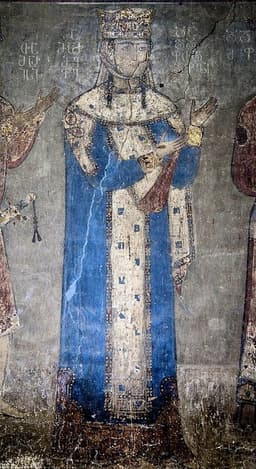
Tamar of Georgia
Emperor · Medieval
71.5Total
Basic Information
Born
1400
1160
Died
1450
1213
Era
Medieval
Medieval
Nationality
Mozambique
Georgia
Occupation
Emperor
Emperor
Civilization
Other
Western
Score Comparison
Military (10%)
72.5
78.0
Political (20%)
68.0
72.0
Influence (20%)
59.0
82.0
Legacy (20%)
50.0
55.0
Leadership (15%)
40.0
80.0
Strategy (15%)
57.5
66.3
TOTAL
56.5
71.5
Nyatsimba Mutota — Complete Timeline
1430 AD
Founding of the Mutapa EmpirePolitical Action
Nyatsimba Mutota led a migration north from Great Zimbabwe and founded the Mutapa Empire in the Zambezi valley. He established a new capital at Zvongombe and began territorial expansion.
Impact: regionalconstructive
1440 AD
Conquest of the TavaraWar◆ Major
Nyatsimba Mutota conquered the Tavara people in the Zambezi valley, incorporating their territory into the Mutapa Empire. This victory secured control over fertile agricultural lands and trade routes.
Impact: regional
1445 AD
Establishment of the Mwenemutapa TitlePolitical Action◆ Major
Nyatsimba Mutota adopted the title Mwenemutapa, meaning 'lord of the conquered lands,' formalizing the imperial structure. This title became hereditary and defined the ruler's authority over conquered peoples.
Impact: regionalconstructive
Tamar of Georgia — Complete Timeline
1184 AD
Coronation as Queen RegnantPolitical Action
Tamar was crowned as the first female ruler of Georgia after her father George III's death. Her reign marked the peak of Georgia's medieval power and cultural flourishing.
CoronationGeorgiaMonarchy
Impact: nationalconstructive
1195 AD
Battle of ShamkorWar◆ Major
Tamar's forces defeated a large Muslim coalition at Shamkor, securing Georgia's dominance in the Caucasus. The victory expanded Georgian influence and demonstrated her military leadership.
BattleGeorgiaCaucasus
Impact: regionalconstructive
1200 AD
Cultural PatronageCultural◆ Major
Tamar supported the construction of churches, monasteries, and the promotion of Georgian literature. Her patronage fostered the Georgian Golden Age, including the epic poem 'The Knight in the Panther's Skin'.
CulturePatronageGeorgia
Impact: nationalconstructive
Expert Analysis
Tamar of Georgia vs Nyatsimba Mutota
# The Throne and the Sword: Nyatsimba Mutota and Tamar of Georgia
On opposite ends of the medieval world, two rulers rose from very different soils to build empires that would define their peoples for centuries. One was a man who led his people northward from the crumbling stone walls of Great Zimbabwe into the fertile Zambezi valley, carving out a kingdom with the sword and sealing it with a new title. The other was a woman who inherited a throne at the moment of her father’s death, then proceeded to shatter every expectation of what a queen could achieve, leading armies and nurturing a golden age of culture that still echoes through Georgian poetry. Nyatsimba Mutota and Tamar of Georgia never knew of each other’s existence, yet their stories converge on a single question: what does it take to found a lasting empire?
Origins
Nyatsimba Mutota was born around 1400 into the elite of Great Zimbabwe, the great stone city that had dominated southern African trade for centuries. By the time he came of age, that civilization was fraying—overgrazing, deforestation, and political fragmentation threatened its cohesion. Mutota saw not decay but opportunity. He was a prince of the Shona people, raised in a world of cattle wealth and gold trade, where power flowed from control over resources and the spiritual authority of the Mwari cult. His era demanded expansion or collapse.
Tamar, born in 1160, was the daughter of King George III of Georgia, a kingdom wedged between the Black Sea and the Caucasus Mountains. Georgia in the twelfth century was a Christian bastion surrounded by Muslim powers—the Seljuk Turks, the Shirvanshahs, and various emirates. Her father had fought to consolidate the realm, but he had no male heir. Tamar was raised to rule, educated in statecraft and theology, yet her path was anything but assured. A woman on the throne was an anomaly in a world where warriors and priests expected a king.
Rise to Power
Mutota’s rise was a deliberate act of creation. In 1430, he led a migration of Shona warriors and followers north from Great Zimbabwe into the Zambezi valley, a region rich in ivory, salt, and fertile land. This was not a conquest of a unified enemy but a colonization of territory inhabited by the Tavara people. Over the next decade, Mutota systematically subdued these communities. In 1440, he conquered the Tavara in a major military campaign, incorporating their lands into his growing domain. But he understood that empire required more than force. In 1445, he adopted the title *Mwenemutapa*—meaning “lord of the conquered lands”—formalizing an imperial structure that blended Shona spiritual authority with military command. His power was not inherited; it was built from the ground up.
Tamar’s ascent was more dramatic and precarious. When her father died in 1184, she was crowned Queen Regnant of Georgia—the first woman to rule in her own right. The nobility was skeptical. Some questioned whether a woman could command armies or enforce justice. But Tamar moved swiftly. She appointed loyalists to key positions, married a capable prince (though she later divorced him for incompetence), and consolidated her authority through a mix of diplomacy and resolve. Her turning point came not in a single battle but in the steady assertion of her will. She proved that the crown was not a burden she carried—it was a weapon she wielded.
Leadership & Governance
Mutota ruled through a decentralized system. The Mwenemutapa was the supreme political and religious authority, but local chiefs retained considerable autonomy as long as they paid tribute and provided warriors. This flexibility allowed the Mutapa Empire to expand rapidly—from the Zambezi into the interior plateau—without overextending its administrative reach. Mutota’s genius lay in adaptation: he took the spiritual prestige of Great Zimbabwe and repurposed it for a new dynasty. He did not build monumental stone cities; he built networks of loyalty.
Tamar’s governance was more centralized and ambitious. She reformed the royal court, curbed the power of rebellious nobles, and expanded Georgia’s influence through both marriage alliances and military campaigns. In 1195, her forces defeated a large Muslim coalition at the Battle of Shamkor, a victory that secured Georgian dominance in the Caucasus for decades. But Tamar understood that empires are not sustained by war alone. She became a legendary patron of culture, commissioning churches, monasteries, and the great epic poem *The Knight in the Panther’s Skin* by Shota Rustaveli. Under her reign, Georgia became a crossroads of Byzantine, Persian, and indigenous traditions—a golden age of literature, architecture, and theology.
Triumph & Tragedy
Mutota’s greatest triumph was the creation of the Mutapa Empire itself. By the time of his death around 1450, he had laid the foundations for a state that would endure for over three centuries. His tragedy is that we know so little of his personal story—no chronicles, no poems, only archaeological fragments and oral traditions. The empire he built would eventually fragment under Portuguese pressure, but his legacy as a founder remained unbroken.
Tamar’s triumph was both military and cultural. The Battle of Shamkor made her name feared across the region. Her patronage of the arts created a legacy that Georgians still celebrate as their cultural zenith. But her tragedy came after her death in 1213. Within decades, the Mongol invasions would shatter the kingdom she had built, reducing Georgia to a vassal state. Her golden age proved fragile, yet her image as a warrior-queen and patroness endured, woven into national memory.
Character & Destiny
Mutota was a pragmatist. He saw a dying civilization and chose migration over stagnation. He was not a conqueror in the style of Alexander—he was a settler, a founder, a man who understood that empire is built on people, not walls. His character was shaped by the land itself: patient, adaptable, rooted in the spiritual traditions of his ancestors.
Tamar was a firebrand in silk. She defied every expectation of her gender with a calm ferocity. She ruled not by mimicking men but by mastering the tools of power—patronage, piety, military command, and political cunning. Her character was forged in a crucible of skepticism, and she emerged as one of the most effective rulers of her age.
Legacy
Mutota’s legacy is the Mutapa Empire—a state that shaped the history of Zimbabwe and Mozambique for centuries. His title, Mwenemutapa, became synonymous with the empire itself. Today, he is remembered as a founder, a figure of origin and pride for the Shona people, though his story remains largely unknown beyond southern Africa.
Tamar’s legacy is immortal. She is canonized as a saint in the Georgian Orthodox Church. Her name adorns streets, universities, and monuments. Georgians call her *Tamar the Great*, and her reign is taught as the pinnacle of their national history. She is not just a ruler—she is a symbol of what Georgia can be.
Conclusion
Mutota and Tamar built empires from opposite ends of the medieval world, yet both understood that power is never simply inherited—it must be claimed, defended, and given meaning. Mutota claimed his with a migration and a new title; Tamar claimed hers with a crown and a sword. One built a kingdom in the shadow of a dying civilization; the other raised a golden age that still lights the Caucasus. Their differences are vast—gender, geography, resources, religion—but their shared truth is this: the greatest empires are not carved from stone, but from will.
Rankings
🥇
Tamar of GeorgiaLeader
Mil: 78.0Pol: 72.0Inf: 82.0
71.5
🥈
Nyatsimba Mutota
Mil: 72.5Pol: 68.0Inf: 59.0
56.5
+15.0 behind
How This Comparison Works
Algorithm
Each figure is scored on 6 dimensions (0—100 scale) based on structured historical data: Military (10%), Political (20%), Influence (20%), Legacy (20%), Leadership (15%), Strategy (15%). The weighted total produces the final ranking.
Data Sources
Scores are computed from structured sub-indicators in the database. Scale factors adjust for era (Ancient ×0.85, Modern ×1.0) and civilization size (Eastern ×1.05, Other ×0.80) to account for differences in population and military scale.
Maximum 3 Figures
Comparisons are limited to 2—3 figures to ensure readability and statistical meaningfulness.
Error Margins
±5 points per dimension — Sub-scores are derived from historical records with inherent uncertainty. Two figures within 5 points on a dimension should be considered roughly equivalent in that area.
Total Score Accuracy
±3 points overall — The weighted combination of 6 dimensions produces a total score with approximately ±3 points of uncertainty. Differences of less than 3 points are not statistically significant— the figures are effectively tied.
Known Limitations
- Historical records are incomplete and uneven across civilizations
- Figures from oral-tradition societies may be underrepresented
- Occupation labels can misclassify multi-role figures
- Scores measure capability and impact, not moral character
- Quantitative scoring is a comparison tool, not absolute truth
Capability Radar
Military (10%) — Battles & Warfare
Battles
55
75
Win Rate
60
85
Expansion
65
75
Political (20%) — Governance & Reform
Reform
50
80
Diplomacy
55
75
Economy
50
85
Influence (20%) — Cultural & Global Reach
Cultural
45
80
Global
40
60
Legacy (20%) — Historical Impact
Historical
55
75
Longevity
50
70
Leadership (15%) — Power & Stability
Tenure
60
85
Stability
55
70
Strategy (15%) — Tactics & Innovation
Strategy
55
80
Tactics
50
70
Reform
40
65
Similar Comparisons
Comments & Discussion
MutotaBasher6/16/2026
Founding an empire through conquest is impressive, but let’s not romanticize Nyatsimba Mutota as some genius visionary. He literally just copied Great Zimbabwe’s model—stone walls, cattle, gold trade—and moved it north because his homeland was dying. Tamar actually innovated, fusing Byzantine court culture with local traditions to create a Georgian renaissance. Mutota’s empire sputtered after a century; Tamar’s legacy lasted 800 years in poetry and national identity. That’s real empire building.
数据控小张6/16/2026
比较一个13世纪女君主和15世纪男君主,数据都不对称。Tamar统治时Georgia人口约200万,控制黑海到里海的贸易网,但Mutota的Mutapa没有可靠人口数据,仅靠葡萄牙人零散记录估计。这种对比本质上是旧框框:把男性君主战争扩张和女性君主文化繁荣对立起来。两边都是中世纪极少数符合传统“帝国”定义的非洲和欧亚案例,但凭空比较除了制造伪历史英雄,没任何分析价值。
喀赫梯老读者6/16/2026
你们非要绑一起比较,就像把高加索山脉和赞比西河强拉同框。Tamar是拜占庭式君主,Mutota是班图王室体系开创者。不同文明土壤,同样结果:都创造了延续性统治。Tamar靠宗教统一,Mutota靠mambo头衔整合酋长。一个让Georgia黄金时代,一个让Shona人口扩散。不必争谁更伟大,而是承认伟大不只有地中海模式这一种。
GloryHunter6/16/2026
Tamar didn’t just "nurture culture"—she personally led armies into battle. When her father died, she crushed revolts from nobles who thought a woman was weak, then smashed the Seljuk Turks at Shamkor in 1195. Meanwhile, Mutota’s biggest achievement is walking north from a dying city and claiming land. It’s like comparing Alexander the Great to a local chieftain who got lucky with a migration route. Tamar earned her crown with blood and steel, not just poems and paintings.
神话显微镜6/16/2026
两边都成了建国神话的牺牲品。Tamar被描绘成“中世纪最伟大女王”,但她的权力高度依赖父亲留下的官僚系统和军队武将(如Mkhargrdzeli家族)。Mutota也被神化为“穆塔帕开国者”,但从葡萄牙记载看,穆塔帕更像是Great Zimbabwe分裂后诸多shona域邦中最成功的一个,而非一声令下建立的帝国。比较最好先拆解这些英雄叙事,看清具体制度基础。