Loading...
Goodwill Zwelithini vs Nicholas I of Russia
Nicholas I of Russia leads by 8.3 pts · 2 figures compared
…

Goodwill Zwelithini
Emperor · Modern
49.5Total
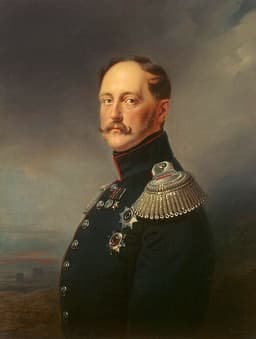
Nicholas I of Russia
Emperor · Modern
57.8Total
Basic Information
Born
1948
1796
Died
—
1855
Era
Modern
Modern
Nationality
Zulu Kingdom
Russia
Occupation
Emperor
Emperor
Civilization
Other
Western
Score Comparison
Military (10%)
23.6
50.0
Political (20%)
43.7
61.3
Influence (20%)
58.0
58.0
Legacy (20%)
50.0
49.2
Leadership (15%)
72.0
72.0
Strategy (15%)
28.0
60.0
TOTAL
49.5
57.8
Goodwill Zwelithini — Complete Timeline
1971 AD
Coronation as Zulu KingPolitical Action◆ Major
Goodwill Zwelithini was crowned as the eighth Zulu monarch, succeeding his father Cyprian Bhekuzulu. His coronation was recognized by the South African government, making him the ceremonial leader of the Zulu nation.
Zulu KingdomCoronationSouth Africa
Impact: regionalconstructive
1994 AD
Establishment of Ingonyama TrustPolitical Action◆ Major
Goodwill Zwelithini signed the Ingonyama Trust Act, placing 2.8 million hectares of Zulu land under a trust administered by the king. This preserved communal land ownership for the Zulu people in post-apartheid South Africa.
Land RightsPost-ApartheidZulu Kingdom
Impact: regionalconstructive
2000 AD
Support for HIV/AIDS AwarenessCultural
Goodwill Zwelithini initially opposed condom use and made controversial statements about HIV/AIDS. Later, he reversed his position and supported awareness campaigns, though his early stance was criticized as harmful.
HIV/AIDSPublic HealthZulu Kingdom
Impact: regional
2015 AD
Controversial Statements on XenophobiaCultural
Goodwill Zwelithini made public statements blaming foreign nationals for crime and economic problems in South Africa, which were widely criticized as inciting xenophobic violence. The remarks sparked debate about the king's political role.
XenophobiaControversySouth Africa
Impact: nationaldestructive
Nicholas I of Russia — Complete Timeline
1825 AD
Suppression of the Decembrist RevoltPolitical Action
Upon ascending the throne, Nicholas I faced a revolt by army officers demanding constitutional reforms. He ordered artillery fire against the rebels in Senate Square, killing hundreds and arresting the leaders. This event set the repressive tone of his reign.
Decembrist RevoltRepressionAutocracy
Impact: nationaldestructive
1826 AD
Establishment of the Third SectionReform◆ Major
Nicholas I created the Third Section of His Imperial Majesty's Own Chancellery, a secret police force tasked with suppressing dissent and monitoring political subversion. This institution became a symbol of state surveillance and repression in Russia.
Secret PoliceRepressionAutocracy
Impact: nationaldestructive
1833 AD
Codification of Russian LawsReform◆ Major
Under Nicholas I, Mikhail Speransky completed the Full Collection of Laws of the Russian Empire, a 45-volume compilation. This codification systematized Russian law for the first time, providing a legal foundation for the autocratic state.
Legal ReformCodificationSperansky
Impact: nationalconstructive
1853 AD
Crimean WarWar
Nicholas I's aggressive expansionism led to war with the Ottoman Empire, Britain, France, and Sardinia. The conflict exposed Russia's military and technological backwardness, culminating in the Siege of Sevastopol and Russia's defeat. The war ended with the Treaty of Paris in 1856.
Crimean WarMilitary DefeatTreaty of Paris
Impact: globaldestructive
Expert Analysis
Origins
Goodwill Zwelithini was born on July 14, 1948, in Nongoma, South Africa, the son of King Cyprian Bhekuzulu. He was educated at the University of Zululand. Nicholas I was born on July 6, 1796, in Gatchina, Russia, the third son of Emperor Paul I and Empress Maria Feodorovna. He was trained for a military career from childhood.
Rise to Power
Zwelithini became king in 1968 after his father's death, but his coronation was delayed until 1971 due to apartheid-era politics. He was recognized by the South African government as the leader of the Zulu nation. Nicholas I ascended the throne in December 1825 after the sudden death of his brother Alexander I. His reign began with the Decembrist Revolt on December 26, 1825, which he suppressed with artillery fire, executing five leaders and exiling hundreds.
Leadership & Governance
Zwelithini's leadership focused on preserving Zulu culture and land. He signed the Ingonyama Trust Act in 1994, placing 2.8 million hectares of Zulu land under a trust administered by the king. He also promoted HIV/AIDS awareness after initial controversial statements. Nicholas I ruled as an autocrat, centralizing power through the Third Section secret police (1826) and codifying Russian laws (1832). He suppressed dissent, enforced censorship, and expanded the Russian Empire into the Caucasus and Central Asia.
Triumph & Tragedy
Zwelithini's triumphs include the preservation of Zulu land and his role in the post-apartheid transition. His tragedies include controversial statements on xenophobia (2015) that sparked violence, and his initial denial of HIV/AIDS. Nicholas I's triumphs include the codification of laws and suppression of the Decembrist revolt. His tragedy was the Crimean War (1853-1856), where Russia's defeat exposed its backwardness and led to his death in 1855.
Character & Destiny
Zwelithini was a traditionalist who navigated the transition from apartheid to democracy, maintaining relevance by focusing on cultural leadership. Nicholas I was a disciplined, hardworking autocrat who believed in absolute monarchy. His rigid control stifled reform, leading to Russia's stagnation and defeat in the Crimean War. Historians note his ability to inspire loyalty among his inner circle but also his paranoia and suppression of free thought.
Legacy
Zwelithini's legacy is tied to the Ingonyama Trust and the preservation of Zulu monarchy in a democratic South Africa. He is remembered as a cultural figurehead. Nicholas I's legacy is mixed: he strengthened autocracy but left Russia technologically and militarily behind. His son Alexander II implemented reforms he had resisted. In the comparison, Nicholas I scores 57.8 total, while Zwelithini scores 49.5. Nicholas I had greater political (61.3 vs 43.7) and strategic (60.0 vs 28.0) impact, while Zwelithini's influence (58.0 vs 58.0) is equal.
Conclusion
Nicholas I had a greater impact on global history due to his role in shaping 19th-century Russia and the Crimean War's consequences. His political and military actions influenced European power dynamics. Zwelithini's influence was largely cultural and regional. While both were symbolic leaders, Nicholas I's decisions altered the course of a major empire, giving him a higher historical significance.
Rankings
🥇
Nicholas I of RussiaLeader
Mil: 50.0Pol: 61.3Inf: 58.0
57.8
🥈
Goodwill Zwelithini
Mil: 23.6Pol: 43.7Inf: 58.0
49.5
+8.3 behind
How This Comparison Works
Algorithm
Each figure is scored on 6 dimensions (0—100 scale) based on structured historical data: Military (10%), Political (20%), Influence (20%), Legacy (20%), Leadership (15%), Strategy (15%). The weighted total produces the final ranking.
Data Sources
Scores are computed from structured sub-indicators in the database. Scale factors adjust for era (Ancient ×0.85, Modern ×1.0) and civilization size (Eastern ×1.05, Other ×0.80) to account for differences in population and military scale.
Maximum 3 Figures
Comparisons are limited to 2—3 figures to ensure readability and statistical meaningfulness.
Error Margins
±5 points per dimension — Sub-scores are derived from historical records with inherent uncertainty. Two figures within 5 points on a dimension should be considered roughly equivalent in that area.
Total Score Accuracy
±3 points overall — The weighted combination of 6 dimensions produces a total score with approximately ±3 points of uncertainty. Differences of less than 3 points are not statistically significant— the figures are effectively tied.
Known Limitations
- Historical records are incomplete and uneven across civilizations
- Figures from oral-tradition societies may be underrepresented
- Occupation labels can misclassify multi-role figures
- Scores measure capability and impact, not moral character
- Quantitative scoring is a comparison tool, not absolute truth
Capability Radar
Military (10%) — Battles & Warfare
Battles
8
55
Win Rate
11
50
Expansion
13
55
Political (20%) — Governance & Reform
Reform
30
30
Diplomacy
40
45
Economy
20
40
Influence (20%) — Cultural & Global Reach
Cultural
60
40
Global
30
50
Legacy (20%) — Historical Impact
Historical
50
55
Longevity
60
50
Leadership (15%) — Power & Stability
Tenure
70
70
Stability
50
50
Strategy (15%) — Tactics & Innovation
Strategy
15
45
Tactics
17
40
Reform
21
60
Similar Comparisons
Comments & Discussion
No comments yet. Be the first to share your thoughts!