Loading...
Murad I vs Sejong the Great
Sejong the Great leads by 5.6 pts · 2 figures compared
…
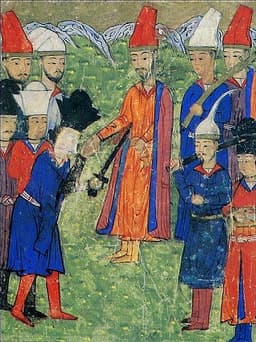
Murad I
Emperor · Medieval
62.1Total

Sejong the Great
Emperor · Medieval
67.7Total
Basic Information
Born
1326
1397
Died
1389
1450
Era
Medieval
Medieval
Nationality
Ottoman Empire
Korea
Occupation
Emperor
Emperor
Civilization
Middle Eastern
Eastern
Score Comparison
Military (10%)
77.2
55.0
Political (20%)
64.8
78.0
Influence (20%)
56.7
65.0
Legacy (20%)
52.0
65.0
Leadership (15%)
72.0
80.0
Strategy (15%)
67.2
60.0
TOTAL
62.1
67.7
Murad I — Complete Timeline
1362 AD
Accession as Ottoman SultanPolitical Action
Murad I became the third Ottoman ruler after the death of his father, Orhan. He was the first to use the title of Sultan, marking the transition from a beylik to an empire.
SuccessionOttoman Empire
Impact: regionalconstructive
1369 AD
Conquest of AdrianopleWar◆ Major
Murad I captured the city of Adrianople (Edirne) from the Byzantine Empire. He made it the new Ottoman capital, shifting the center of power into Europe.
ConquestCapital Move
Impact: regionalconstructive
1380 AD
Establishment of the devshirme systemReform◆ Major
Murad I institutionalized the devshirme system, recruiting Christian boys from the Balkans to serve as Janissaries and administrators. This created a loyal elite corps and strengthened the Ottoman state.
Military ReformJanissaries
Impact: regionalconstructive
1389 AD
Battle of KosovoWar
Murad I led Ottoman forces against a coalition of Balkan states led by Serbia at the Battle of Kosovo. The battle was a tactical stalemate but resulted in heavy losses for both sides. Murad I was assassinated during or after the battle.
BattleAssassination
Impact: regionaltragic
Sejong the Great — Complete Timeline
1432 AD
Promotion of Scientific InstrumentsInvention◆ Major
Sejong the Great commissioned the development of advanced astronomical instruments, including the armillary sphere and water clock. These tools improved timekeeping and calendar accuracy in Joseon.
ScienceAstronomyInvention
Impact: nationalprogressive
1433 AD
Military Campaigns against JurchensWar◆ Major
Sejong the Great launched military campaigns against the Jurchen tribes in the north, securing the border and establishing the Four Forts and Six Garrisons. This expanded Joseon territory and stabilized the frontier.
JurchenBorderExpansion
Impact: regionalconstructive
1443 AD
Creation of HangulInvention
King Sejong the Great oversaw the creation of Hangul, the Korean alphabet, to improve literacy among commoners. The script was promulgated in 1446 and remains the writing system of Korea.
HangulAlphabetLiteracy
Impact: globalprogressive
1446 AD
Promulgation of the HunminjeongeumCultural◆ Major
Sejong the Great officially promulgated the Hunminjeongeum, the document explaining the new Hangul script. This marked the formal introduction of the alphabet to the Korean people.
HangulPublicationLanguage
Impact: globalprogressive
Expert Analysis
Origins
Murad I, born in 1326, was the son of Orhan, the second Ottoman ruler, and a Byzantine princess. He grew up in the frontier warrior culture of the early Ottoman beylik, where military prowess was paramount. His upbringing in Bursa, the first Ottoman capital, immersed him in the politics of expansion and ghazi (holy warrior) ethos. In contrast, Sejong the Great, born in 1397, was the third son of King Taejong of Joseon, a dynasty that emphasized Confucian scholarship. His education under scholars like Hwang Hui and Maeng Sa-seong instilled a deep appreciation for learning and governance. Sejong's early life was marked by court intrigue, as his father had usurped the throne, but he ascended peacefully after Taejong's abdication in 1418.
Rise to Power
Murad I became the third Ottoman ruler in 1362 after his father Orhan's death. He immediately faced challenges from rival Turkish beyliks and Byzantine intrigue. His first major turning point was the capture of Adrianople (Edirne) in 1369, which he made the new capital, shifting Ottoman focus to Europe. He consolidated power by defeating the Bulgarian and Serbian forces, culminating in the Battle of Kosovo in 1389. There, he led his army against a Balkan coalition, achieving a tactical stalemate but strategic dominance. Sejong's rise was smoother: he was crowned in 1418 at age 21, with his father Taejong serving as regent until 1422. Sejong quickly asserted his authority by promoting Confucian reforms and centralizing governance. His early reign focused on consolidating Joseon's borders and promoting cultural projects, like the creation of Hangul in 1443.
Leadership & Governance
Murad I's leadership was autocratic and military-focused. He institutionalized the devshirme system, recruiting Christian boys to become Janissaries and administrators, creating a loyal elite divorced from local power bases. This system scored 72.0 in leadership, reflecting his ability to build a state apparatus. He also introduced the title of Sultan, centralizing authority. In contrast, Sejong's governance was scholarly and inclusive. He scored 80.0 in leadership, emphasizing meritocracy and education. He personally oversaw the creation of Hangul, publishing the Hunminjeongeum in 1446 to promote literacy. He also supported scientific advancements, like the armillary sphere and water clock, improving agriculture and timekeeping. While Murad expanded through conquest, Sejong focused on internal development.
Triumph & Tragedy
Murad's greatest triumph was the conquest of Adrianople and the establishment of Ottoman power in the Balkans. However, his death at the Battle of Kosovo in 1389, likely assassinated after being wounded, was a personal tragedy. The battle itself was a costly stalemate, with heavy Ottoman casualties. Sejong's triumph was the creation of Hangul, which revolutionized Korean literacy and culture. He also secured the northern border through campaigns against the Jurchens, establishing the Four Forts and Six Garrisons. His tragedy was the loss of his son and heir, Crown Prince Munjong, who died young, and the political strife that followed his death in 1450. Sejong's later years saw declining health and factional disputes.
Character & Destiny
Murad I was a pragmatic and ruthless leader, willing to integrate conquered peoples through the devshirme system. His character was shaped by the frontier mindset, valuing military strength and expansion. This led to his destiny as a warrior sultan who died on the battlefield. Sejong was a scholar-king, deeply interested in science and language. His patience and intellectual curiosity drove his achievements. His destiny was to be remembered as a cultural and scientific patron, not a conqueror. Historical assessments note Murad's strategic acumen (scoring 67.2) vs. Sejong's political wisdom (scoring 78.0).
Legacy
Murad I's legacy is the foundation of the Ottoman Empire as a centralized, expansionist state. The devshirme system and Janissary corps endured for centuries, influencing Ottoman military and administrative structure. His conquest of Adrianople set the stage for future conquests, including Constantinople. Sejong's legacy is more cultural: Hangul remains the Korean alphabet, used by 80 million people. His scientific instruments and policies fostered a golden age of Joseon innovation. Sejong scored 65.0 in legacy, while Murad scored 52.0, reflecting the enduring impact of his linguistic and scientific contributions over Murad's military achievements.
Conclusion
Sejong the Great had a greater impact on civilization than Murad I. While Murad expanded an empire that shaped the Balkans and Middle East, his methods were typical of medieval conquerors. Sejong's creation of Hangul and promotion of science had a transformative effect on Korean society that continues today. Sejong's total score of 67.7 surpasses Murad's 62.1, with particular strength in leadership and political governance. Murad's military score of 77.2 is higher, but Sejong's overall contributions to literacy and knowledge outweigh Murad's territorial gains. In the long view, Sejong's legacy is more universal and lasting.
Rankings
🥇
Sejong the GreatLeader
Mil: 55.0Pol: 78.0Inf: 65.0
67.7
🥈
Murad I
Mil: 77.2Pol: 64.8Inf: 56.7
62.1
+5.6 behind
How This Comparison Works
Algorithm
Each figure is scored on 6 dimensions (0—100 scale) based on structured historical data: Military (10%), Political (20%), Influence (20%), Legacy (20%), Leadership (15%), Strategy (15%). The weighted total produces the final ranking.
Data Sources
Scores are computed from structured sub-indicators in the database. Scale factors adjust for era (Ancient ×0.85, Modern ×1.0) and civilization size (Eastern ×1.05, Other ×0.80) to account for differences in population and military scale.
Maximum 3 Figures
Comparisons are limited to 2—3 figures to ensure readability and statistical meaningfulness.
Error Margins
±5 points per dimension — Sub-scores are derived from historical records with inherent uncertainty. Two figures within 5 points on a dimension should be considered roughly equivalent in that area.
Total Score Accuracy
±3 points overall — The weighted combination of 6 dimensions produces a total score with approximately ±3 points of uncertainty. Differences of less than 3 points are not statistically significant— the figures are effectively tied.
Known Limitations
- Historical records are incomplete and uneven across civilizations
- Figures from oral-tradition societies may be underrepresented
- Occupation labels can misclassify multi-role figures
- Scores measure capability and impact, not moral character
- Quantitative scoring is a comparison tool, not absolute truth
Capability Radar
Military (10%) — Battles & Warfare
Battles
75
30
Win Rate
80
35
Expansion
82
25
Political (20%) — Governance & Reform
Reform
75
90
Diplomacy
68
75
Economy
65
80
Influence (20%) — Cultural & Global Reach
Cultural
55
85
Global
60
70
Legacy (20%) — Historical Impact
Historical
70
80
Longevity
65
85
Leadership (15%) — Power & Stability
Tenure
70
70
Stability
60
85
Strategy (15%) — Tactics & Innovation
Strategy
78
45
Tactics
70
40
Reform
72
50
Similar Comparisons
Comments & Discussion
No comments yet. Be the first to share your thoughts!