Loading...
Mohan Singh vs Yitzhak Rabin
Yitzhak Rabin leads by 19.8 pts · 2 figures compared
…
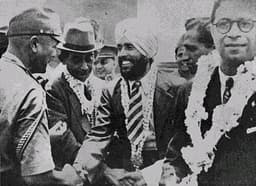
Mohan Singh
General · Modern
46.6Total
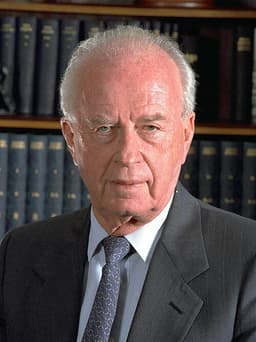
Yitzhak Rabin
General · Modern
66.4Total
Basic Information
Born
1909
1922
Died
1989
—
Era
Modern
Modern
Nationality
India
Israel
Occupation
General
General
Civilization
Indian
Middle Eastern
Score Comparison
Military (10%)
50.0
61.7
Political (20%)
36.5
82.0
Influence (20%)
57.2
68.0
Legacy (20%)
48.3
55.0
Leadership (15%)
36.9
78.0
Strategy (15%)
41.7
55.0
TOTAL
46.6
66.4
Mohan Singh — Complete Timeline
1942 AD
Founding of the Indian National ArmyPolitical Action◆ Major
Mohan Singh founded the Indian National Army (INA) in Singapore with captured Indian soldiers from the British Indian Army. He aimed to fight alongside Japan for Indian independence, but later fell out with Japanese leadership.
Indian National ArmyWorld War IIIndependence
Impact: nationalconstructive
Dissolution of the First INAPolitical Action◆ Major
Mohan Singh dissolved the first Indian National Army after disagreements with the Japanese over its command and objectives. He was arrested by the Japanese, and the INA was later revived by Subhas Chandra Bose.
Indian National ArmyJapanese ConflictDissolution
Impact: nationaldestructive
1945 AD
Imprisonment by BritishPolitical Action
Mohan Singh was imprisoned by the British after World War II for his role in the INA. He was tried and sentenced, but later released after Indian independence, becoming a symbol of resistance.
ImprisonmentBritish EmpireINA
Impact: nationaltragic
Yitzhak Rabin — Complete Timeline
1967 AD
Chief of Staff during the Six-Day WarWar
As Chief of Staff of the Israel Defense Forces, Rabin commanded the Israeli military during the Six-Day War against Egypt, Jordan, and Syria. Israel captured the Sinai Peninsula, Gaza Strip, West Bank, East Jerusalem, and Golan Heights, reshaping the region.
Six-Day WarTerritorial ExpansionMilitary Victory
Impact: global
1993 AD
Signing of the Oslo AccordsPolitical Action
As prime minister, Rabin signed the Oslo Accords with PLO Chairman Yasser Arafat on the White House lawn. The agreement established the Palestinian Authority and set a framework for Palestinian self-governance in the West Bank and Gaza Strip.
Peace ProcessPalestiniansOslo
Impact: globalconstructive
1995 AD
Assassination at Peace RallyPolitical Action
Rabin was assassinated by Israeli extremist Yigal Amir after a peace rally in Tel Aviv. The assassination shocked Israel and the world, derailing the Oslo peace process and leading to a period of political instability.
AssassinationPeace ProcessPolitical Violence
Impact: globaltragic
Expert Analysis
Yitzhak Rabin vs Mohan Singh
# The Soldier Who Fell Between Peace and War
On a warm November evening in 1995, Yitzhak Rabin stood on a stage in Tel Aviv, singing a song of peace with a crowd of 100,000 Israelis. Moments later, three bullets from a fellow Israeli’s gun ended his life. Across the world, in a very different time, another soldier—Mohan Singh—stood in a Singapore prison cell in 1945, watching his dream of an independent Indian army dissolve not from an assassin’s bullet but from the slow erosion of trust between himself and his Japanese allies. Both men were generals who tried to reshape their nations’ destinies through war and politics. One died a martyr for peace; the other faded into historical obscurity. Why did their paths diverge so sharply?
Origins
Yitzhak Rabin was born in Jerusalem in 1922 to secular Zionist parents who had emigrated from Russia and Ukraine. He grew up in a land that was still British Palestine, a place where every Jewish settlement felt like a fortress under siege. His generation inherited a world of constant conflict—Arab riots, British restrictions, and the looming shadow of the Holocaust. Rabin’s upbringing was austere, shaped by the socialist ideals of the kibbutz movement. He learned early that survival required discipline, pragmatism, and a willingness to fight.
Mohan Singh, born in 1909 in Punjab, India, came from a different world. He was a Sikh from a farming family, raised under British colonial rule. His father had served in the British Indian Army, and young Mohan followed the same path, joining the army in the 1930s. For him, loyalty to the British Crown was not a question—it was the only reality he knew. But the Second World War shattered that certainty. When Singapore fell to the Japanese in February 1942, Mohan Singh, then a captain, found himself a prisoner of war, surrounded by 60,000 other Indian soldiers who suddenly had to ask themselves: Whom do we serve now?
Rise to Power
Rabin’s rise was methodical, almost inevitable. He joined the Palmach, the elite strike force of the Jewish underground, in his twenties. By 1948, during Israel’s War of Independence, he was already commanding a brigade. His ascent continued through the young state’s military hierarchy: head of operations, chief of training, and finally, in 1964, Chief of Staff of the Israel Defense Forces. The turning point came in June 1967, when Rabin led the IDF to a stunning victory in the Six-Day War. In six days, Israel captured the Sinai, Gaza, the West Bank, the Golan Heights, and East Jerusalem. Rabin became a national hero overnight.
Mohan Singh’s rise was far more chaotic. In February 1942, as a prisoner of war in Singapore, he was approached by Japanese officers who wanted to recruit Indian soldiers for a liberation army against the British. Mohan Singh agreed, but not out of sympathy for Japan. He saw an opportunity: the chance to create an Indian National Army (INA) that would fight for India’s independence. Within months, he had organized thousands of Indian POWs into a disciplined force. By August 1942, he was formally declared the commander of the INA. It was a dizzying ascent—from captain to general in less than a year—but it rested on fragile foundations.
Leadership & Governance
Rabin’s leadership style was that of a calm, methodical commander. He was not a charismatic speaker or a fiery ideologue. He was a problem-solver, a man who read intelligence reports late into the night and made decisions based on cold calculation. As Chief of Staff, he transformed the IDF into a modern, highly coordinated fighting machine. His political career, which began after his retirement from the military, followed the same pattern. As prime minister in the 1990s, he pursued peace with the Palestinians not out of idealism but out of a pragmatic belief that Israel could not rule millions of Arabs forever. The Oslo Accords, signed in 1993 on the White House lawn, were his greatest political achievement—a handshake with Yasser Arafat that shocked the world.
Mohan Singh’s leadership was more improvisational. He had to build an army from scratch, using men who were demoralized prisoners, not volunteers. He negotiated with Japanese commanders who saw the INA as a propaganda tool, not a real fighting force. His military strategy was hampered by Japanese refusal to give the INA genuine autonomy. Politically, he showed remarkable skill in rallying Indian soldiers to a nationalist cause, but he lacked the diplomatic finesse to manage the Japanese. In December 1942, just months after founding the INA, he dissolved it in frustration, unable to accept Japanese demands that the army serve under their command. It was a principled decision, but it also ended his moment on the historical stage.
Triumph & Tragedy
Rabin’s greatest triumph was the Six-Day War, a lightning campaign that reshaped the Middle East. His greatest tragedy was the peace that followed. By 1995, Israeli society was bitterly divided over the Oslo Accords. Right-wing extremists called him a traitor. On November 4, 1995, after a peace rally in Tel Aviv, a young Israeli named Yigal Amir shot Rabin in the back. The assassin later said he acted to stop the peace process. Rabin died on the operating table, his last words reportedly a request for water.
Mohan Singh’s tragedy was different. He never saw a single battle. His army, the first INA, dissolved before it could fight. He was imprisoned by the British after the war, tried for treason, and later released. He lived a long life, dying in 1989 at the age of eighty, but he spent decades watching another man—Subhas Chandra Bose—take the INA to its real glory. Bose rebuilt the army, led it into battle, and became a legend. Mohan Singh became a footnote.
Character & Destiny
Rabin’s character was defined by a tension between duty and doubt. He was a soldier who understood the costs of war. In his final years, he often quoted the words of an Israeli poet: “Don’t say the day will come / Bring on that day / For it is not a dream.” He was not a natural pacifist, but he had seen enough death to know that peace was the only rational choice. That rationality made him a target.
Mohan Singh’s character was defined by pride and principle. He could not accept Japanese domination, even if it meant sacrificing his army. He was a nationalist who refused to be a puppet. But in the brutal world of war, principles without power are often crushed. His decision to dissolve the INA was honorable, but it also left him isolated. He lacked the ruthlessness to hold onto power.
Legacy
Rabin’s legacy is written in both blood and hope. In Israel, he is remembered as the prime minister who tried to end the conflict. His assassination became a national trauma, a warning about the dangers of extremism. The Oslo Accords, though flawed, remain the foundation of Israeli-Palestinian negotiations. His name is carved into the memory of a country that still struggles with his unfinished work.
Mohan Singh’s legacy is quieter but no less real. In India, he is remembered as the founder of the INA, the man who first gave Indian soldiers a nationalist cause. His early efforts paved the way for Bose’s later triumphs. After independence, he served as a member of parliament, a small but dignified role. He lived long enough to see his dream of a free India become reality, even if his own part in it was mostly forgotten.
Conclusion
Two generals, two paths. Rabin rose to power through a stable state and fell to an extremist’s bullet. Mohan Singh rose through chaos and fell to his own principles. One died at the peak of his influence, the other lived to see his influence fade. Their stories remind us that history does not reward good intentions alone. It rewards timing, luck, and the ability to hold onto power when the moment demands it. Rabin had that ability until the very end. Mohan Singh let it slip away. In the end, both men were soldiers who wanted peace for their people—but only one of them got to sing the song.
Rankings
🥇
Yitzhak RabinLeader
Mil: 61.7Pol: 82.0Inf: 68.0
66.4
🥈
Mohan Singh
Mil: 50.0Pol: 36.5Inf: 57.2
46.6
+19.8 behind
How This Comparison Works
Algorithm
Each figure is scored on 6 dimensions (0—100 scale) based on structured historical data: Military (10%), Political (20%), Influence (20%), Legacy (20%), Leadership (15%), Strategy (15%). The weighted total produces the final ranking.
Data Sources
Scores are computed from structured sub-indicators in the database. Scale factors adjust for era (Ancient ×0.85, Modern ×1.0) and civilization size (Eastern ×1.05, Other ×0.80) to account for differences in population and military scale.
Maximum 3 Figures
Comparisons are limited to 2—3 figures to ensure readability and statistical meaningfulness.
Error Margins
±5 points per dimension — Sub-scores are derived from historical records with inherent uncertainty. Two figures within 5 points on a dimension should be considered roughly equivalent in that area.
Total Score Accuracy
±3 points overall — The weighted combination of 6 dimensions produces a total score with approximately ±3 points of uncertainty. Differences of less than 3 points are not statistically significant— the figures are effectively tied.
Known Limitations
- Historical records are incomplete and uneven across civilizations
- Figures from oral-tradition societies may be underrepresented
- Occupation labels can misclassify multi-role figures
- Scores measure capability and impact, not moral character
- Quantitative scoring is a comparison tool, not absolute truth
Capability Radar
Military (10%) — Battles & Warfare
Battles
15
65
Win Rate
10
70
Expansion
10
50
Political (20%) — Governance & Reform
Reform
25
65
Diplomacy
30
85
Economy
10
60
Influence (20%) — Cultural & Global Reach
Cultural
30
55
Global
25
70
Legacy (20%) — Historical Impact
Historical
40
75
Longevity
30
60
Leadership (15%) — Power & Stability
Tenure
20
70
Stability
10
40
Strategy (15%) — Tactics & Innovation
Strategy
25
75
Tactics
20
60
Reform
30
55
Similar Comparisons
Comments & Discussion
PeacemakerPatrol6/16/2026
Why are we even comparing Rabin, an actual head of state who reshaped a nation, to a footnote like Mohan Singh? Rabin’s assassination alone proves his impact—he was killed precisely because his peace camp terrified extremists. Singh’s INA collapsed because he couldn't manage basic logistics—his Japanese backers literally starved his troops. That’s not “erosion of trust,” that’s incompetence. Rabin earned his martyrdom; Singh just failed upwards.|
历史真实侦探6/16/2026
别扯什么“命运分叉”,根本是能力差距。莫汉·辛格1942年在新加坡就搞不定英军战俘,连自己人的忠诚都保不住,只配当日本人的傀儡。拉宾可是从帕尔马赫一路打到六日战争,军事指挥能力经过血战检验。一个战场英雄,一个投降派军官,能放一起比吗?历史不埋没真金,也不抬举朽木。
DataSkeptic6/16/2026
You're romanticizing Rabin's death while ignoring he could have lived. Fact: 100,000 people at that rally—and his own security detail was understaffed by 40% that night. A career military man who understood risk assessment, yet he stood on that stage without a bulletproof vest. Mohan Singh at least survived to write his memoirs. Who's the better strategist: the man who got assassinated or the one who lived to tell the tale?
边疆骑兵6/16/2026
拉宾的悲剧在于他太天真,以为签个《奥斯陆协议》就能换来和平。莫汉·辛格倒是明白人——他早看出日本盟友靠不住,1942年就试图摆脱他们控制,虽然失败了但至少没当走狗到底。一个被自己人开枪打死,一个被同盟国审判后安然回家种田,谁更失败?活着才有翻盘的机会,拉宾死了,连后悔的机会都没了。