Loading...
Modu Chanyu vs Sinmun of Silla
Modu Chanyu leads by 6.4 pts · 2 figures compared
…
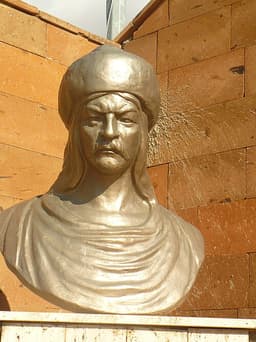
Modu Chanyu
Emperor · Ancient
61.1Total

Sinmun of Silla
Emperor · Ancient
54.7Total
Basic Information
Born
-234
-647
Died
-174
—
Era
Ancient
Ancient
Nationality
Xiongnu
Korea
Occupation
Emperor
Emperor
Civilization
Eastern
Eastern
Score Comparison
Military (10%)
77.5
55.0
Political (20%)
62.7
68.0
Influence (20%)
56.7
51.8
Legacy (20%)
40.0
44.2
Leadership (15%)
78.0
70.0
Strategy (15%)
80.3
45.0
TOTAL
61.1
54.7
Modu Chanyu — Complete Timeline
209 BC
Unification of the Xiongnu TribesPolitical Action
Modu Chanyu unified the nomadic tribes of the Mongolian steppe into the Xiongnu Empire after killing his father, Touman. He established a centralized military and political structure, creating a powerful confederation that rivaled Han China.
UnificationXiongnu EmpireNomadic Confederation
Impact: regional
200 BC
Battle of BaidengWar
Modu Chanyu besieged Emperor Gaozu of Han at Baideng (modern Datong, Shanxi) for seven days. The Han emperor was forced to negotiate a peace treaty, agreeing to pay tribute and send a princess for marriage, establishing Xiongnu dominance over northern China.
BattleHan DynastyTribute System
Impact: regional
198 BC
Treaty of HeqinPolitical Action◆ Major
Modu Chanyu formalized the Heqin treaty with the Han Dynasty, which included annual tribute payments, marriage alliances, and the recognition of the Xiongnu as equals. This treaty maintained peace for decades and set a precedent for Han-Xiongnu relations.
TreatyHeqinDiplomacy
Impact: regional
176 BC
Expansion into Central AsiaWar◆ Major
Modu Chanyu expanded Xiongnu control westward, defeating the Yuezhi and other nomadic groups. He extended Xiongnu influence over the Tarim Basin and parts of Central Asia, controlling key trade routes and establishing a vast steppe empire.
ExpansionCentral AsiaYuezhi
Impact: regional
Sinmun of Silla — Complete Timeline
679 AD
Construction of Sacheonwangsa TempleCultural
Sinmun built Sacheonwangsa Temple in Gyeongju, dedicated to the Four Heavenly Kings of Buddhism. The temple was intended to protect the kingdom from external threats and internal strife, reflecting the integration of Buddhist beliefs into state security.
TempleBuddhismSilla
Impact: nationalconstructive
681 AD
Suppression of the Kim Heumdol rebellionWar◆ Major
Sinmun faced a rebellion led by Kim Heumdol, a powerful aristocrat who opposed the centralization of power. The king's forces crushed the revolt, executing the rebels and confiscating their lands. This victory solidified Sinmun's control over the unified kingdom.
RebellionAristocracySilla
Impact: nationaldestructive
682 AD
Consolidation of central governmentReform◆ Major
King Sinmun reorganized the Silla government by establishing a centralized bureaucracy modeled on Tang China. He created new administrative offices and standardized tax collection, strengthening royal authority and reducing the power of local aristocrats.
AdministrationCentralizationSilla
Impact: nationalconstructive
Promotion of Confucian educationReform
Sinmun established the National Confucian Academy in Gyeongju, which taught Confucian classics and trained government officials. This institution promoted Confucian values in governance and created a merit-based system for selecting bureaucrats.
EducationConfucianismSilla
Impact: nationalconstructive
Expert Analysis
Origins
Modu Chanyu, born around 234 BCE, was the son of Touman, chieftain of the Xiongnu confederation. His early life was marked by danger: his father initially sent him as a hostage to the Yuezhi, then attacked them to provoke Modu's execution. Modu escaped, killing his father in 209 BCE to seize power. He transformed the fragmented nomadic tribes into a centralized empire.
Sinmun of Silla, born in 661 CE, was the son of King Munmu, who completed the unification of the Korean peninsula under Silla. He ascended the throne in 681 CE after his father's death. His upbringing was steeped in the Confucian and Buddhist traditions of Tang China, which influenced his governance.
Rise to Power
Modu's rise was violent. After killing his father, he eliminated rival chieftains and consolidated the Xiongnu tribes. He created a disciplined military force, famously testing loyalty by ordering his archers to shoot his favorite horse and wife. Those who hesitated were executed. By 200 BCE, he commanded a formidable army that threatened the newly established Han Dynasty.
Sinmun's rise was smoother. He inherited a unified kingdom from his father, but faced immediate challenges from powerful aristocrats. His early reign was dominated by the need to centralize authority. In 681 CE, he crushed the rebellion of Kim Heumdol, a high-ranking noble who opposed royal power. This victory solidified his control.
Leadership & Governance
Modu ruled through a combination of military might and diplomatic cunning. He established a hierarchical structure with appointed governors, dividing the empire into left and right wings. His strategy of extracting tribute from the Han through the Heqin treaty (198 BCE) demonstrated pragmatic statecraft. Modu scored 78.0 in leadership, reflecting his ability to command loyalty and maintain a vast nomadic federation.
Sinmun focused on institutional consolidation. He reorganized the Silla bureaucracy, creating six ministries and a central administrative system modeled on Tang China. He promoted Confucian education, founding the National Confucian Academy in 682 CE to train officials. His political score of 68.0 reflects his success in stabilizing the kingdom, though his military score is lower at 55.0.
Triumph & Tragedy
Modu's greatest triumph was the Battle of Baideng (200 BCE), where he surrounded Emperor Gaozu of Han and forced a humiliating peace. He expanded Xiongnu control westward, defeating the Yuezhi and dominating the Tarim Basin. However, his empire lacked institutional permanence; after his death, it fragmented under weaker successors. His strategy score of 80.3 highlights his military acumen, but his legacy score of 40.0 reflects the empire's ephemeral nature.
Sinmun's triumph was the peaceful consolidation of Silla after unification. He suppressed internal revolts and built cultural institutions like Sacheonwangsa Temple. His tragedy was the failure to fully integrate the former kingdoms of Goguryeo and Baekje, leading to lingering regional tensions. His influence score of 51.8 indicates moderate impact beyond his immediate realm.
Character & Destiny
Modu was ruthless and calculating. His parricide and loyalty tests reveal a leader who prioritized control over personal bonds. This trait enabled his rise but also created a culture of fear. Historical assessments note his strategic genius but also his inability to build lasting institutions.
Sinmun was a reformer and consolidator. He favored bureaucratic order over military conquest. His character was shaped by Confucian ideals, emphasizing education and ritual. This made him effective in peacetime but less dynamic in crisis. His total score of 54.7 reflects a steady but unspectacular reign.
Legacy
Modu's legacy is the creation of the first steppe empire, which set a pattern for later nomadic confederations like the Mongols. The Heqin system influenced Han-Xiongnu relations for decades. However, his empire collapsed within a century.
Sinmun's legacy is more enduring. The centralized government he built lasted for centuries, and the Confucian academy became a model for Korean education. Silla's unified kingdom laid the foundation for later Korean states. His legacy score of 44.2 slightly exceeds Modu's 40.0.
Conclusion
Modu Chanyu had a higher total score (61.1 vs 54.7) and greater immediate impact, reshaping the geopolitical landscape of East Asia. His military and strategic achievements were superior. However, Sinmun's contributions to stable governance and cultural institutions had longer-lasting effects on Korean civilization. While Modu's empire was fleeting, Sinmun's institutional reforms endured. On balance, Modu's transformative influence on the steppe and his challenge to Han China give him the edge in historical significance. His creation of a nomadic empire that rivaled the settled Chinese dynasties was a singular achievement. Therefore, Modu Chanyu is the more impactful figure.
Rankings
🥇
Modu ChanyuLeader
Mil: 77.5Pol: 62.7Inf: 56.7
61.1
🥈
Sinmun of Silla
Mil: 55.0Pol: 68.0Inf: 51.8
54.7
+6.4 behind
How This Comparison Works
Algorithm
Each figure is scored on 6 dimensions (0—100 scale) based on structured historical data: Military (10%), Political (20%), Influence (20%), Legacy (20%), Leadership (15%), Strategy (15%). The weighted total produces the final ranking.
Data Sources
Scores are computed from structured sub-indicators in the database. Scale factors adjust for era (Ancient ×0.85, Modern ×1.0) and civilization size (Eastern ×1.05, Other ×0.80) to account for differences in population and military scale.
Maximum 3 Figures
Comparisons are limited to 2—3 figures to ensure readability and statistical meaningfulness.
Error Margins
±5 points per dimension — Sub-scores are derived from historical records with inherent uncertainty. Two figures within 5 points on a dimension should be considered roughly equivalent in that area.
Total Score Accuracy
±3 points overall — The weighted combination of 6 dimensions produces a total score with approximately ±3 points of uncertainty. Differences of less than 3 points are not statistically significant— the figures are effectively tied.
Known Limitations
- Historical records are incomplete and uneven across civilizations
- Figures from oral-tradition societies may be underrepresented
- Occupation labels can misclassify multi-role figures
- Scores measure capability and impact, not moral character
- Quantitative scoring is a comparison tool, not absolute truth
Capability Radar
Military (10%) — Battles & Warfare
Battles
85
30
Win Rate
90
35
Expansion
95
30
Political (20%) — Governance & Reform
Reform
90
55
Diplomacy
85
50
Economy
75
50
Influence (20%) — Cultural & Global Reach
Cultural
70
40
Global
75
30
Legacy (20%) — Historical Impact
Historical
85
45
Longevity
80
40
Leadership (15%) — Power & Stability
Tenure
80
60
Stability
80
55
Strategy (15%) — Tactics & Innovation
Strategy
92
35
Tactics
88
30
Reform
95
25
Similar Comparisons
Comments & Discussion
No comments yet. Be the first to share your thoughts!