Loading...
Gyeongdeok of Silla vs Modu Chanyu
Modu Chanyu leads by 11.7 pts · 2 figures compared
…

Gyeongdeok of Silla
Emperor · Ancient
49.4Total
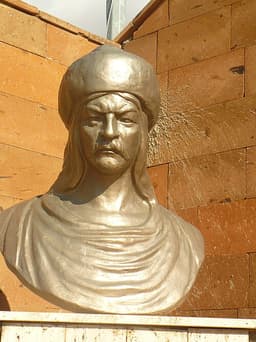
Modu Chanyu
Emperor · Ancient
61.1Total
Basic Information
Born
-723
-234
Died
—
-174
Era
Ancient
Ancient
Nationality
Korea
Xiongnu
Occupation
Emperor
Emperor
Civilization
Eastern
Eastern
Score Comparison
Military (10%)
16.0
77.5
Political (20%)
54.7
62.7
Influence (20%)
56.4
56.7
Legacy (20%)
54.0
40.0
Leadership (15%)
40.0
78.0
Strategy (15%)
60.0
80.3
TOTAL
49.4
61.1
Gyeongdeok of Silla — Complete Timeline
765 AD
Economic reforms and tax collectionReform
Gyeongdeok implemented economic reforms to improve tax collection and state revenue. He standardized grain taxes and land surveys, which helped fund his ambitious construction projects but also increased the burden on peasants, leading to social tensions.
EconomyTaxationSilla
Impact: national
770 AD
Promotion of Buddhist art and cultureCultural
Gyeongdeok sponsored the creation of Buddhist sculptures, paintings, and manuscripts. His patronage led to a flourishing of Buddhist art in Silla, with many works reflecting the influence of Tang Chinese styles while developing distinct Korean characteristics.
ArtBuddhismSilla
Impact: nationalconstructive
771 AD
Construction of the Great Bell of BongdeoksaCultural◆ Major
Gyeongdeok commissioned the casting of the Great Bell of Bongdeoksa, also known as the Emille Bell. Weighing approximately 18 tons, the bronze bell is renowned for its size and sound, and it remains a symbol of Silla's artistic and technological achievements.
ArtBellSilla
Impact: regionalconstructive
774 AD
Completion of Bulguksa TempleCultural◆ Major
King Gyeongdeok oversaw the completion of Bulguksa Temple, a project begun by his father, King Seongdeok. The temple complex, with its two stone pagodas (Dabotap and Seokgatap), became a masterpiece of Silla Buddhist architecture and a major religious center.
TempleBuddhismSilla
Impact: regionalconstructive
Modu Chanyu — Complete Timeline
209 BC
Unification of the Xiongnu TribesPolitical Action
Modu Chanyu unified the nomadic tribes of the Mongolian steppe into the Xiongnu Empire after killing his father, Touman. He established a centralized military and political structure, creating a powerful confederation that rivaled Han China.
UnificationXiongnu EmpireNomadic Confederation
Impact: regional
200 BC
Battle of BaidengWar
Modu Chanyu besieged Emperor Gaozu of Han at Baideng (modern Datong, Shanxi) for seven days. The Han emperor was forced to negotiate a peace treaty, agreeing to pay tribute and send a princess for marriage, establishing Xiongnu dominance over northern China.
BattleHan DynastyTribute System
Impact: regional
198 BC
Treaty of HeqinPolitical Action◆ Major
Modu Chanyu formalized the Heqin treaty with the Han Dynasty, which included annual tribute payments, marriage alliances, and the recognition of the Xiongnu as equals. This treaty maintained peace for decades and set a precedent for Han-Xiongnu relations.
TreatyHeqinDiplomacy
Impact: regional
176 BC
Expansion into Central AsiaWar◆ Major
Modu Chanyu expanded Xiongnu control westward, defeating the Yuezhi and other nomadic groups. He extended Xiongnu influence over the Tarim Basin and parts of Central Asia, controlling key trade routes and establishing a vast steppe empire.
ExpansionCentral AsiaYuezhi
Impact: regional
Expert Analysis
Origins
Gyeongdeok of Silla (r. 742–765 CE) was born into the royal Kim clan of the Silla Kingdom, one of the Three Kingdoms of Korea. His father, King Seongdeok, had already initiated major construction projects, including the foundations of Bulguksa Temple. Gyeongdeok was raised in a Buddhist court, receiving a classical Confucian and Buddhist education. His reign came during Silla's golden age, when the kingdom was unified and prosperous.
Modu Chanyu (c. 234–174 BCE) was the son of Touman, a Xiongnu chieftain in the Mongolian steppe. As a prince, Modu was sent as a hostage to the Yuezhi tribe. After his father attacked the Yuezhi hoping Modu would be killed, Modu escaped and returned, later killing his father to seize power in 209 BCE. His early life was defined by warfare and survival, shaping his ruthless ambition.
Rise to Power
Gyeongdeok ascended the Silla throne in 742 CE after the death of his father, King Seongdeok. His rise was peaceful, as he was the legitimate heir in a stable kingdom. He focused on consolidating power through Buddhist patronage and administrative reforms. His key allies were the Buddhist clergy and the aristocracy, who supported his temple-building projects.
Modu Chanyu's rise was violent. After escaping the Yuezhi, he trained his personal guard to follow his every command without question. He tested their loyalty by ordering them to shoot his favorite horse, then his wife, and finally his father—all of whom were killed by the guards. In 209 BCE, he assassinated his father and declared himself Chanyu. He then unified the Xiongnu tribes through conquest and alliances, defeating the Donghu and Yuezhi to create a powerful confederation.
Leadership & Governance
Gyeongdeok ruled as a Buddhist monarch, emphasizing cultural and religious development. He completed Bulguksa Temple, a masterpiece of Silla architecture, and commissioned the Great Bell of Bongdeoksa (Emille Bell), weighing 18 tons. His economic reforms standardized grain taxes and land surveys, improving state revenue. However, his military score of 16.0 reflects minimal expansion; he maintained peace with Tang China through tribute. His leadership score of 40.0 indicates a focus on internal development over military strength.
Modu Chanyu was a military and political strategist. He structured the Xiongnu Empire into a centralized hierarchy with appointed governors, dividing the realm into left and right wings. His army was a mobile cavalry force, capable of rapid raids. He defeated the Han Dynasty at the Battle of Baideng in 200 BCE, besieging Emperor Gaozu for seven days. This led to the Heqin treaty, which secured annual tribute and a marriage alliance. His military score of 77.5 and strategy score of 80.3 reflect his dominance in steppe warfare.
Triumph & Tragedy
Gyeongdeok's greatest triumph was the completion of Bulguksa Temple and the Emille Bell, which became enduring symbols of Korean Buddhist art. His patronage led to a flourishing of Buddhist culture. However, his reign saw economic strain from excessive construction and military weakness. The kingdom faced threats from the Tang and Balhae, but Gyeongdeok's response was diplomatic rather than martial. His total score of 49.4 reflects a moderate but culturally significant reign.
Modu Chanyu's triumphs include founding the Xiongnu Empire, which controlled the steppe from Manchuria to Central Asia. His victory at Baideng forced the Han to treat the Xiongnu as equals. However, his legacy is marred by his brutal rise—killing his father—and the empire's decline after his death. The Heqin treaty, while successful, was a form of extortion that eventually led to Han retaliation. His total score of 61.1 is higher, driven by military and political achievements.
Character & Destiny
Gyeongdeok was a pious and culturally minded ruler, prioritizing religion and art over military expansion. His character was shaped by the stability of Silla, allowing him to focus on legacy projects. However, his lack of military assertiveness left the kingdom vulnerable. Historians note that his reign represents the peak of Silla's cultural florescence but also the beginning of its decline.
Modu Chanyu was calculating, ruthless, and ambitious. His decision to kill his father demonstrated his willingness to break norms for power. He was a master of psychological warfare, using loyalty tests and terror to command absolute obedience. His destiny was to create an empire that challenged China for centuries, but his methods sowed seeds of internal instability. His leadership score of 78.0 reflects his ability to inspire fierce loyalty.
Legacy
Gyeongdeok's legacy endures through Bulguksa Temple and the Emille Bell, both UNESCO World Heritage sites. His patronage shaped Korean Buddhist art, influencing subsequent dynasties. However, his political and military impact was limited; Silla declined after his reign. His influence score of 56.4 reflects cultural rather than geopolitical reach.
Modu Chanyu's legacy is the Xiongnu Empire itself, which set a template for steppe confederations. The Heqin treaty influenced Sino-nomadic relations for centuries. His unification of tribes led to a powerful state that the Han could not conquer. However, his empire fragmented after his death, and his personal reputation is tainted by patricide. His legacy score of 40.0 is lower due to the empire's transience, but his influence on later nomadic states is significant.
Conclusion
Modu Chanyu had greater impact on world history. His military and political scores (77.5 and 62.7) dwarf Gyeongdeok's (16.0 and 54.7). Modu created an empire that challenged the Han Dynasty, reshaping East Asian geopolitics. Gyeongdeok's cultural contributions are important but localized to Korea. The 11.7-point total score gap reflects Modu's broader influence. While Gyeongdeok built temples, Modu built an empire that forced a superpower to pay tribute. Modu Chanyu is the more consequential figure.
Rankings
🥇
Modu ChanyuLeader
Mil: 77.5Pol: 62.7Inf: 56.7
61.1
🥈
Gyeongdeok of Silla
Mil: 16.0Pol: 54.7Inf: 56.4
49.4
+11.7 behind
How This Comparison Works
Algorithm
Each figure is scored on 6 dimensions (0—100 scale) based on structured historical data: Military (10%), Political (20%), Influence (20%), Legacy (20%), Leadership (15%), Strategy (15%). The weighted total produces the final ranking.
Data Sources
Scores are computed from structured sub-indicators in the database. Scale factors adjust for era (Ancient ×0.85, Modern ×1.0) and civilization size (Eastern ×1.05, Other ×0.80) to account for differences in population and military scale.
Maximum 3 Figures
Comparisons are limited to 2—3 figures to ensure readability and statistical meaningfulness.
Error Margins
±5 points per dimension — Sub-scores are derived from historical records with inherent uncertainty. Two figures within 5 points on a dimension should be considered roughly equivalent in that area.
Total Score Accuracy
±3 points overall — The weighted combination of 6 dimensions produces a total score with approximately ±3 points of uncertainty. Differences of less than 3 points are not statistically significant— the figures are effectively tied.
Known Limitations
- Historical records are incomplete and uneven across civilizations
- Figures from oral-tradition societies may be underrepresented
- Occupation labels can misclassify multi-role figures
- Scores measure capability and impact, not moral character
- Quantitative scoring is a comparison tool, not absolute truth
Capability Radar
Military (10%) — Battles & Warfare
Battles
34
85
Win Rate
37
90
Expansion
37
95
Political (20%) — Governance & Reform
Reform
40
90
Diplomacy
50
85
Economy
50
75
Influence (20%) — Cultural & Global Reach
Cultural
70
70
Global
30
75
Legacy (20%) — Historical Impact
Historical
65
85
Longevity
70
80
Leadership (15%) — Power & Stability
Tenure
60
80
Stability
55
80
Strategy (15%) — Tactics & Innovation
Strategy
39
92
Tactics
47
88
Reform
47
95
Similar Comparisons
Comments & Discussion
No comments yet. Be the first to share your thoughts!