Loading...
Modu Chanyu vs Napoleon Bonaparte
Napoleon Bonaparte leads by 9.8 pts · 2 figures compared
…
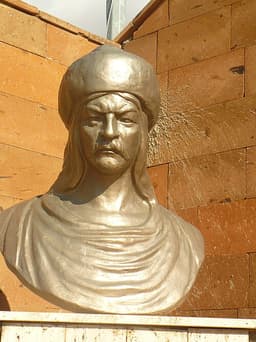
Modu Chanyu
Emperor · Ancient
61.1Total

Napoleon Bonaparte
General · Modern
70.9Total
Basic Information
Born
-234
1769
Died
-174
1821
Era
Ancient
Modern
Nationality
Xiongnu
France
Occupation
Emperor
General
Civilization
Eastern
Western
Score Comparison
Military (10%)
77.5
94.0
Political (20%)
62.7
72.0
Influence (20%)
56.7
40.0
Legacy (20%)
40.0
80.0
Leadership (15%)
78.0
78.0
Strategy (15%)
80.3
90.0
TOTAL
61.1
70.9
Modu Chanyu — Complete Timeline
209 BC
Unification of the Xiongnu TribesPolitical Action
Modu Chanyu unified the nomadic tribes of the Mongolian steppe into the Xiongnu Empire after killing his father, Touman. He established a centralized military and political structure, creating a powerful confederation that rivaled Han China.
UnificationXiongnu EmpireNomadic Confederation
Impact: regional
200 BC
Battle of BaidengWar
Modu Chanyu besieged Emperor Gaozu of Han at Baideng (modern Datong, Shanxi) for seven days. The Han emperor was forced to negotiate a peace treaty, agreeing to pay tribute and send a princess for marriage, establishing Xiongnu dominance over northern China.
BattleHan DynastyTribute System
Impact: regional
198 BC
Treaty of HeqinPolitical Action◆ Major
Modu Chanyu formalized the Heqin treaty with the Han Dynasty, which included annual tribute payments, marriage alliances, and the recognition of the Xiongnu as equals. This treaty maintained peace for decades and set a precedent for Han-Xiongnu relations.
TreatyHeqinDiplomacy
Impact: regional
176 BC
Expansion into Central AsiaWar◆ Major
Modu Chanyu expanded Xiongnu control westward, defeating the Yuezhi and other nomadic groups. He extended Xiongnu influence over the Tarim Basin and parts of Central Asia, controlling key trade routes and establishing a vast steppe empire.
ExpansionCentral AsiaYuezhi
Impact: regional
Napoleon Bonaparte — Complete Timeline
1799 AD
Coup of 18 BrumaireOther◆ Major
Napoleon Bonaparte, with support from his brother Lucien and key political figures, overthrew the Directory in a bloodless coup. He established the Consulate with himself as First Consul, effectively becoming the ruler of France. This event ended the French Revolution's most unstable period.
French RevolutionCoupRise to Power
Impact: regional
1804 AD
Promulgation of the Napoleonic CodeOther◆ Major
Napoleon enacted the Civil Code of the French, known as the Napoleonic Code, a comprehensive set of laws that replaced the fragmented feudal legal systems. The code established legal equality, protected property rights, and secularized law. It became the basis for legal systems in many European and world countries.
Legal ReformNapoleonic CodeCivil Law
Impact: globalconstructive
1805 AD
Battle of AusterlitzWar◆ Major
Napoleon's Grande Arm
Napoleonic WarsBattleDecisive Victory
Impact: global
1812 AD
Invasion of RussiaWar◆ Major
Napoleon led the Grande Arm
Napoleonic WarsInvasionDisaster
Impact: globaldestructive
1815 AD
Battle of WaterlooWar◆ Major
Napoleon's French army was defeated by the combined forces of the Duke of Wellington's Anglo-Allied army and Gebhard Leberecht von Bl
Napoleonic WarsBattleFinal Defeat
Impact: globaldestructive
Expert Analysis
modu-chanyu-vs-napoleon-bonaparte
# The Emperor of the Steppe and the Emperor of Europe
In the winter of 200 BCE, a Chinese emperor sat trapped on a frozen hill in what is now Shanxi province, surrounded by horsemen who seemed to materialize from the wind. Seven days he waited, his army starving, his pride shattered. On the plains below, a man who had killed his own father to seize power watched, calculating. He did not finish the emperor off. Instead, he accepted tribute, a princess, and a treaty that would shape Asia for generations. That man was Modu Chanyu, founder of the Xiongnu Empire. Two thousand years later, another conqueror would stand before the pyramids of Egypt, telling his soldiers that forty centuries were watching them. Napoleon Bonaparte would also reshape a continent, also marry a princess, also face a frozen siege—but his story ended on a remote Atlantic island. What drove these two men, so far apart in time and place, to such different fates?
Origins
Modu Chanyu was born into a world of constant motion and violence. The Mongolian steppe of the third century BCE offered no fixed borders, no written laws, only the harsh logic of survival. His father, Touman, was a chieftain who tried to have him killed—first by sending him as a hostage to a rival tribe, then by attacking that tribe while Modu was still there. Modu escaped, and his father, impressed or afraid, gave him command of ten thousand horsemen. The young prince then trained his men with a chilling innovation: any arrow that did not follow his whistling signal arrow would bring death to the archer. He tested them first on his favorite horse, then on his own wife. Those who hesitated died. By the time he turned his whistling arrow on his father, his men did not flinch.
Napoleon Bonaparte was born on the Mediterranean island of Corsica in 1769, the year after France bought the island from Genoa. His family were minor nobility, but they were poor and resentful of French rule. Young Napoleon spoke Italian before French, and his schoolmates mocked his accent. He devoured military history and mathematics, graduated early from the École Militaire in Paris, and entered an artillery regiment at sixteen. While Modu learned leadership by killing those closest to him, Napoleon learned it by reading Caesar and studying siegecraft. One was forged by the absolute loyalty of the steppe; the other by the competitive meritocracy of revolutionary France.
Rise to Power
Modu’s path was brutal and direct. In 209 BCE, he assassinated his father and declared himself Chanyu, supreme ruler of the Xiongnu. But the title meant nothing without obedience. He crushed rival tribes one by one—the Donghu to the east, the Yuezhi to the west—and absorbed their warriors into his army. Within a decade, he had transformed a loose confederation of feuding nomads into a centralized empire capable of fielding over 300,000 mounted archers. His power rested on speed, terror, and a system of decimal organization that allowed him to command armies across thousands of miles without telegraph or road.
Napoleon’s rise was slower but more spectacular. A Corsican outsider in the French officer corps, he first gained notice in 1793 when he drove British forces from the port of Toulon. He was twenty-four. Then came the Italian campaign of 1796–1797, where he defeated larger Austrian armies through rapid marches and bold flanking maneuvers. By 1799, he had seized power in a coup and made himself First Consul. In 1804, he crowned himself Emperor in Notre Dame, taking the crown from the Pope’s hands and placing it on his own head. Where Modu inherited a tradition of absolute rule, Napoleon had to invent one—and he did so with a flair that still dazzles.
Leadership & Governance
As rulers, both men understood that military victory was only the beginning. Modu governed the Xiongnu through a dual system: he divided his empire into left and right wings, each commanded by trusted relatives, and used the annual tribute from China to reward loyal chieftains. He never tried to conquer China outright—he knew his horsemen could not hold cities. Instead, he created a system of extraction that kept his empire rich and his enemies weak. The Heqin treaty of 198 BCE, which forced the Han Dynasty to send silk, grain, and a princess as a bride, was his masterpiece of political strategy. He got what he wanted without fighting.
Napoleon’s governance was more ambitious and more fragile. He reformed French law into the Napoleonic Code, which abolished feudal privileges, protected property rights, and established secular courts. He built schools, roads, and a centralized bureaucracy that outlasted his empire. But he also appointed his brothers as kings of conquered states, which bred resentment and incompetence. His Continental System, designed to strangle Britain economically, backfired and alienated his allies. Modu knew the limits of his power; Napoleon did not.
Triumph & Tragedy
Modu’s greatest moment came at Baideng in 200 BCE. He had lured Emperor Gaozu of the Han Dynasty into a trap, surrounding him with cavalry so numerous that the horses on each side were of a single color—white, black, red, and bay—a spectacle of coordinated power. But he let the emperor go. Why? Perhaps because he understood that killing a Chinese emperor would invite endless war, while a humiliated emperor would pay tribute. It was a strategic patience that Napoleon never mastered.
Napoleon’s greatest triumph was Austerlitz in 1805, where he crushed the combined armies of Russia and Austria in a single day. He called it his masterpiece. His greatest tragedy was the invasion of Russia in 1812, where he lost over 400,000 men to cold, hunger, and guerrilla attacks. Where Modu used winter as a weapon, Napoleon let winter destroy him. Exiled to Elba in 1814, he escaped and ruled for a hundred days before Waterloo ended his ambitions. His final exile on Saint Helena was a slow death from stomach cancer, surrounded by British guards and bitter memories.
Character & Destiny
Modu Chanyu was cold, calculating, and patient. He killed his father, his wife, and his rivals without apparent remorse, but he never fought a war he could not win. His cruelty was a tool, not a compulsion. Napoleon was restless, brilliant, and incapable of stopping. “Power is my mistress,” he once said, and he pursued it until the end. His ambition built an empire and destroyed it. Modu died in his bed around 174 BCE, his empire intact. Napoleon died in exile, his empire reduced to a memory.
Legacy
Modu Chanyu is remembered in China as a barbarian threat, but among the Mongols and later steppe peoples, he is a founding hero. His system of horse archers and decimal organization influenced Genghis Khan, who would conquer far more. Napoleon’s legacy is global: the Napoleonic Code shaped civil law across Europe and the Americas; his military innovations are still studied; his name became synonymous with ambition and genius. Yet Modu achieved something Napoleon did not: he built an empire that lasted, in some form, for centuries. Napoleon’s fell within a decade of his death.
Conclusion
Standing before the pyramids, Napoleon told his men, “Soldiers, from the height of these pyramids, forty centuries are watching you.” Modu Chanyu, who lived two thousand years before Napoleon, could have said the same. Both men commanded armies that moved faster than their enemies could imagine. Both understood that power is a story told with blood and gold. But Modu knew when to stop. Napoleon never learned. Perhaps that is the deepest difference between the emperor of the steppe and the emperor of Europe: one built a world he could hold, the other a world that could only hold him.
Rankings
🥇
Napoleon BonaparteLeader
Mil: 94.0Pol: 72.0Inf: 40.0
70.9
🥈
Modu Chanyu
Mil: 77.5Pol: 62.7Inf: 56.7
61.1
+9.8 behind
How This Comparison Works
Algorithm
Each figure is scored on 6 dimensions (0—100 scale) based on structured historical data: Military (10%), Political (20%), Influence (20%), Legacy (20%), Leadership (15%), Strategy (15%). The weighted total produces the final ranking.
Data Sources
Scores are computed from structured sub-indicators in the database. Scale factors adjust for era (Ancient ×0.85, Modern ×1.0) and civilization size (Eastern ×1.05, Other ×0.80) to account for differences in population and military scale.
Maximum 3 Figures
Comparisons are limited to 2—3 figures to ensure readability and statistical meaningfulness.
Error Margins
±5 points per dimension — Sub-scores are derived from historical records with inherent uncertainty. Two figures within 5 points on a dimension should be considered roughly equivalent in that area.
Total Score Accuracy
±3 points overall — The weighted combination of 6 dimensions produces a total score with approximately ±3 points of uncertainty. Differences of less than 3 points are not statistically significant— the figures are effectively tied.
Known Limitations
- Historical records are incomplete and uneven across civilizations
- Figures from oral-tradition societies may be underrepresented
- Occupation labels can misclassify multi-role figures
- Scores measure capability and impact, not moral character
- Quantitative scoring is a comparison tool, not absolute truth
Capability Radar
Military (10%) — Battles & Warfare
Battles
85
95
Win Rate
90
90
Expansion
95
95
Political (20%) — Governance & Reform
Reform
90
95
Diplomacy
85
80
Economy
75
85
Influence (20%) — Cultural & Global Reach
Cultural
70
85
Global
75
90
Legacy (20%) — Historical Impact
Historical
85
95
Longevity
80
90
Leadership (15%) — Power & Stability
Tenure
80
85
Stability
80
70
Strategy (15%) — Tactics & Innovation
Strategy
92
95
Tactics
88
98
Reform
95
92
Similar Comparisons
Comments & Discussion
No comments yet. Be the first to share your thoughts!