Loading...
Leo I the Thracian vs Modu Chanyu
Modu Chanyu leads by 12.7 pts · 2 figures compared
…

Leo I the Thracian
Emperor · Ancient
48.4Total
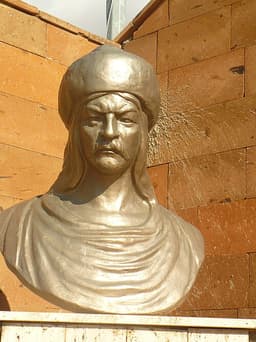
Modu Chanyu
Emperor · Ancient
61.1Total
Basic Information
Born
401
-234
Died
474
-174
Era
Ancient
Ancient
Nationality
Byzantine Empire
Xiongnu
Occupation
Emperor
Emperor
Civilization
Western
Eastern
Score Comparison
Military (10%)
45.0
77.5
Political (20%)
43.7
62.7
Influence (20%)
49.4
56.7
Legacy (20%)
40.8
40.0
Leadership (15%)
65.0
78.0
Strategy (15%)
50.0
80.3
TOTAL
48.4
61.1
Leo I the Thracian — Complete Timeline
457 AD
Crowned by the Patriarch of ConstantinoplePolitical Action
Leo I was crowned Eastern Roman Emperor by Patriarch Anatolius of Constantinople. This was the first time a Byzantine emperor was crowned by a patriarch, establishing a precedent for the role of the Church in imperial coronations and strengthening the bond between church and state.
CoronationChurch-State RelationsPrecedent
Impact: globalconstructive
468 AD
Launched the disastrous expedition against the VandalsWar
Leo I, in cooperation with the Western Emperor Anthemius, launched a massive naval expedition against the Vandal Kingdom. The campaign ended in a catastrophic defeat at the Battle of Cape Bon, costing the empire immense resources and weakening its military position.
Vandal WarMilitary CampaignNaval Battle
Impact: regionaldestructive
471 AD
Assassinated the Alan general AsparPolitical Action◆ Major
Leo I ordered the assassination of the powerful Alan magister militum Aspar and his son, who had dominated the Eastern court for decades. This act ended the Germanic influence over the Eastern Roman army and solidified Leo's authority, but also led to a brief civil war.
AssassinationPower StruggleCivil War
Impact: nationaldestructive
Modu Chanyu — Complete Timeline
209 BC
Unification of the Xiongnu TribesPolitical Action
Modu Chanyu unified the nomadic tribes of the Mongolian steppe into the Xiongnu Empire after killing his father, Touman. He established a centralized military and political structure, creating a powerful confederation that rivaled Han China.
UnificationXiongnu EmpireNomadic Confederation
Impact: regional
200 BC
Battle of BaidengWar
Modu Chanyu besieged Emperor Gaozu of Han at Baideng (modern Datong, Shanxi) for seven days. The Han emperor was forced to negotiate a peace treaty, agreeing to pay tribute and send a princess for marriage, establishing Xiongnu dominance over northern China.
BattleHan DynastyTribute System
Impact: regional
198 BC
Treaty of HeqinPolitical Action◆ Major
Modu Chanyu formalized the Heqin treaty with the Han Dynasty, which included annual tribute payments, marriage alliances, and the recognition of the Xiongnu as equals. This treaty maintained peace for decades and set a precedent for Han-Xiongnu relations.
TreatyHeqinDiplomacy
Impact: regional
176 BC
Expansion into Central AsiaWar◆ Major
Modu Chanyu expanded Xiongnu control westward, defeating the Yuezhi and other nomadic groups. He extended Xiongnu influence over the Tarim Basin and parts of Central Asia, controlling key trade routes and establishing a vast steppe empire.
ExpansionCentral AsiaYuezhi
Impact: regional
Expert Analysis
Origins
Leo I the Thracian was born around 401 AD in the province of Thrace, likely of modest origins. Little is known of his early life, but he rose through the ranks of the Byzantine military, becoming a tribune. His background was typical of the late Roman officer class, with no familial ties to the previous imperial dynasty. In contrast, Modu Chanyu was born around 234 BC to Touman, the chanyu (ruler) of the Xiongnu confederation. As a prince, he was sent as a hostage to the Yuezhi, a rival nomadic group, demonstrating the harsh realities of steppe politics. Modu's early experiences included nearly being executed by his father, which shaped his ruthless ambition.
Rise to Power
Leo I's rise was catalyzed by the assassination of Emperor Marcian in 457 AD. The powerful Alan general Aspar, who effectively controlled the Eastern Roman army, chose Leo as a puppet emperor. Leo was crowned by Patriarch Anatolius of Constantinople in 457, the first such coronation by a patriarch, symbolizing the growing independence of the Eastern Church. However, Leo quickly sought to free himself from Aspar's influence. Modu's ascent was more dramatic. Around 209 BC, he killed his father Touman and seized power after proving his loyalty to the Xiongnu by executing his own beloved horse and wife on command. He then unified the warring Xiongnu tribes through a combination of military victories and strategic alliances, establishing a centralized empire.
Leadership & Governance
Leo I's governance was marked by internal power struggles. To counter Aspar, he promoted Isaurian soldiers, forming the Excubitors guard. He also sought cooperation with the Western Roman Emperor Anthemius against the Vandals. However, his leadership was indecisive and reactive. For example, his 468 AD expedition against the Vandal kingdom was a massive effort involving over 1,000 ships, but poor coordination led to a catastrophic defeat at Cape Bon. Modu, on the other hand, was a visionary leader who reorganized the Xiongnu into a decimal-based military system (units of 10, 100, 1000, 10,000), enhancing efficiency. He also established a tribute system with the Han Dynasty through the Heqin treaty (198 BC), securing annual payments and a marriage alliance. His governance combined military prowess with diplomatic acumen, earning him a strategy score of 80.3 compared to Leo's 50.0.
Triumph & Tragedy
Leo I's greatest triumph was the assassination of Aspar in 471 AD, which ended the Alan domination of the Eastern court and restored imperial authority. However, his greatest failure was the 468 expedition against the Vandals, which drained the treasury and weakened the empire. The defeat also led to the collapse of cooperation with the Western Empire. Modu's triumphs include the unification of the Xiongnu and the victory at Baideng (200 BC), where he besieged Emperor Gaozu of Han for seven days, forcing a humiliating peace. He expanded Xiongnu control over the Tarim Basin and defeated the Yuezhi. However, his failure was the lack of a sustainable succession system; after his death, the Xiongnu empire fragmented due to internal strife. His military score of 77.5 reflects his battlefield successes, but his legacy score of 40.0 indicates the empire's fragility.
Character & Destiny
Leo I was cautious and cunning, but often indecisive. His reliance on Isaurians created new power centers, leading to future instability. His character was shaped by the need to survive in a treacherous court. Modu was ruthless and strategic, willing to sacrifice personal attachments for power. His decision to kill his father and later his own son to test loyalty exemplifies his cold pragmatism. Historians note that Modu's character was perfectly suited to the brutal steppe politics, allowing him to build an empire that challenged China for centuries.
Legacy
Leo I's legacy is mixed. He is remembered for ending Aspar's dominance and for the first patriarchal coronation, which set a precedent for the relationship between church and state in Byzantium. However, his failed Vandal expedition hastened the Western Empire's decline. Modu's legacy is more profound: he founded the Xiongnu Empire, which became a model for later steppe empires like the Mongols. The Heqin treaty established a pattern of Chinese-nomad relations. His military and political systems influenced subsequent nomadic confederations. Modu's overall score of 61.1 exceeds Leo's 48.4, reflecting his greater impact on history.
Conclusion
Modu Chanyu had a greater impact than Leo I. While Leo's actions affected the Byzantine court and the Western Roman Empire, Modu's unification of the steppe created a political entity that shaped Eurasian history for centuries. His military and political scores (77.5 and 62.7) far surpass Leo's (45.0 and 43.7), and his strategic innovations left a lasting legacy. Leo's reign, though significant in Byzantine history, was largely reactive and ultimately failed to reverse the empire's decline. Modu, by contrast, built an empire from scratch and established a template for nomadic power. The data supports this: Modu's total score of 61.1 against Leo's 48.4 clearly indicates his superior historical influence.
Rankings
🥇
Modu ChanyuLeader
Mil: 77.5Pol: 62.7Inf: 56.7
61.1
🥈
Leo I the Thracian
Mil: 45.0Pol: 43.7Inf: 49.4
48.4
+12.7 behind
How This Comparison Works
Algorithm
Each figure is scored on 6 dimensions (0—100 scale) based on structured historical data: Military (10%), Political (20%), Influence (20%), Legacy (20%), Leadership (15%), Strategy (15%). The weighted total produces the final ranking.
Data Sources
Scores are computed from structured sub-indicators in the database. Scale factors adjust for era (Ancient ×0.85, Modern ×1.0) and civilization size (Eastern ×1.05, Other ×0.80) to account for differences in population and military scale.
Maximum 3 Figures
Comparisons are limited to 2—3 figures to ensure readability and statistical meaningfulness.
Error Margins
±5 points per dimension — Sub-scores are derived from historical records with inherent uncertainty. Two figures within 5 points on a dimension should be considered roughly equivalent in that area.
Total Score Accuracy
±3 points overall — The weighted combination of 6 dimensions produces a total score with approximately ±3 points of uncertainty. Differences of less than 3 points are not statistically significant— the figures are effectively tied.
Known Limitations
- Historical records are incomplete and uneven across civilizations
- Figures from oral-tradition societies may be underrepresented
- Occupation labels can misclassify multi-role figures
- Scores measure capability and impact, not moral character
- Quantitative scoring is a comparison tool, not absolute truth
Capability Radar
Military (10%) — Battles & Warfare
Battles
30
85
Win Rate
30
90
Expansion
15
95
Political (20%) — Governance & Reform
Reform
40
90
Diplomacy
45
85
Economy
35
75
Influence (20%) — Cultural & Global Reach
Cultural
30
70
Global
25
75
Legacy (20%) — Historical Impact
Historical
35
85
Longevity
30
80
Leadership (15%) — Power & Stability
Tenure
60
80
Stability
40
80
Strategy (15%) — Tactics & Innovation
Strategy
25
92
Tactics
25
88
Reform
20
95
Similar Comparisons
Comments & Discussion
No comments yet. Be the first to share your thoughts!