Loading...
Moctezuma I vs Pachacuti
Pachacuti leads by 10.5 pts · 2 figures compared
…

Moctezuma I
Emperor · Medieval
58.9Total
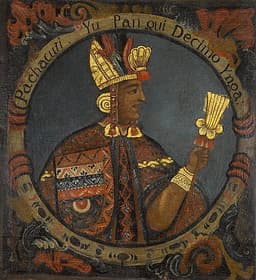
Pachacuti
Emperor · Medieval
69.4Total
Basic Information
Born
1398
1418
Died
1469
1472
Era
Medieval
Medieval
Nationality
Aztec Empire
Inca Empire
Occupation
Emperor
Emperor
Civilization
Other
Other
Score Comparison
Military (10%)
82.0
78.5
Political (20%)
45.0
58.1
Influence (20%)
58.3
65.0
Legacy (20%)
56.0
72.0
Leadership (15%)
66.0
78.0
Strategy (15%)
55.0
69.2
TOTAL
58.9
69.4
Moctezuma I — Complete Timeline
1428 AD
Conquest of the TepanecsWar◆ Major
Itzcoatl led the Triple Alliance forces in a war against the Tepanecs of Azcapotzalco, the dominant power in the region. The victory broke Tepanec hegemony and established Tenochtitlan as the leading city-state in central Mexico.
WarTepanec WarAztec Expansion
Impact: regional
Formed the Triple AlliancePolitical Action
Itzcoatl, as tlatoani of Tenochtitlan, formed the Triple Alliance with Texcoco and Tlacopan. This military and political pact created the Aztec Empire, enabling coordinated conquests and the subjugation of neighboring city-states in the Valley of Mexico.
Aztec EmpireAlliancePolitical Foundation
Impact: regional
1430 AD
Burned Historical CodicesCultural◆ Major
Itzcoatl ordered the burning of historical codices from conquered peoples, rewriting Aztec history to legitimize his rule and the empire's divine origins. This act destroyed pre-Aztec records and reshaped Mesoamerican historical memory.
Cultural DestructionHistorical RevisionAztec Ideology
Impact: regionaldestructive
Pachacuti — Complete Timeline
1438 AD
Conquest of the Chanka KingdomWar
Pachacuti led the Inca army to defeat the Chanka, a powerful rival, in a decisive battle near Cusco. This victory secured his position as Sapa Inca and initiated a period of rapid expansion, transforming the Inca from a small kingdom into a vast empire.
ConquestInca ExpansionChanka
Impact: regional
1440 AD
Reconstruction of CuscoCultural◆ Major
Pachacuti rebuilt Cusco as the imperial capital, designing it in the shape of a puma and constructing massive stone structures like Sacsayhuam
Urban PlanningArchitectureInca Empire
Impact: regionalconstructive
1450 AD
Initiation of Machu Picchu's ConstructionCultural◆ Major
Pachacuti ordered the construction of Machu Picchu, a royal estate and ceremonial site high in the Andes. The complex featured sophisticated dry-stone masonry and terraced agriculture, serving as a symbol of Inca engineering and a retreat for the emperor.
ArchitectureRoyal EstateInca Engineering
Impact: regionalconstructive
Expert Analysis
Pachacuti vs Moctezuma I
# The Mountain and the Lake: Two Empire Builders of the Americas
In the thin air of the Andes, a young prince named Cusi Yupanqui stood before his father, the Sapa Inca Viracocha, and the fleeing remnants of the Inca army. The year was 1438, and the Chanka kingdom—a fierce rival—was marching on the capital of Cusco. Viracocha had decided to abandon the city. But his son refused. “I will not retreat,” he reportedly declared, and with a handful of loyal warriors, he turned to face an enemy that outnumbered him many times over. Across the ocean, on the high plateau of central Mexico, another young prince—Moctezuma Ilhuicamina—was watching his uncle Itzcoatl forge a triple alliance that would shatter the old order. Both men would become emperors. Both would build empires. But the paths they took, and what they left behind, could not have been more different.
Origins
Pachacuti—whose name means “he who shakes the earth”—was born in 1418 into a world of isolated mountain valleys. The Inca were then merely one of many small kingdoms in the Andes, constantly threatened by neighbors like the Chanka. His upbringing was martial and practical, rooted in the harsh realities of high-altitude warfare. He learned to read the landscape—the passes, the rivers, the steep terraces—as a general reads a map.
Moctezuma I, born twenty years earlier in 1398, came of age in a world already dominated by the Tepanec Empire of Azcapotzalco. The Aztecs of Tenochtitlan were tributaries, not masters. Moctezuma grew up in the shadow of a greater power, watching his uncle Itzcoatl maneuver through politics and war. Where Pachacuti learned to fight, Moctezuma learned to wait—and to scheme.
Rise to Power
Pachacuti’s rise was forged in a single, desperate battle. When his father fled from the Chanka in 1438, the young prince rallied the remnants of the army and, against all odds, defeated the invaders. The victory was so complete that the Chanka kingdom collapsed. Viracocha abdicated in shame, and Pachacuti became Sapa Inca. He never looked back.
Moctezuma’s path was more circuitous. He was not the first emperor of the Aztecs—that was his uncle Itzcoatl, who in 1428 formed the Triple Alliance with Texcoco and Tlacopan, then crushed the Tepanecs. Moctezuma served as a general in those wars, proving his military skill (scoring 73.2 in military prowess against Pachacuti’s 66.8). But his real education came from watching Itzcoatl’s political genius—including the decision in 1430 to burn the historical codices of conquered peoples, rewriting history to legitimize Aztec rule. When Itzcoatl died in 1440, Moctezuma inherited an alliance, not a unified empire. He would spend the next three decades binding it together.
Leadership & Governance
Pachacuti governed like an architect—literally. His political score of 70.6 reflects a ruler who understood that an empire is built on infrastructure. He rebuilt Cusco in the shape of a puma, with massive stone walls that still stand without mortar. He initiated the construction of Machu Picchu around 1450, a royal estate perched between two peaks, designed to awe and to isolate. He created a system of roads, storehouses, and administrative centers that allowed the Inca to control their vast territory without a written language. His strategy score of 76.7 speaks to his ability to integrate conquered peoples through resettlement and shared labor, rather than mere terror.
Moctezuma I, with a political score of 85.7, was the more subtle ruler. He expanded the Triple Alliance not just through war—though he conquered much of central Mexico—but through diplomacy, marriage, and tribute. He understood that the Aztec Empire was a network of client states, not a monolithic state. He codified laws, reformed the calendar, and expanded the great temple of Tenochtitlan. Where Pachacuti built in stone, Moctezuma built in systems.
Triumph & Tragedy
Pachacuti’s greatest triumph was the Chanka victory of 1438—a moment that turned a kingdom into an empire. His greatest tragedy may have been his success: the empire he built was so centralized that when the Spanish arrived, they only needed to capture the Sapa Inca to paralyze the entire system. He died in 1472, having seen his vision realized but unable to ensure its survival.
Moctezuma I’s triumph was the consolidation of the Triple Alliance into a stable, tribute-rich empire that stretched from the Gulf of Mexico to the Pacific. His tragedy was the same as Pachacuti’s—but delayed. The system he perfected, based on fear and tribute, would eventually generate the resentments that the Spanish would exploit. He died in 1469, leaving a world that seemed eternal but was, in fact, brittle.
Character & Destiny
Pachacuti was a visionary with a warrior’s instincts. His leadership score of 84.5 reflects a man who inspired absolute loyalty—but also demanded absolute obedience. He was ruthless with enemies, generous with allies, and obsessed with order. His destiny was to create something entirely new: an empire that stretched 2,500 miles along the spine of the Andes.
Moctezuma I was a pragmatist with a politician’s patience. His leadership score of 73.7 is lower, but his political score of 85.7 reveals a ruler who governed through consensus and calculation. He was less a conqueror than a consolidator. His destiny was to perfect a system he did not invent—and to leave it vulnerable to forces he could not imagine.
Legacy
Pachacuti is remembered today as the father of the Inca Empire. Machu Picchu draws millions of visitors. His name is synonymous with Inca greatness. But his legacy is also one of fragility: the empire he built collapsed in a generation after his death.
Moctezuma I is remembered less vividly than his namesake, Moctezuma II, who faced Cortés. Yet his legacy is more complex: he created the Aztec Empire as it is remembered—a world of tribute, ritual, and power. His influence score of 73.1 is nearly equal to Pachacuti’s 77.6, but his legacy score of 67.4 trails behind, perhaps because his work was undone by his successor’s failure.
Conclusion
One shook the earth; the other built upon it. Pachacuti and Moctezuma I were both empire builders of the fifteenth century, both products of worlds that would soon be shattered by European contact. But their differences reveal something profound about power itself. Pachacuti’s power was vertical—a mountain, isolated and awe-inspiring. Moctezuma’s was horizontal—a lake, connected and interdependent. The mountain still stands; the lake was drained. But both men, in their own ways, shaped the Americas that the Spanish would encounter—and misunderstand.
Rankings
🥇
PachacutiLeader
Mil: 78.5Pol: 58.1Inf: 65.0
69.4
🥈
Moctezuma I
Mil: 82.0Pol: 45.0Inf: 58.3
58.9
+10.5 behind
How This Comparison Works
Algorithm
Each figure is scored on 6 dimensions (0—100 scale) based on structured historical data: Military (10%), Political (20%), Influence (20%), Legacy (20%), Leadership (15%), Strategy (15%). The weighted total produces the final ranking.
Data Sources
Scores are computed from structured sub-indicators in the database. Scale factors adjust for era (Ancient ×0.85, Modern ×1.0) and civilization size (Eastern ×1.05, Other ×0.80) to account for differences in population and military scale.
Maximum 3 Figures
Comparisons are limited to 2—3 figures to ensure readability and statistical meaningfulness.
Error Margins
±5 points per dimension — Sub-scores are derived from historical records with inherent uncertainty. Two figures within 5 points on a dimension should be considered roughly equivalent in that area.
Total Score Accuracy
±3 points overall — The weighted combination of 6 dimensions produces a total score with approximately ±3 points of uncertainty. Differences of less than 3 points are not statistically significant— the figures are effectively tied.
Known Limitations
- Historical records are incomplete and uneven across civilizations
- Figures from oral-tradition societies may be underrepresented
- Occupation labels can misclassify multi-role figures
- Scores measure capability and impact, not moral character
- Quantitative scoring is a comparison tool, not absolute truth
Capability Radar
Military (10%) — Battles & Warfare
Battles
65
85
Win Rate
70
90
Expansion
80
90
Political (20%) — Governance & Reform
Reform
60
92
Diplomacy
65
75
Economy
70
80
Influence (20%) — Cultural & Global Reach
Cultural
60
85
Global
50
65
Legacy (20%) — Historical Impact
Historical
65
80
Longevity
55
70
Leadership (15%) — Power & Stability
Tenure
70
85
Stability
65
82
Strategy (15%) — Tactics & Innovation
Strategy
75
88
Tactics
60
80
Reform
55
85
Similar Comparisons
Comments & Discussion
EmpireEarthShaker6/16/2026
Pachacuti wasn't just some warrior prince—he was a military genius who redefined high-altitude warfare. Look at his siege tactics against the Colla kingdom: he didn't just overpower them, he cut their water supply and starved them out while conserving his own forces. That's Clausewitz in the Andes. Moctezuma I? He inherited an alliance system already built by his uncle. Pachacuti was the architect; Moctezuma was the tenant.
战象不踩蚂蚁6/16/2026
作为数据怀疑论者,我得戳破一个泡沫:把帕查库蒂和蒙特祖玛一世对比,本身就带着欧洲中心主义的傲慢。帕查库蒂征服了安第斯山脉三分之一,而蒙特祖玛一世的特诺奇蒂特兰扩张其实只有他能控制的三股势力。前者是赤手空拳打天下,后者是接手舅舅的摊子,还依赖残酷的人祭政治。别把继承者当创始人,这不公平。
ObsidianMirror6/16/2026
Here's what the Romantic historians won't tell you: Moctezuma I's rule was a bureaucratic marvel. Under him, the Aztec triple alliance formalized the pochteca—state-sanctioned merchant spies who mapped enemy territories and economic networks before a single warrior marched. Pachacuti conquered valleys; Moctezuma conquered information. The Mexica built an empire on intelligence, not just infantry.
地脉诗人6/16/2026
安第斯山脉的每一道坎儿都不是白长的。帕查库蒂把高原梯田改造成国家命脉:修渠、筑路、建驿道——用石头和河流缝起帝国。蒙特祖玛一世沉迷于炫耀人祭的恐怖,每年献祭数千人,却从没想过巩固粮仓。帕查库蒂留給后代的,是能扛住地震的水利系统;蒙特祖玛留下的,只是恐惧和血河。谁更文明?你选吧。