Loading...
Meng Gong vs Muqali
Muqali leads by 6.5 pts · 2 figures compared
…

Meng Gong
General · Medieval
54.8Total
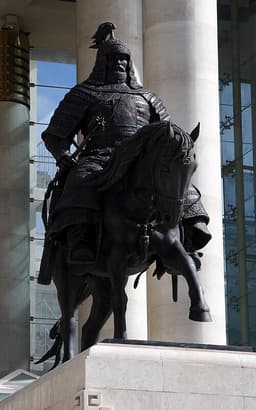
Muqali
General · Medieval
61.3Total
Basic Information
Born
1195
1170
Died
1246
1223
Era
Medieval
Medieval
Nationality
China
Mongol Empire
Occupation
General
General
Civilization
Eastern
Eastern
Score Comparison
Military (10%)
67.3
65.0
Political (20%)
45.1
68.0
Influence (20%)
51.8
58.0
Legacy (20%)
47.5
49.2
Leadership (15%)
62.0
70.4
Strategy (15%)
72.0
72.0
TOTAL
54.8
61.3
Meng Gong — Complete Timeline
1219 AD
Defended Xiangyang against JinWar◆ Major
Meng Gong successfully defended the strategic city of Xiangyang against a Jin siege. His leadership prevented a Jin breakthrough into the Yangtze region.
Southern SongJinDefense
Impact: regionalconstructive
1233 AD
Campaign against Jin in 1233-1234War
Meng Gong led Song forces in a joint campaign with the Mongols to destroy the Jin dynasty. He captured the Jin emperor at Caizhou, ending the Jin dynasty in 1234.
Southern SongJinConquest
Impact: regionalconstructive
1235 AD
Defended against Mongol invasionWar◆ Major
Meng Gong repelled the first Mongol invasion of Southern Song at the Battle of Jiangling. He used riverine warfare and fortifications to hold the Mongol advance.
Southern SongMongolDefense
Impact: regionalconstructive
1236 AD
Battle of YizhouWar◆ Major
Meng Gong defeated a Mongol army at Yizhou, securing the Song position in the Sichuan region. This victory delayed Mongol conquest of southern China.
Southern SongMongolBattle
Impact: regionalconstructive
1246 AD
Death and legacyOther
Meng Gong died, having been one of the most capable Song generals. His defensive strategies against Jin and Mongols were studied by later military leaders.
Southern SongDeathLegacy
Impact: regional
Muqali — Complete Timeline
1211 AD
Campaign in Northern ChinaWar◆ Major
Muqali was a key commander in Genghis Khan's invasion of the Jin Dynasty. He led forces in the capture of numerous cities and fortresses in northern China, including the victory at the Battle of Yehuling in 1211, which broke Jin resistance.
Jin DynastyYehulingNorthern China
Impact: regional
1212 AD
Conquest of ManchuriaWar
Muqali led a campaign to subdue the Khitan and Jurchen tribes in Manchuria. He defeated the rebel Khitan leader Yel
ManchuriaKhitanJurchen
Impact: regional
1215 AD
Siege of ZhongduWar◆ Major
Muqali participated in the Mongol siege of Zhongdu (modern Beijing), the capital of the Jin Dynasty. The city fell after a prolonged siege, leading to the massacre of its inhabitants and the effective collapse of Jin authority in northern China.
ZhongduBeijingSiege
Impact: regionaldestructive
1217 AD
Appointment as Viceroy of ChinaPolitical Action◆ Major
Genghis Khan appointed Muqali as viceroy (guo-wang) of all conquered territories in China, granting him command of the Mongol forces in the region. This made Muqali the de facto ruler of Mongol-occupied northern China.
ViceroyChinaGenghis Khan
Impact: regionalconstructive
Expert Analysis
Origins
Meng Gong (1195–1246) was born into a military family in the Southern Song dynasty. His father, Meng Zongzheng, was a general, and young Meng Gong received a rigorous education in military classics and martial arts. He began his career as a low-ranking officer, but his talents were recognized early. His formative experiences included campaigns against the Jurchen Jin dynasty, which had occupied northern China.
Muqali (1170–1223) was a member of the Jalayir tribe, a Mongol clan that submitted to Genghis Khan. He became a trusted nökor (companion) of Genghis Khan after saving his life in battle. Unlike Meng Gong, Muqali rose from humble origins through personal loyalty and military prowess. He was known for his strategic acumen and was appointed as one of Genghis Khan's top generals.
Rise to Power
Meng Gong's rise came during the Song-Jin wars. In 1233, he was appointed to lead a joint Song-Mongol campaign against the Jin. He captured the Jin emperor at Caizhou in 1234, ending the Jin dynasty. This victory earned him fame and promotion. He then became the primary defender of the Song's northern frontier, with his defense of Xiangyang in 1236 against a Jin siege solidifying his reputation.
Muqali rose under Genghis Khan. He played a key role in the Mongol invasion of the Jin dynasty, participating in the siege of Zhongdu (modern Beijing) in 1215. In 1217, Genghis Khan appointed him viceroy (guo-wang) of all conquered territories in China, giving him command of Mongol forces in the region. This made him the de facto ruler of northern China for the next six years.
Leadership & Governance
Meng Gong's leadership style was defensive and adaptive. He excelled at fortification and riverine warfare, using the Yangtze River and its tributaries to block Mongol cavalry. He implemented a system of fortified cities and mobile river fleets. His governance focused on maintaining the Song's defensive line, often at the expense of offensive campaigns. For example, he repelled the first Mongol invasion at Jiangling in 1236 by using fire ships and shore defenses.
Muqali was an offensive strategist. He adopted Chinese siege techniques and incorporated surrendered Jin troops into his army. His governance of northern China was pragmatic: he established a civil administration, collected taxes, and promoted local elites who submitted to Mongol rule. He was known for his ability to balance brutal conquest with political co-optation. For instance, he defeated the Khitan rebel Yelü Liuge in Manchuria but then appointed him as a local governor.
Triumph & Tragedy
Meng Gong's greatest triumph was his successful defense against the first Mongol invasion in 1236, which saved the Southern Song from early collapse. He also won the Battle of Yizhou in 1239, securing Sichuan. However, his greatest failure was his inability to prevent the eventual Mongol conquest. After his death in 1246, the Song defense weakened, and the Mongols breached the Yangtze in 1276. His defensive strategies, while effective, were not enough to overcome the Mongol numerical and technological superiority.
Muqali's triumphs include the conquest of Manchuria and the capture of over 30 cities in northern China. His appointment as viceroy was a testament to his trustworthiness. However, his tragedy was that he died in 1223 before completing the conquest of the Jin. His successor, Bōl, lacked his diplomatic skill, leading to a Jin resurgence. Muqali's death left a vacuum that delayed the Mongol victory in China.
Character & Destiny
Meng Gong was cautious and methodical, preferring to avoid decisive battles. His character was shaped by the Song's defensive doctrine. He was loyal to the Song court but often frustrated by political interference. His destiny was to be a defender, not a conqueror. Historical assessments note that he was one of the few Song generals who could match the Mongols tactically, but his limited resources and political constraints prevented a more aggressive strategy.
Muqali was bold and adaptable, willing to learn from enemies. His loyalty to Genghis Khan was absolute, and he was rewarded with unprecedented authority. His character was that of a conqueror and administrator. His destiny was to be the architect of Mongol rule in northern China. Historians praise his ability to integrate Chinese administrative methods into the Mongol system, but note that his early death prevented him from seeing the final conquest.
Legacy
Meng Gong's legacy is that of a defender of Chinese civilization. His defensive tactics were studied by later Chinese generals. He delayed the Mongol conquest by decades, allowing the Song to survive for another 40 years. His influence is scored at 51.8, reflecting his regional impact.
Muqali's legacy is more profound. His viceroyalty established the model for Mongol governance in China, which later evolved into the Yuan dynasty. His conquests paved the way for the unification of China under Kublai Khan. His influence score of 58.0 is higher, and his leadership score of 70.4 reflects his role as a key architect of the Mongol Empire.
Conclusion
While Meng Gong was a brilliant defender with a strategy score of 72.0, Muqali had a greater impact on world history. His military score of 65.0 is slightly lower than Meng Gong's 67.3, but his political score of 68.0 dwarfs Meng Gong's 45.1. Muqali's total score of 61.3 exceeds Meng Gong's 54.8 by 6.5 points, reflecting his broader influence. Muqali's conquests directly contributed to the creation of the Mongol Empire, which reshaped Eurasia. Meng Gong's defense, while heroic, only delayed the inevitable. Muqali is the one who changed the course of history.
Rankings
🥇
MuqaliLeader
Mil: 65.0Pol: 68.0Inf: 58.0
61.3
🥈
Meng Gong
Mil: 67.3Pol: 45.1Inf: 51.8
54.8
+6.5 behind
How This Comparison Works
Algorithm
Each figure is scored on 6 dimensions (0—100 scale) based on structured historical data: Military (10%), Political (20%), Influence (20%), Legacy (20%), Leadership (15%), Strategy (15%). The weighted total produces the final ranking.
Data Sources
Scores are computed from structured sub-indicators in the database. Scale factors adjust for era (Ancient ×0.85, Modern ×1.0) and civilization size (Eastern ×1.05, Other ×0.80) to account for differences in population and military scale.
Maximum 3 Figures
Comparisons are limited to 2—3 figures to ensure readability and statistical meaningfulness.
Error Margins
±5 points per dimension — Sub-scores are derived from historical records with inherent uncertainty. Two figures within 5 points on a dimension should be considered roughly equivalent in that area.
Total Score Accuracy
±3 points overall — The weighted combination of 6 dimensions produces a total score with approximately ±3 points of uncertainty. Differences of less than 3 points are not statistically significant— the figures are effectively tied.
Known Limitations
- Historical records are incomplete and uneven across civilizations
- Figures from oral-tradition societies may be underrepresented
- Occupation labels can misclassify multi-role figures
- Scores measure capability and impact, not moral character
- Quantitative scoring is a comparison tool, not absolute truth
Capability Radar
Military (10%) — Battles & Warfare
Battles
75
75
Win Rate
80
80
Expansion
30
85
Political (20%) — Governance & Reform
Reform
40
65
Diplomacy
65
72
Economy
35
60
Influence (20%) — Cultural & Global Reach
Cultural
40
55
Global
30
55
Legacy (20%) — Historical Impact
Historical
55
65
Longevity
50
50
Leadership (15%) — Power & Stability
Tenure
50
70
Stability
55
68
Strategy (15%) — Tactics & Innovation
Strategy
80
82
Tactics
85
78
Reform
60
60
Similar Comparisons
Comments & Discussion
No comments yet. Be the first to share your thoughts!