Loading...
Minamoto no Yoshiie vs Muqali
Muqali leads by 10.9 pts · 2 figures compared
…

Minamoto no Yoshiie
General · Medieval
50.4Total
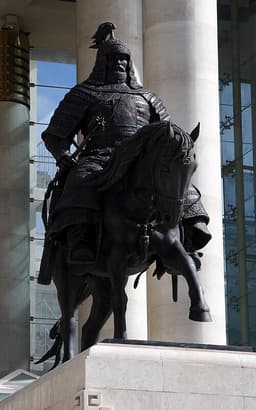
Muqali
General · Medieval
61.3Total
Basic Information
Born
1039
1170
Died
1106
1223
Era
Medieval
Medieval
Nationality
Japan
Mongol Empire
Occupation
General
General
Civilization
Eastern
Eastern
Score Comparison
Military (10%)
61.7
65.0
Political (20%)
27.9
68.0
Influence (20%)
54.9
58.0
Legacy (20%)
47.5
49.2
Leadership (15%)
57.6
70.4
Strategy (15%)
58.0
72.0
TOTAL
50.4
61.3
Minamoto no Yoshiie — Complete Timeline
1062 AD
Participation in the Former Nine Years WarWar
Minamoto no Yoshiie fought alongside his father Yoriyoshi in the Former Nine Years War against the Abe clan. He distinguished himself in combat, particularly at the Siege of Kuriyagawa, earning a reputation as a fierce warrior.
WarCombatMinamoto Clan
Impact: regional
1083 AD
Appointment as Chinjufu ShogunPolitical Action◆ Major
Yoshiie was appointed Chinjufu Shogun, following his father's footsteps. This position gave him command over military affairs in northern Japan and set the stage for his involvement in the Gosannen War.
AppointmentNorthern Command
Impact: regional
1087 AD
Gosannen War CampaignWar◆ Major
Yoshiie led a campaign against the Kiyohara clan in the Gosannen War. He defeated Kiyohara no Iehira at the Battle of Kanazawa, but the war was inconclusive and drained Minamoto resources, leading to a decline in their influence.
WarCampaignKiyohara Clan
Impact: regional
1091 AD
Conflict with the Imperial CourtPolitical Action
Yoshiie was involved in a dispute with the Imperial Court over land rights and military authority. The court ordered him to cease hostilities in the north, and he was forced to comply, highlighting the limits of his power and the growing tension between the Minamoto and the court.
ConflictCourt PoliticsMinamoto Decline
Impact: nationaldestructive
Muqali — Complete Timeline
1211 AD
Campaign in Northern ChinaWar◆ Major
Muqali was a key commander in Genghis Khan's invasion of the Jin Dynasty. He led forces in the capture of numerous cities and fortresses in northern China, including the victory at the Battle of Yehuling in 1211, which broke Jin resistance.
Jin DynastyYehulingNorthern China
Impact: regional
1212 AD
Conquest of ManchuriaWar
Muqali led a campaign to subdue the Khitan and Jurchen tribes in Manchuria. He defeated the rebel Khitan leader Yel
ManchuriaKhitanJurchen
Impact: regional
1215 AD
Siege of ZhongduWar◆ Major
Muqali participated in the Mongol siege of Zhongdu (modern Beijing), the capital of the Jin Dynasty. The city fell after a prolonged siege, leading to the massacre of its inhabitants and the effective collapse of Jin authority in northern China.
ZhongduBeijingSiege
Impact: regionaldestructive
1217 AD
Appointment as Viceroy of ChinaPolitical Action◆ Major
Genghis Khan appointed Muqali as viceroy (guo-wang) of all conquered territories in China, granting him command of the Mongol forces in the region. This made Muqali the de facto ruler of Mongol-occupied northern China.
ViceroyChinaGenghis Khan
Impact: regionalconstructive
Expert Analysis
Origins
Minamoto no Yoshiie (born 1039) was the son of Minamoto no Yoriyoshi, a prominent samurai commander. Growing up in a warrior family in Heian-era Japan, he was trained from childhood in martial arts and military strategy. His moniker "Hachiman Taro" reflects his dedication to the god of war. Muqali (born 1170) was a Mongol from the Jalayir tribe, who rose from humble origins to become one of Genghis Khan's most trusted nökör (companions). Little is known of his early life, but he likely joined Genghis as a young warrior during the unification of the Mongol tribes.
Rise to Power
Yoshiie's rise came through his participation in the Former Nine Years War (1051-1063) alongside his father against the Abe clan. He distinguished himself in combat, particularly at the Battle of Kawasaki in 1057. His appointment as Chinjufu Shogun in 1075 gave him command over military affairs in northern Japan. Muqali's rise was tied to Genghis Khan's campaigns. He proved his loyalty during the war against the Naimans (c. 1204) and was rewarded with high command. In 1211, he led a wing of the Mongol army in the invasion of the Jin Dynasty, capturing numerous cities. His greatest promotion came in 1217 when Genghis appointed him viceroy (guo-wang) of all conquered territories in China, effectively making him the supreme commander in the region.
Leadership & Governance
Yoshiie's leadership was based on personal valor and clan loyalty. He led from the front, which inspired his troops but also exposed him to danger. His governance was limited to military command; he had little political power beyond the battlefield. Muqali, by contrast, was an administrator as well as a general. As viceroy, he implemented Mongol policies in northern China, including taxation and recruitment of Chinese auxiliaries. His leadership score of 70.4 reflects his ability to manage both military and civil affairs, while Yoshiie's 57.6 indicates a narrower scope.
Triumph & Tragedy
Yoshiie's greatest triumph was his performance in the Gosannen War (1083-1087), where he defeated Kiyohara no Iehira at the Battle of Kanazawa. However, the war was inconclusive, and his unauthorized campaigns led to conflict with the Imperial Court. His greatest failure was his inability to secure lasting peace in the north, and his political score of 27.9 reflects his poor relations with the court. Muqali's triumphs include the siege of Zhongdu (1215) and the conquest of Manchuria. He successfully subdued the Khitan rebel Yelü Liuge and stabilized Mongol rule in China. His tragedy came from overwork; he died in 1223 from illness, possibly exacerbated by constant campaigning. His political score of 68.0 indicates effective governance.
Character & Destiny
Yoshiie was a warrior's warrior, embodying the samurai ideal of bravery and loyalty. His character was shaped by the bushido code, but his lack of political acumen limited his achievements. Muqali was pragmatic and loyal, earning Genghis's trust. His destiny was to be the architect of Mongol rule in China, a role he fulfilled with competence. Historical assessments note that while Yoshiie became a legendary figure in Japanese folklore, Muqali's contributions were more concrete.
Legacy
Yoshiie's legacy is cultural: he is remembered as a symbol of the samurai spirit and inspired later warrior tales. His military score of 61.7 and influence score of 54.9 reflect his impact on Japanese martial tradition. Muqali's legacy is political: he established the administrative framework for Mongol rule in China, which later influenced the Yuan Dynasty. His military score of 65.0 and leadership score of 70.4 indicate a more effective commander. However, his influence score of 58.0 is limited by his relative obscurity outside Mongol studies.
Conclusion
Muqali had greater impact. His total score of 61.3 surpasses Yoshiie's 50.4 by 10.9 points. While Yoshiie was a skilled warrior, Muqali's combination of military prowess and administrative ability allowed him to shape the course of Chinese history. Yoshiie's legacy is legendary but localized, whereas Muqali's contributions to the Mongol Empire had lasting effects on East Asian geopolitics.
Rankings
🥇
MuqaliLeader
Mil: 65.0Pol: 68.0Inf: 58.0
61.3
🥈
Minamoto no Yoshiie
Mil: 61.7Pol: 27.9Inf: 54.9
50.4
+10.9 behind
How This Comparison Works
Algorithm
Each figure is scored on 6 dimensions (0—100 scale) based on structured historical data: Military (10%), Political (20%), Influence (20%), Legacy (20%), Leadership (15%), Strategy (15%). The weighted total produces the final ranking.
Data Sources
Scores are computed from structured sub-indicators in the database. Scale factors adjust for era (Ancient ×0.85, Modern ×1.0) and civilization size (Eastern ×1.05, Other ×0.80) to account for differences in population and military scale.
Maximum 3 Figures
Comparisons are limited to 2—3 figures to ensure readability and statistical meaningfulness.
Error Margins
±5 points per dimension — Sub-scores are derived from historical records with inherent uncertainty. Two figures within 5 points on a dimension should be considered roughly equivalent in that area.
Total Score Accuracy
±3 points overall — The weighted combination of 6 dimensions produces a total score with approximately ±3 points of uncertainty. Differences of less than 3 points are not statistically significant— the figures are effectively tied.
Known Limitations
- Historical records are incomplete and uneven across civilizations
- Figures from oral-tradition societies may be underrepresented
- Occupation labels can misclassify multi-role figures
- Scores measure capability and impact, not moral character
- Quantitative scoring is a comparison tool, not absolute truth
Capability Radar
Military (10%) — Battles & Warfare
Battles
65
75
Win Rate
70
80
Expansion
40
85
Political (20%) — Governance & Reform
Reform
20
65
Diplomacy
35
72
Economy
25
60
Influence (20%) — Cultural & Global Reach
Cultural
65
55
Global
35
55
Legacy (20%) — Historical Impact
Historical
60
65
Longevity
55
50
Leadership (15%) — Power & Stability
Tenure
50
70
Stability
30
68
Strategy (15%) — Tactics & Innovation
Strategy
60
82
Tactics
75
78
Reform
30
60
Similar Comparisons
Comments & Discussion
No comments yet. Be the first to share your thoughts!