Loading...
This comparison has not been analyzed yet.
One-time AI generation (~1 minute). Scores and timeline are already available below.
Marduk-apla-iddina II vs Rudradaman I
Rudradaman I leads by 4.0 pts · 2 figures compared
…
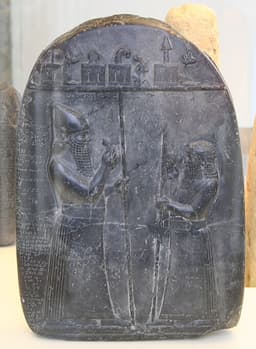
Marduk-apla-iddina II
Emperor · Ancient
47.4Total

Rudradaman I
Emperor · Ancient
51.4Total
Basic Information
Born
-722
109
Died
-710
150
Era
Ancient
Ancient
Nationality
Babylon
India
Occupation
Emperor
Emperor
Civilization
Middle Eastern
Indian
Score Comparison
Military (10%)
30.0
50.0
Political (20%)
42.3
68.0
Influence (20%)
51.0
51.8
Legacy (20%)
44.2
45.0
Leadership (15%)
55.3
40.0
Strategy (15%)
60.0
60.0
TOTAL
47.4
51.4
Marduk-apla-iddina II — Complete Timeline
721 BC
Resistance Against Assyrian DominationWar
Marduk-apla-iddina II, known as Merodach-Baladan in the Bible, led a rebellion against Assyrian rule under Sargon II. He seized the Babylonian throne and resisted Assyrian attempts to reconquer Babylon for over a decade, becoming a symbol of Babylonian independence.
Assyrian ResistanceRebellionBabylonian Independence
Impact: regional
710 BC
Defeat and Flight to ElamWar◆ Major
After a prolonged campaign, the Assyrian king Sargon II defeated Marduk-apla-iddina II and recaptured Babylon. Marduk-apla-iddina fled to Elam, where he continued to plot against Assyria, but his direct rule over Babylon ended.
Assyrian VictoryExileBabylon
Impact: regionaltragic
Rudradaman I — Complete Timeline
135 AD
Expanded Shaka TerritoryWar◆ Major
Rudradaman I expanded the Western Kshatrapa kingdom by conquering territories in Gujarat, Malwa, and parts of Rajasthan. He brought several regions under Shaka control, strengthening their position in western India.
ConquestExpansionShaka
Impact: regional
140 AD
Repaired the Sudarshana Lake DamReform◆ Major
Rudradaman I ordered the repair of the Sudarshana Lake dam in the Kathiawar peninsula, which had been damaged by a storm. The project involved reinforcing the embankment and restoring irrigation to the region, benefiting agriculture.
IrrigationPublic WorksAgriculture
Impact: regionalconstructive
145 AD
Defeated the SatavahanasWar◆ Major
Rudradaman I fought against the Satavahana king Vashishtiputra Satakarni, defeating him in battle. However, he spared his life due to a marital alliance, as Satakarni was his son-in-law.
WarSatavahanaAlliance
Impact: regional
150 AD
Commissioned the Junagadh Rock InscriptionCultural◆ Major
Rudradaman I commissioned the Junagadh rock inscription, which records his repair of the Sudarshana Lake dam and details his reign. The inscription is notable for being one of the earliest long Sanskrit inscriptions in India.
InscriptionSanskritHistorical Record
Impact: regionalconstructive
This comparison has not been analyzed yet.
One-time AI generation (~1 minute). Scores and timeline are already available below.
Rankings
🥇
Rudradaman ILeader
Mil: 50.0Pol: 68.0Inf: 51.8
51.4
🥈
Marduk-apla-iddina II
Mil: 30.0Pol: 42.3Inf: 51.0
47.4
+4.0 behind
How This Comparison Works
Algorithm
Each figure is scored on 6 dimensions (0—100 scale) based on structured historical data: Military (10%), Political (20%), Influence (20%), Legacy (20%), Leadership (15%), Strategy (15%). The weighted total produces the final ranking.
Data Sources
Scores are computed from structured sub-indicators in the database. Scale factors adjust for era (Ancient ×0.85, Modern ×1.0) and civilization size (Eastern ×1.05, Other ×0.80) to account for differences in population and military scale.
Maximum 3 Figures
Comparisons are limited to 2—3 figures to ensure readability and statistical meaningfulness.
Error Margins
±5 points per dimension — Sub-scores are derived from historical records with inherent uncertainty. Two figures within 5 points on a dimension should be considered roughly equivalent in that area.
Total Score Accuracy
±3 points overall — The weighted combination of 6 dimensions produces a total score with approximately ±3 points of uncertainty. Differences of less than 3 points are not statistically significant— the figures are effectively tied.
Known Limitations
- Historical records are incomplete and uneven across civilizations
- Figures from oral-tradition societies may be underrepresented
- Occupation labels can misclassify multi-role figures
- Scores measure capability and impact, not moral character
- Quantitative scoring is a comparison tool, not absolute truth
Capability Radar
Military (10%) — Battles & Warfare
Battles
45
40
Win Rate
40
45
Expansion
35
45
Political (20%) — Governance & Reform
Reform
30
55
Diplomacy
50
50
Economy
35
60
Influence (20%) — Cultural & Global Reach
Cultural
30
40
Global
35
30
Legacy (20%) — Historical Impact
Historical
45
50
Longevity
40
40
Leadership (15%) — Power & Stability
Tenure
40
60
Stability
30
55
Strategy (15%) — Tactics & Innovation
Strategy
55
50
Tactics
50
50
Reform
30
30
Similar Comparisons
Comments & Discussion
No comments yet. Be the first to share your thoughts!