Loading...
Marduk-apla-iddina II vs Napoleon Bonaparte
Napoleon Bonaparte leads by 23.5 pts · 2 figures compared
…
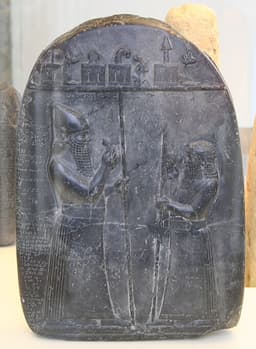
Marduk-apla-iddina II
Emperor · Ancient
47.4Total

Napoleon Bonaparte
General · Modern
70.9Total
Basic Information
Born
-722
1769
Died
-710
1821
Era
Ancient
Modern
Nationality
Babylon
France
Occupation
Emperor
General
Civilization
Middle Eastern
Western
Score Comparison
Military (10%)
30.0
94.0
Political (20%)
42.3
72.0
Influence (20%)
51.0
40.0
Legacy (20%)
44.2
80.0
Leadership (15%)
55.3
78.0
Strategy (15%)
60.0
90.0
TOTAL
47.4
70.9
Marduk-apla-iddina II — Complete Timeline
721 BC
Resistance Against Assyrian DominationWar
Marduk-apla-iddina II, known as Merodach-Baladan in the Bible, led a rebellion against Assyrian rule under Sargon II. He seized the Babylonian throne and resisted Assyrian attempts to reconquer Babylon for over a decade, becoming a symbol of Babylonian independence.
Assyrian ResistanceRebellionBabylonian Independence
Impact: regional
710 BC
Defeat and Flight to ElamWar◆ Major
After a prolonged campaign, the Assyrian king Sargon II defeated Marduk-apla-iddina II and recaptured Babylon. Marduk-apla-iddina fled to Elam, where he continued to plot against Assyria, but his direct rule over Babylon ended.
Assyrian VictoryExileBabylon
Impact: regionaltragic
Napoleon Bonaparte — Complete Timeline
1799 AD
Coup of 18 BrumaireOther◆ Major
Napoleon Bonaparte, with support from his brother Lucien and key political figures, overthrew the Directory in a bloodless coup. He established the Consulate with himself as First Consul, effectively becoming the ruler of France. This event ended the French Revolution's most unstable period.
French RevolutionCoupRise to Power
Impact: regional
1804 AD
Promulgation of the Napoleonic CodeOther◆ Major
Napoleon enacted the Civil Code of the French, known as the Napoleonic Code, a comprehensive set of laws that replaced the fragmented feudal legal systems. The code established legal equality, protected property rights, and secularized law. It became the basis for legal systems in many European and world countries.
Legal ReformNapoleonic CodeCivil Law
Impact: globalconstructive
1805 AD
Battle of AusterlitzWar◆ Major
Napoleon's Grande Arm
Napoleonic WarsBattleDecisive Victory
Impact: global
1812 AD
Invasion of RussiaWar◆ Major
Napoleon led the Grande Arm
Napoleonic WarsInvasionDisaster
Impact: globaldestructive
1815 AD
Battle of WaterlooWar◆ Major
Napoleon's French army was defeated by the combined forces of the Duke of Wellington's Anglo-Allied army and Gebhard Leberecht von Bl
Napoleonic WarsBattleFinal Defeat
Impact: globaldestructive
Expert Analysis
marduk-apla-iddina-ii-vs-napoleon-bonaparte
# The Emperor and the King of Ruins
In the spring of 1815, Napoleon Bonaparte stood before his Grande Armée for the last time, the tricolor fluttering over a field in Belgium that would soon be soaked in blood. Twenty-five centuries earlier, another ruler had faced his own final reckoning—Marduk-apla-iddina II, fleeing across the marshes of southern Mesopotamia as Assyrian chariots burned his capital. One man reshaped Europe from the Atlantic to the Vistula; the other fought desperately to keep a single city free. What separated them was not merely time or geography, but the entire architecture of their worlds—and the different kinds of greatness those worlds demanded.
Origins
Napoleon was born in 1769 on the Mediterranean island of Corsica, a land recently annexed by France. His family were minor nobles of Italian descent, speaking Corsican dialect more fluently than French. This marginality shaped him: he was an outsider who had to prove himself, a provincial who would conquer the continent that looked down on him. The Enlightenment was in full flower; Voltaire and Rousseau were still recent memories. Napoleon read voraciously, absorbing the ideas of reason, law, and progress that would later inform his reforms.
Marduk-apla-iddina II emerged from an entirely different world—the ancient city-state of Babylon, where the god Marduk was believed to choose kings and where the written word was clay. He was a Chaldean chieftain who seized the throne of Babylon around 722 BC, during a period when the Neo-Assyrian Empire was the most formidable military power in the Near East. His world was one of omens, temple rituals, and dynastic struggles where defeat meant not exile but impalement. The Bible would remember him as Merodach-Baladan, a name that sounds like a curse.
Rise to Power
Napoleon’s ascent was meteoric and meritocratic. At age 24, he drove the British out of Toulon; by 26, he was commanding the Army of Italy. His 1796 Italian campaign was a masterpiece of speed and deception—he defeated larger Austrian armies by striking at their flanks and communications. The Directory in Paris, corrupt and unpopular, needed a hero, and Napoleon made himself indispensable. In 1799, he staged a coup d’état and became First Consul. By 1804, he crowned himself Emperor in Notre-Dame, taking the crown from Pope Pius VII’s hands and placing it on his own head—a gesture of pure, breathtaking ambition.
Marduk-apla-iddina II’s path was narrower and more desperate. He became king of Babylon during the chaos following the death of the Assyrian king Shalmaneser V. The Assyrian Empire was distracted by revolts elsewhere, and he seized his chance. His rise was not a story of genius but of opportunism in a world where empires crushed city-states like insects. He allied with the Elamites, a mountain people to the east, and with local tribes who resented Assyrian taxation. His power base was not an army of millions but a coalition of the fearful.
Leadership & Governance
Napoleon governed with a blend of autocracy and efficiency. He centralized the French state, created the Bank of France, and most enduringly, established the Napoleonic Code—a legal system based on rational principles that abolished feudal privileges and protected property rights. It spread across Europe and remains influential today. His military genius was staggering: he fought over sixty battles and lost only seven. At Austerlitz in 1805, he lured the Russian and Austrian armies into a trap on a frozen lake, then shattered them. His soldiers adored him because he shared their hardships and promoted by talent, not birth.
Marduk-apla-iddina II ruled a city, not an empire. His governance was traditional Babylonian—tax collection, temple maintenance, irrigation management. His political score of 44.7 reflects the narrowness of his options. He could not reform his society because he barely controlled it. His military score of 33.1 is not a judgment of his courage but of his resources: he commanded perhaps a few thousand men against an Assyrian war machine that could field tens of thousands of professional soldiers armed with iron weapons. His strategy score of 60.3 suggests he was competent, but competence was not enough.
Triumph & Tragedy
Napoleon’s greatest moment was probably the Austerlitz campaign, where he destroyed a coalition of two empires in a single day. His greatest tragedy was the 1812 invasion of Russia. He marched 600,000 men into the vastness of winter and emerged with fewer than 100,000. The disaster broke his aura of invincibility. In 1814, the Allies invaded France; Napoleon abdicated and was exiled to Elba. He escaped, raised another army, and was finally defeated at Waterloo in June 1815. The British sent him to Saint Helena, a volcanic rock in the South Atlantic, where he died in 1821—possibly poisoned by arsenic in the wallpaper.
Marduk-apla-iddina II’s triumph was the rebellion itself. For over a decade, he held Babylon against the might of Assyria. Sargon II, the Assyrian king, spent years campaigning against him, and even after defeating him in 710 BC, the Babylonian king escaped to Elam. He returned later, only to be driven out again. His tragedy was the inevitability of his defeat. He was not outgeneraled; he was out-resourced. The Bible mentions him in Isaiah 39, where he sends envoys to King Hezekiah of Judah, seeking allies against Assyria—a gesture of desperate diplomacy that came to nothing.
Character & Destiny
Napoleon was possessed by an insatiable hunger for glory. “I am not a man,” he once said, “but a thing.” He saw himself as a force of history, a necessary storm. This belief drove him to conquer but also to overreach. He could not stop. His personality was a paradox: a rational reformer who was also a compulsive gambler with armies. His total score of 82.4 reflects a man who achieved the near-impossible but destroyed himself by trying for the impossible.
Marduk-apla-iddina II was a survivor, not a visionary. His leadership score of 37.6 suggests he was not a charismatic figure who inspired devotion but a pragmatic chieftain who held together a coalition through negotiation and fear. He fought not to reshape the world but to keep his world from being erased. His destiny was to be a footnote—a name in the Bible, a cuneiform inscription in a museum. He failed, but his failure was not dishonorable. He was a king who chose resistance over submission, knowing he would likely lose.
Legacy
Napoleon’s legacy is monumental. He reshaped Europe’s borders, spread the ideals of the French Revolution, and inspired nationalism from Germany to Italy to Egypt. The Napoleonic Code governs millions of people today. He is remembered as both a liberator and a tyrant—the man who ended feudalism and the man who restored slavery in the French colonies. His influence score of 82.0 places him among the most consequential figures in Western history.
Marduk-apla-iddina II’s legacy is fragile but real. He represents the ancient struggle of small nations against empires. In Babylon, he was remembered as a hero who defied the Assyrians. In the Bible, he appears as a symbol of Babylonian pride that would eventually fall. His legacy score of 58.8 is modest, but it is a testament to the power of memory: he is still known, 2,700 years later, because he refused to disappear quietly.
Conclusion
To compare Napoleon and Marduk-apla-iddina II is to compare a volcano and a candle. One erupted across a continent, melting old orders and forging new ones. The other flickered in the dark, briefly illuminating a city before the wind blew it out. Yet both were responding to the same fundamental question: What does it mean to rule when the world is against you? Napoleon had the resources, the genius, and the luck to answer with conquest. Marduk-apla-iddina II had only his will. History remembers the volcano, but it should not forget the candle—for in its small, desperate flame, we see the courage of those who fight not to win, but to resist.
Rankings
🥇
Napoleon BonaparteLeader
Mil: 94.0Pol: 72.0Inf: 40.0
70.9
🥈
Marduk-apla-iddina II
Mil: 30.0Pol: 42.3Inf: 51.0
47.4
+23.5 behind
How This Comparison Works
Algorithm
Each figure is scored on 6 dimensions (0—100 scale) based on structured historical data: Military (10%), Political (20%), Influence (20%), Legacy (20%), Leadership (15%), Strategy (15%). The weighted total produces the final ranking.
Data Sources
Scores are computed from structured sub-indicators in the database. Scale factors adjust for era (Ancient ×0.85, Modern ×1.0) and civilization size (Eastern ×1.05, Other ×0.80) to account for differences in population and military scale.
Maximum 3 Figures
Comparisons are limited to 2—3 figures to ensure readability and statistical meaningfulness.
Error Margins
±5 points per dimension — Sub-scores are derived from historical records with inherent uncertainty. Two figures within 5 points on a dimension should be considered roughly equivalent in that area.
Total Score Accuracy
±3 points overall — The weighted combination of 6 dimensions produces a total score with approximately ±3 points of uncertainty. Differences of less than 3 points are not statistically significant— the figures are effectively tied.
Known Limitations
- Historical records are incomplete and uneven across civilizations
- Figures from oral-tradition societies may be underrepresented
- Occupation labels can misclassify multi-role figures
- Scores measure capability and impact, not moral character
- Quantitative scoring is a comparison tool, not absolute truth
Capability Radar
Military (10%) — Battles & Warfare
Battles
45
95
Win Rate
40
90
Expansion
35
95
Political (20%) — Governance & Reform
Reform
30
95
Diplomacy
50
80
Economy
35
85
Influence (20%) — Cultural & Global Reach
Cultural
30
85
Global
35
90
Legacy (20%) — Historical Impact
Historical
45
95
Longevity
40
90
Leadership (15%) — Power & Stability
Tenure
40
85
Stability
30
70
Strategy (15%) — Tactics & Innovation
Strategy
55
95
Tactics
50
98
Reform
30
92
Similar Comparisons
Comments & Discussion
MarshalMapper6/17/2026
This comparison is absurd. Napoleon commanded armies of 600,000 men using revolutionary logistics and corps organization. Marduk-apla-iddina had maybe 20,000 poorly armed militias. Sure, he gave the Assyrians trouble, but he never conquered anything beyond Babylon’s walls. Napoleon redrew the map of Europe, codified civil law, and his cavalry tactics are still studied. Marduk’s greatest achievement was surviving long enough to drown in a swamp. This isn't a debate.
田野守夜人6/17/2026
拿数据说事吧:拿破仑的《民法典》影响了全球法律体系,至今沿用;而这位巴比伦王连一块像样的碑文都没留下,只靠亚述人的战报才被记得。马杜克-阿普拉-伊丁纳最多是个地方军阀,靠沼泽逃跑刷存在感。拿破仑是真正改变历史走向的人,别拿游击队长和帝国皇帝相提并论。