Loading...
Mahfud MD vs Rafael Correa
Mahfud MD leads by 0.0 pts · 2 figures compared
…
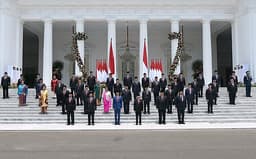
Mahfud MD
Politician · Modern
49.8Total

Rafael Correa
Politician · Modern
49.8Total
Basic Information
Born
1957
1963
Died
—
—
Era
Modern
Modern
Nationality
Indonesia
Ecuador
Occupation
Politician
Politician
Civilization
Eastern
Western
Score Comparison
Military (10%)
13.2
10.0
Political (20%)
60.0
55.0
Influence (20%)
55.7
58.0
Legacy (20%)
45.0
45.8
Leadership (15%)
78.0
72.0
Strategy (15%)
26.3
38.3
TOTAL
49.8
49.8
Mahfud MD — Complete Timeline
2008 AD
Appointed Chief Justice of the Constitutional CourtPolitical Action◆ Major
Mahfud MD was appointed Chief Justice of Indonesia's Constitutional Court. During his tenure, he oversaw several landmark decisions, including rulings on electoral disputes and constitutional amendments, enhancing the court's independence and credibility.
JudiciaryConstitutional CourtLegal Reform
Impact: nationalconstructive
2013 AD
Resigned as Chief Justice to Run for Vice PresidentPolitical Action
Mahfud MD resigned as Chief Justice of the Constitutional Court to pursue a vice presidential candidacy. He was ultimately not selected as a running mate, but his resignation marked a transition from judicial to political ambitions.
ResignationPolitical AmbitionTransition
Impact: national
2019 AD
Appointed Coordinating Minister for Political, Legal, and Security AffairsPolitical Action◆ Major
Mahfud MD was appointed Coordinating Minister for Political, Legal, and Security Affairs in President Joko Widodo's second cabinet. He oversaw national security policies, including counter-terrorism efforts and handling of separatist movements in Papua.
CabinetSecurityPolicy
Impact: nationalconstructive
Rafael Correa — Complete Timeline
2007 AD
Election and Citizen Revolution (2007)Political Action◆ Major
Rafael Correa assumed the presidency of Ecuador, launching the 'Citizen Revolution.' His administration convened a Constituent Assembly to draft a new constitution, which was approved by referendum in 2008. The new constitution expanded social rights, strengthened state control over natural resources, and allowed for presidential re-election.
New ConstitutionCitizen RevolutionSocialism
Impact: nationalconstructive
2008 AD
Debt Default and Restructuring (2008-2009)Political Action◆ Major
Correa defaulted on $3.2 billion in foreign debt, declaring it 'illegitimate' and 'illegal' due to corruption in its issuance. His administration subsequently bought back the defaulted bonds at a steep discount, reducing Ecuador's debt burden. This move was praised by some but criticized by international creditors.
Debt DefaultSovereign DebtEconomic Policy
Impact: globalconstructive
2012 AD
Assange Asylum and WikiLeaks (2012-2019)Political Action◆ Major
Correa granted political asylum to Julian Assange in the Ecuadorian Embassy in London, where Assange had taken refuge to avoid extradition to Sweden. This decision strained relations with the UK and US, and made Ecuador a central player in the global debate over press freedom and diplomatic immunity.
Julian AssangeDiplomatic AsylumWikiLeaks
Impact: global
Expert Analysis
Origins
Mahfud MD was born on May 13, 1957, in Sampang, Madura, Indonesia, to a modest farming family. He studied law at the Islamic University of Indonesia and later earned a doctorate from Gadjah Mada University. His early career combined academia and politics, teaching constitutional law while serving as a member of the People's Consultative Assembly from 1999 to 2004. Rafael Correa was born on April 6, 1963, in Guayaquil, Ecuador, to a middle-class family. He earned a master's in economics from the Catholic University of Leuven and a PhD from the University of Illinois. Before entering politics, he worked as a university professor and served as Minister of Finance in 2005 under President Alfredo Palacio.
Rise to Power
Mahfud MD rose to national prominence when he was appointed Chief Justice of Indonesia's Constitutional Court in 2008. His tenure was marked by key decisions, including rulings on electoral disputes and judicial independence. In 2019, he was appointed Coordinating Minister for Political, Legal, and Security Affairs under President Joko Widodo, overseeing national security and legal reforms. His political influence grew through his role in the National Mandate Party. Rafael Correa rose to power by positioning himself as an anti-establishment outsider. He was elected president in 2006 with 56% of the vote, promising a 'Citizen Revolution' to dismantle the old political order. He immediately convened a Constituent Assembly that drafted a new constitution, ratified by referendum in 2008. This expanded presidential powers and allowed him to be re-elected twice.
Leadership & Governance
Mahfud MD's leadership style is legalistic and consensus-oriented. As Constitutional Court chief, he prioritized judicial independence and transparency. His political score of 60.0 reflects his ability to navigate Indonesia's complex coalition politics. However, his strategic score of 26.3 indicates limited long-term planning. Rafael Correa governed through direct confrontation with elites, media, and foreign creditors. He defaulted on $3.2 billion in foreign debt in 2008, arguing it was 'illegitimate.' He also expelled the US ambassador in 2011 over WikiLeaks cables. His leadership score of 72.0 is higher than Mahfud's 78.0, but his political score of 55.0 is lower, reflecting polarizing governance.
Triumph & Tragedy
Mahfud MD's greatest success was strengthening Indonesia's Constitutional Court, earning global recognition for judicial reform. His failure came in 2014 when he resigned as chief justice to run for vice president but was not selected, ending his presidential ambitions. Rafael Correa's triumph was reducing poverty from 37% to 22% and increasing public spending on health and education. His tragedy was the economic fallout from his policies, including a recession in 2016-2017, and the corruption conviction of his successor, Lenin Moreno, which tarnished his legacy. His asylum to Julian Assange in 2012 also damaged Ecuador's international relations.
Character & Destiny
Mahfud MD is methodical and cautious, traits that served him well in the judiciary but limited his political ambitions. His leadership score of 78.0 suggests effective management, but his total score of 49.8 indicates moderate overall impact. Rafael Correa is charismatic and combative, willing to challenge institutions. His leadership score of 72.0 reflects his ability to inspire followers, but his confrontational style led to legal troubles; he was convicted of corruption in absentia in 2020 and fled to Belgium.
Legacy
Mahfud MD's legacy is tied to Indonesia's Constitutional Court, which remains a model in Southeast Asia. His influence score of 55.7 reflects his impact on legal reforms. Rafael Correa's legacy is the 'Citizen Revolution,' which transformed Ecuador's political landscape, though his policies remain controversial. His influence score of 58.0 is slightly higher, but his legacy score of 45.8 is nearly identical to Mahfud's 45.0.
Conclusion
While both scored 49.8 overall, Mahfud MD had a more lasting impact through institutional reform, whereas Correa's legacy is more volatile. Mahfud's work on the Constitutional Court has enduring effects on Indonesian democracy, while Correa's policies are being reversed by successors. Thus, Mahfud MD's impact is more sustainable.
Rankings
🥇
Mahfud MDLeader
Mil: 13.2Pol: 60.0Inf: 55.7
49.8
🥈
Rafael Correa
Mil: 10.0Pol: 55.0Inf: 58.0
49.8
How This Comparison Works
Algorithm
Each figure is scored on 6 dimensions (0—100 scale) based on structured historical data: Military (10%), Political (20%), Influence (20%), Legacy (20%), Leadership (15%), Strategy (15%). The weighted total produces the final ranking.
Data Sources
Scores are computed from structured sub-indicators in the database. Scale factors adjust for era (Ancient ×0.85, Modern ×1.0) and civilization size (Eastern ×1.05, Other ×0.80) to account for differences in population and military scale.
Maximum 3 Figures
Comparisons are limited to 2—3 figures to ensure readability and statistical meaningfulness.
Error Margins
±5 points per dimension — Sub-scores are derived from historical records with inherent uncertainty. Two figures within 5 points on a dimension should be considered roughly equivalent in that area.
Total Score Accuracy
±3 points overall — The weighted combination of 6 dimensions produces a total score with approximately ±3 points of uncertainty. Differences of less than 3 points are not statistically significant— the figures are effectively tied.
Known Limitations
- Historical records are incomplete and uneven across civilizations
- Figures from oral-tradition societies may be underrepresented
- Occupation labels can misclassify multi-role figures
- Scores measure capability and impact, not moral character
- Quantitative scoring is a comparison tool, not absolute truth
Capability Radar
Military (10%) — Battles & Warfare
Battles
17
0
Win Rate
15
0
Expansion
20
0
Political (20%) — Governance & Reform
Reform
60
75
Diplomacy
55
60
Economy
50
65
Influence (20%) — Cultural & Global Reach
Cultural
40
50
Global
35
40
Legacy (20%) — Historical Impact
Historical
40
45
Longevity
30
30
Leadership (15%) — Power & Stability
Tenure
65
70
Stability
55
55
Strategy (15%) — Tactics & Innovation
Strategy
26
0
Tactics
28
0
Reform
27
10
Similar Comparisons
Comments & Discussion
No comments yet. Be the first to share your thoughts!