Loading...
Mahfud MD vs Soong Ching-ling
Soong Ching-ling leads by 4.5 pts · 2 figures compared
…
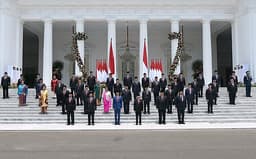
Mahfud MD
Politician · Modern
49.8Total

Soong Ching-ling
Politician · Modern
54.3Total
Basic Information
Born
1957
1893
Died
—
1981
Era
Modern
Modern
Nationality
Indonesia
China
Occupation
Politician
Politician
Civilization
Eastern
Eastern
Score Comparison
Military (10%)
13.2
13.7
Political (20%)
60.0
68.0
Influence (20%)
55.7
55.0
Legacy (20%)
45.0
58.0
Leadership (15%)
78.0
72.0
Strategy (15%)
26.3
36.5
TOTAL
49.8
54.3
Mahfud MD — Complete Timeline
2008 AD
Appointed Chief Justice of the Constitutional CourtPolitical Action◆ Major
Mahfud MD was appointed Chief Justice of Indonesia's Constitutional Court. During his tenure, he oversaw several landmark decisions, including rulings on electoral disputes and constitutional amendments, enhancing the court's independence and credibility.
JudiciaryConstitutional CourtLegal Reform
Impact: nationalconstructive
2013 AD
Resigned as Chief Justice to Run for Vice PresidentPolitical Action
Mahfud MD resigned as Chief Justice of the Constitutional Court to pursue a vice presidential candidacy. He was ultimately not selected as a running mate, but his resignation marked a transition from judicial to political ambitions.
ResignationPolitical AmbitionTransition
Impact: national
2019 AD
Appointed Coordinating Minister for Political, Legal, and Security AffairsPolitical Action◆ Major
Mahfud MD was appointed Coordinating Minister for Political, Legal, and Security Affairs in President Joko Widodo's second cabinet. He oversaw national security policies, including counter-terrorism efforts and handling of separatist movements in Papua.
CabinetSecurityPolicy
Impact: nationalconstructive
Soong Ching-ling — Complete Timeline
1915 AD
Married Sun Yat-senPolitical Action◆ Major
Soong Ching-ling married Sun Yat-sen in Tokyo, becoming his second wife. This marriage aligned her with the Chinese revolutionary movement and made her a key figure in the Kuomintang.
MarriageSun Yat-senRevolution
Impact: nationalconstructive
1927 AD
Opposed Chiang Kai-shek's purge of CommunistsPolitical Action◆ Major
Soong Ching-ling publicly condemned Chiang Kai-shek's massacre of Communists in Shanghai, breaking with the right-wing Kuomintang. She went into exile in the Soviet Union and Europe, advocating for leftist causes.
Kuomintang SplitCommunist PurgeExile
Impact: nationaldestructive
1938 AD
Co-founded the China Welfare InstitutePolitical Action◆ Major
Soong Ching-ling established the China Welfare Institute in Hong Kong to raise funds and medical supplies for the Chinese resistance against Japan. The organization supported the Communist-led Eighth Route Army.
HumanitarianSecond Sino-Japanese WarCommunist Support
Impact: nationalconstructive
1949 AD
Became Vice President of the People's Republic of ChinaPolitical Action◆ Major
Soong Ching-ling was appointed Vice President of the newly founded People's Republic of China, serving under Mao Zedong. She held this position until 1975, symbolizing the united front between the Communist Party and leftist non-Communists.
PRC FoundingVice PresidentUnited Front
Impact: nationalconstructive
1981 AD
Appointed Honorary President of the PRCPolitical Action◆ Major
Soong Ching-ling was named Honorary President of the People's Republic of China shortly before her death, a unique title created for her. She was also granted posthumous membership in the Chinese Communist Party.
Honorary PresidentPRCDeath
Impact: nationalconstructive
Expert Analysis
Origins
Mahfud MD was born on 13 May 1957 in Sampang, Madura, Indonesia, into a modest family. He pursued legal education at the Islamic University of Indonesia, earning his bachelor's degree in law, and later obtained a doctorate in constitutional law from Gadjah Mada University. His early career as a lecturer and legal scholar shaped his focus on constitutionalism. Soong Ching-ling was born on 27 January 1893 in Shanghai, China, into the wealthy and influential Soong family. She studied at Wesleyan College in Macon, Georgia, USA, where she developed progressive ideals. Her father, Charlie Soong, was a Methodist minister and supporter of Sun Yat-sen, which exposed her to revolutionary politics from a young age.
Rise to Power
Mahfud MD rose to prominence through academia and government service. He served as a member of the People's Representative Council from 1999 to 2004, then as Minister of Defense in 2000-2001 under President Abdurrahman Wahid. His appointment as Chief Justice of the Constitutional Court in 2008 marked his peak influence. Soong Ching-ling's rise was tied to her marriage to Sun Yat-sen in 1915, which made her a central figure in the Chinese Revolution. After Sun's death in 1925, she became a key leftist leader, opposing Chiang Kai-shek's right-wing Kuomintang. In 1949, she was appointed Vice President of the People's Republic of China, a role she held until 1975.
Leadership & Governance
Mahfud MD's leadership is characterized by his role as a constitutional arbiter. As Chief Justice, he oversaw decisions on electoral disputes and judicial review, enhancing the court's independence. He scored 78.0 in leadership, reflecting his ability to navigate political pressures. His governance style was technocratic, focusing on legal consistency. Soong Ching-ling, scoring 72.0 in leadership, wielded influence through moral authority and symbolic power. As Vice President, she focused on women's and children's welfare through the China Welfare Institute, but had limited direct political power in Mao's regime. Her leadership was more about representing revolutionary continuity than administrative control.
Triumph & Tragedy
Mahfud MD's greatest success was strengthening Indonesia's Constitutional Court, earning widespread respect for its rulings. His tragedy was his failed bid for the vice presidency in 2014, which ended his judicial career. He scored 60.0 in political influence, reflecting his effective but circumscribed role. Soong Ching-ling's triumph was her role in founding the PRC and her humanitarian work. Her tragedy was her isolation from family and her limited agency within the Communist Party. She scored 68.0 in political influence, higher than Mahfud, due to her symbolic importance. However, her military score of 13.7 is comparable to Mahfud's 13.2, as neither had direct military command.
Character & Destiny
Mahfud MD is seen as principled and pragmatic, often walking a line between judicial independence and political reality. His character led him to resign from the court to pursue higher office, a move that diminished his legacy. Soong Ching-ling was idealistic and steadfast, choosing exile and opposition to maintain her revolutionary principles. Her character made her a revered figure, but also a tool for Communist propaganda. Historical assessments note her genuine commitment to social welfare, contrasting with her family's capitalist ties.
Legacy
Mahfud MD's legacy is tied to Indonesia's constitutional democracy. His court decisions shaped electoral law and human rights protections. He scored 45.0 in legacy, reflecting a moderate but lasting impact. Soong Ching-ling's legacy is more monumental: she is remembered as the "Mother of the Nation" in China, with the China Welfare Institute still active. Her honorary presidency set a precedent for symbolic leadership. She scored 58.0 in legacy, higher than Mahfud, due to her role in the founding of the PRC.
Conclusion
Soong Ching-ling had a greater impact, scoring 54.3 overall versus Mahfud MD's 49.8. While Mahfud excelled in leadership (78.0 vs 72.0), Soong's political influence (68.0 vs 60.0) and legacy (58.0 vs 45.0) were higher. Her role in the Chinese Revolution and the founding of the PRC fundamentally shaped modern China, whereas Mahfud's influence was confined to Indonesia's legal system. Soong's total score advantage of 4.5 points reflects her broader historical significance. Thus, Soong Ching-ling emerges as the more consequential figure.
Rankings
🥇
Soong Ching-lingLeader
Mil: 13.7Pol: 68.0Inf: 55.0
54.3
🥈
Mahfud MD
Mil: 13.2Pol: 60.0Inf: 55.7
49.8
+4.5 behind
How This Comparison Works
Algorithm
Each figure is scored on 6 dimensions (0—100 scale) based on structured historical data: Military (10%), Political (20%), Influence (20%), Legacy (20%), Leadership (15%), Strategy (15%). The weighted total produces the final ranking.
Data Sources
Scores are computed from structured sub-indicators in the database. Scale factors adjust for era (Ancient ×0.85, Modern ×1.0) and civilization size (Eastern ×1.05, Other ×0.80) to account for differences in population and military scale.
Maximum 3 Figures
Comparisons are limited to 2—3 figures to ensure readability and statistical meaningfulness.
Error Margins
±5 points per dimension — Sub-scores are derived from historical records with inherent uncertainty. Two figures within 5 points on a dimension should be considered roughly equivalent in that area.
Total Score Accuracy
±3 points overall — The weighted combination of 6 dimensions produces a total score with approximately ±3 points of uncertainty. Differences of less than 3 points are not statistically significant— the figures are effectively tied.
Known Limitations
- Historical records are incomplete and uneven across civilizations
- Figures from oral-tradition societies may be underrepresented
- Occupation labels can misclassify multi-role figures
- Scores measure capability and impact, not moral character
- Quantitative scoring is a comparison tool, not absolute truth
Capability Radar
Military (10%) — Battles & Warfare
Battles
17
15
Win Rate
15
19
Expansion
20
23
Political (20%) — Governance & Reform
Reform
60
55
Diplomacy
55
70
Economy
50
30
Influence (20%) — Cultural & Global Reach
Cultural
40
55
Global
35
60
Legacy (20%) — Historical Impact
Historical
40
65
Longevity
30
60
Leadership (15%) — Power & Stability
Tenure
65
60
Stability
55
50
Strategy (15%) — Tactics & Innovation
Strategy
26
21
Tactics
28
28
Reform
27
27
Similar Comparisons
Comments & Discussion
No comments yet. Be the first to share your thoughts!