Loading...
Ong Ye Kung vs Rafael Correa
Rafael Correa leads by 2.5 pts · 2 figures compared
…
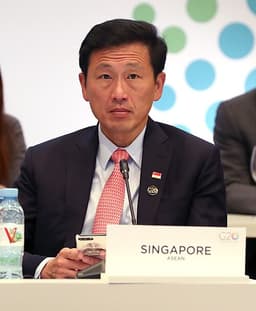
Ong Ye Kung
Politician · Modern
47.3Total

Rafael Correa
Politician · Modern
49.8Total
Basic Information
Born
1969
1963
Died
—
—
Era
Modern
Modern
Nationality
Singapore
Ecuador
Occupation
Politician
Politician
Civilization
Eastern
Western
Score Comparison
Military (10%)
13.9
10.0
Political (20%)
53.8
55.0
Influence (20%)
49.4
58.0
Legacy (20%)
39.2
45.8
Leadership (15%)
79.8
72.0
Strategy (15%)
36.8
38.3
TOTAL
47.3
49.8
Ong Ye Kung — Complete Timeline
2011 AD
Elected to Parliament for Sembawang GRCPolitical Action
Ong Ye Kung was first elected to Parliament as a Member of Parliament for Sembawang GRC. This marked the start of his political career in the People's Action Party.
ElectionParliamentPAP
constructive
2015 AD
Appointed Minister for EducationPolitical Action◆ Major
Ong Ye Kung was appointed Minister for Education (Higher Education and Skills), overseeing the university and polytechnic sectors. He promoted lifelong learning and skills upgrading.
EducationHigher EducationSkills
Impact: nationalconstructive
2018 AD
Appointed Minister for TransportPolitical Action◆ Major
Ong was appointed Minister for Transport, overseeing Singapore's transport infrastructure. He oversaw the expansion of the MRT network and the implementation of the 'Walk Cycle Ride' vision.
TransportInfrastructureSingapore
Impact: nationalconstructive
2021 AD
Appointed Minister for HealthPolitical Action◆ Major
Ong Ye Kung was appointed Minister for Health, overseeing Singapore's healthcare system. He managed the later stages of the COVID-19 pandemic, including the transition to endemic living and healthcare reforms.
HealthCOVID-19Healthcare
Impact: nationalconstructive
Rafael Correa — Complete Timeline
2007 AD
Election and Citizen Revolution (2007)Political Action◆ Major
Rafael Correa assumed the presidency of Ecuador, launching the 'Citizen Revolution.' His administration convened a Constituent Assembly to draft a new constitution, which was approved by referendum in 2008. The new constitution expanded social rights, strengthened state control over natural resources, and allowed for presidential re-election.
New ConstitutionCitizen RevolutionSocialism
Impact: nationalconstructive
2008 AD
Debt Default and Restructuring (2008-2009)Political Action◆ Major
Correa defaulted on $3.2 billion in foreign debt, declaring it 'illegitimate' and 'illegal' due to corruption in its issuance. His administration subsequently bought back the defaulted bonds at a steep discount, reducing Ecuador's debt burden. This move was praised by some but criticized by international creditors.
Debt DefaultSovereign DebtEconomic Policy
Impact: globalconstructive
2012 AD
Assange Asylum and WikiLeaks (2012-2019)Political Action◆ Major
Correa granted political asylum to Julian Assange in the Ecuadorian Embassy in London, where Assange had taken refuge to avoid extradition to Sweden. This decision strained relations with the UK and US, and made Ecuador a central player in the global debate over press freedom and diplomatic immunity.
Julian AssangeDiplomatic AsylumWikiLeaks
Impact: global
Expert Analysis
Origins
**Ong Ye Kung** was born in 1969 in Singapore. He attended the University of Cambridge, earning a degree in economics, and later obtained a master's in public administration from the Harvard Kennedy School. His early career was in the civil service and private sector, including stints at the Ministry of Defence and the Economic Development Board. He also served as chief executive of the Singapore Workforce Development Agency. His rise was nurtured within the People's Action Party (PAP), the dominant political party in Singapore.
**Rafael Correa** was born in 1963 in Guayaquil, Ecuador, into a lower-middle-class family. He earned a master's in economics from the Catholic University of Leuven and a PhD from the University of Illinois at Urbana-Champaign. His academic background focused on development economics. Before entering politics, he served as Ecuador's Minister of Finance in 2005 for a brief period, implementing reforms that clashed with the existing political establishment. His upbringing and education shaped his leftist populist ideology.
Rise to Power
**Ong Ye Kung** entered electoral politics in 2015, winning a seat in Parliament for Sembawang GRC. He quickly rose through the ranks, appointed Minister for Education (Higher Education and Skills) in 2016, Minister for Transport in 2020, and Minister for Health in 2021. His rise was steady, backed by the PAP's structured succession planning. Key allies included Prime Minister Lee Hsien Loong and former PM Lee Kuan Yew, under whom he served as a private secretary. His rise lacked dramatic turning points, reflecting Singapore's stable political environment.
**Rafael Correa** rose to prominence as a fiery critic of the political establishment. After a brief stint as finance minister in 2005, he ran for president in 2006 as a populist outsider. He won the runoff election with 56.7% of the vote. His rise was fueled by dissatisfaction with traditional parties and economic inequality. He convened a Constituent Assembly in 2007 that drafted a new constitution, consolidating his power. His allies included social movements and leftist intellectuals; his opponents were the traditional elite and media.
Leadership & Governance
**Ong Ye Kung** exemplifies the Singaporean technocratic style: pragmatic, data-driven, and focused on efficiency. As Health Minister, he managed the later stages of COVID-19, emphasizing vaccination campaigns and calibrated restrictions. He scored 79.8 in leadership, reflecting his competence in crisis management. His governance approach is consensus-based within the PAP, with limited public dissent. He promotes lifelong learning and skills development, aligning with Singapore's human capital strategy. However, his political score (53.8) and influence (49.4) are moderate, as he operates within a collective leadership.
**Rafael Correa** led with a populist, confrontational style. He centralized power, using executive decrees and referendums to bypass the legislature. His Citizen Revolution reduced poverty from 37.6% to 22.5% and increased public spending on health and education. He defaulted on $3.2 billion in foreign debt in 2008, characterizing it as illegitimate. His leadership score (72.0) reflects strong control and charisma, but his strategy score (38.3) indicates less structured planning. His governance was marked by polarization, with critics accusing him of authoritarianism.
Triumph & Tragedy
**Ong Ye Kung's** greatest success is managing Singapore's COVID-19 response in 2021-2022, achieving high vaccination rates and low mortality. He oversaw the expansion of the MRT network as Transport Minister. However, his failures are limited due to his role within a system; a notable challenge was the temporary closure of borders during COVID, which disrupted travel and trade. His overall legacy score (39.2) is modest, as he is still early in his career.
**Rafael Correa's** triumphs include reducing poverty, implementing social programs, and restructuring debt. His granting of asylum to Julian Assange in 2012 raised his international profile. His tragedies include growing authoritarianism, suppression of press freedom, and a corruption conviction in 2020 that forced him to flee the country. His economic policies, while initially successful, led to a recession after his term. His influence score (58.0) is higher than Ong's, but his legacy (45.8) is tarnished by legal issues.
Character & Destiny
**Ong Ye Kung** is cautious, disciplined, and loyal. His decision-making is analytical, avoiding risks. This has kept him within the PAP's hierarchy, preventing personal scandals. His destiny is likely continued advancement within Singapore's system, possibly as a future prime minister candidate. His character aligns with Singapore's meritocratic ethos.
**Rafael Correa** is charismatic, combative, and ideological. He thrived on confrontation and used it to consolidate power. His character led to both his popularity and his downfall: his defiance of international financial institutions won him support, but his intolerance for opposition alienated many. His fate—conviction and exile—was shaped by his unwillingness to compromise.
Legacy
**Ong Ye Kung's** legacy is tied to Singapore's effective COVID-19 response and transport improvements. He has contributed to the PAP's long-term governance stability. However, his individual impact is limited by the collective nature of Singapore's leadership. He scores 39.2 in legacy, reflecting his ongoing career.
**Rafael Correa's** legacy is more transformative. He reshaped Ecuador's political landscape, embedding leftist policies and a new constitution. His debt default set a precedent for other nations. However, his authoritarian tendencies and corruption conviction undermine his achievements. His influence score (58.0) is higher, but his legacy is contested.
Conclusion
Rafael Correa had greater impact than Ong Ye Kung. Correa's total score of 49.8 versus Ong's 47.3 reflects his higher influence and political marks. Correa fundamentally altered Ecuador's political and economic direction, with effects still felt today. Ong operates within a stable system where individual impact is muted. While Ong's leadership score (79.8) is higher, Correa's broader influence and transformative actions give him the edge. The data supports Correa as the more consequential figure.
Rankings
🥇
Rafael CorreaLeader
Mil: 10.0Pol: 55.0Inf: 58.0
49.8
🥈
Ong Ye Kung
Mil: 13.9Pol: 53.8Inf: 49.4
47.3
+2.5 behind
How This Comparison Works
Algorithm
Each figure is scored on 6 dimensions (0—100 scale) based on structured historical data: Military (10%), Political (20%), Influence (20%), Legacy (20%), Leadership (15%), Strategy (15%). The weighted total produces the final ranking.
Data Sources
Scores are computed from structured sub-indicators in the database. Scale factors adjust for era (Ancient ×0.85, Modern ×1.0) and civilization size (Eastern ×1.05, Other ×0.80) to account for differences in population and military scale.
Maximum 3 Figures
Comparisons are limited to 2—3 figures to ensure readability and statistical meaningfulness.
Error Margins
±5 points per dimension — Sub-scores are derived from historical records with inherent uncertainty. Two figures within 5 points on a dimension should be considered roughly equivalent in that area.
Total Score Accuracy
±3 points overall — The weighted combination of 6 dimensions produces a total score with approximately ±3 points of uncertainty. Differences of less than 3 points are not statistically significant— the figures are effectively tied.
Known Limitations
- Historical records are incomplete and uneven across civilizations
- Figures from oral-tradition societies may be underrepresented
- Occupation labels can misclassify multi-role figures
- Scores measure capability and impact, not moral character
- Quantitative scoring is a comparison tool, not absolute truth
Capability Radar
Military (10%) — Battles & Warfare
Battles
16
0
Win Rate
15
0
Expansion
20
0
Political (20%) — Governance & Reform
Reform
60
75
Diplomacy
55
60
Economy
60
65
Influence (20%) — Cultural & Global Reach
Cultural
20
50
Global
15
40
Legacy (20%) — Historical Impact
Historical
20
45
Longevity
15
30
Leadership (15%) — Power & Stability
Tenure
65
70
Stability
65
55
Strategy (15%) — Tactics & Innovation
Strategy
23
0
Tactics
24
0
Reform
28
10
Similar Comparisons
Comments & Discussion
No comments yet. Be the first to share your thoughts!