Loading...
Lucius Quietus vs Vercingetorix
Vercingetorix leads by 5.4 pts · 2 figures compared
…

Lucius Quietus
General · Ancient
44.7Total
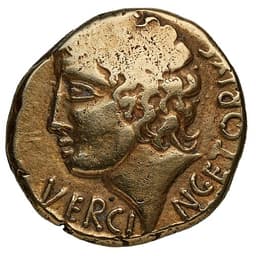
Vercingetorix
General · Ancient
50.1Total
Basic Information
Born
70
-82
Died
118
-46
Era
Ancient
Ancient
Nationality
Roman Empire
Gaul
Occupation
General
General
Civilization
Western
Western
Score Comparison
Military (10%)
67.3
60.0
Political (20%)
30.7
29.3
Influence (20%)
48.6
59.0
Legacy (20%)
40.8
54.0
Leadership (15%)
36.9
35.4
Strategy (15%)
55.0
61.3
TOTAL
44.7
50.1
Lucius Quietus — Complete Timeline
101 AD
Command of Moorish Cavalry in Trajan's Dacian WarsWar
Lucius Quietus led a contingent of Moorish cavalry from North Africa in Emperor Trajan's campaigns against Dacia. His skilled horsemen played a key role in several battles, earning him a reputation as a formidable commander and imperial favor.
Dacian WarsMoorish CavalryTrajan
Impact: regional
115 AD
Suppression of the Jewish Diaspora Revolt in MesopotamiaWar◆ Major
During Trajan's Parthian campaign, Quietus was tasked with crushing the Jewish revolt that erupted in Mesopotamia. He conducted brutal reprisals, destroying rebel strongholds and executing thousands, temporarily restoring Roman authority in the region.
Jewish RevoltMesopotamiaRepression
Impact: regionaldestructive
117 AD
Appointment as Governor of JudaeaPolitical Action
Emperor Trajan appointed Lucius Quietus as governor of Judaea, likely to continue suppressing Jewish unrest. His harsh administration further inflamed tensions, and he was one of the few equestrian governors of the province, reflecting his high status.
JudaeaGovernorshipTrajan
Impact: regional
118 AD
Execution by Emperor HadrianPolitical Action◆ Major
Shortly after Hadrian's accession, Lucius Quietus was executed along with three other senior senators. They were accused of plotting against the new emperor, though the charges may have been pretextual, aimed at removing potential rivals.
Imperial PoliticsExecutionHadrian
Impact: nationaltragic
Vercingetorix — Complete Timeline
52 BC
Gallic revolt against CaesarWar◆ Major
Vercingetorix united the Gallic tribes in a major revolt against Julius Caesar's Roman occupation. He was elected commander-in-chief of the Gallic forces and implemented a scorched-earth strategy to deny supplies to the Roman army, marking the climax of the Gallic Wars.
Gallic WarsRevoltJulius Caesar
Impact: regional
Battle of GergoviaWar◆ Major
Vercingetorix successfully defended the fortified hilltop town of Gergovia against Julius Caesar's Roman legions. Caesar was forced to withdraw after suffering significant losses, marking one of his few tactical defeats in the Gallic Wars and boosting Gallic morale.
Gallic WarsBattleVictory
Impact: regional
Battle of AlesiaWar
Vercingetorix was besieged by Julius Caesar at the oppidum of Alesia. Caesar built extensive fortifications to trap the Gallic army inside and repel a relief force. After a prolonged siege, Vercingetorix surrendered, ending the major Gallic resistance to Roman rule.
Gallic WarsSiegeSurrender
Impact: regionaltragic
Surrender and imprisonmentPolitical Action◆ Major
Vercingetorix surrendered to Julius Caesar at Alesia, reportedly laying down his arms at Caesar's feet. He was taken to Rome as a prisoner and held for six years, awaiting Caesar's triumph. His surrender marked the end of organized Gallic resistance.
Gallic WarsSurrenderImprisonment
Impact: regionaltragic
46 BC
Execution in RomePolitical Action◆ Major
Vercingetorix was executed by strangulation in the Tullianum prison in Rome as part of Julius Caesar's triumph. His death symbolized the final subjugation of Gaul and the consolidation of Roman control over the region.
ExecutionGallic WarsRoman Republic
Impact: regionaltragic
Expert Analysis
Origins
Lucius Quietus, born around 80 AD in Mauretania (modern-day Algeria), was a Berber prince who became a Roman cavalry commander. His family likely held Roman citizenship, and he rose through military service under Emperor Trajan. Vercingetorix, born around 82 BC in Gaul (modern-day France), was a noble of the Arverni tribe. His father, Celtillus, was executed for attempting to rule all Gaul, leaving Vercingetorix with a legacy of ambition and opposition to Roman expansion.
Rise to Power
Quietus rose to prominence leading Moorish cavalry in Trajan's Dacian Wars (101-106 AD). His cavalry's effectiveness earned him command of a mixed unit of Roman auxiliaries and local horsemen. During Trajan's Parthian campaign (115-117 AD), the Jewish Diaspora Revolt erupted in Mesopotamia. Quietus was tasked with its suppression, which he accomplished with extreme brutality, earning him the governorship of Judaea. Vercingetorix unified Gallic tribes in 52 BC through a combination of diplomacy and coercion, leveraging anti-Roman sentiment after Caesar's conquests. He was elected commander-in-chief at a council of tribes, with key allies like the Aedui initially hesitant but eventually joining.
Leadership & Governance
Quietus governed Judaea with a harsh hand, continuing reprisals against Jewish communities. His leadership style was autocratic and militaristic, relying on fear rather than consensus. In contrast, Vercingetorix demonstrated strategic flexibility, employing scorched-earth tactics to deny Caesar supplies. He successfully defended Gergovia against Caesar's legions, forcing a Roman retreat. However, his coalition governance was fragile; at Alesia, the relief force failed to coordinate effectively, leading to disaster. Quietus scored 36.9 in leadership, Vercingetorix 35.4, reflecting their shared difficulties in managing diverse forces.
Triumph & Tragedy
Quietus's greatest success was crushing the Jewish revolt, securing Trajan's eastern frontier. His cavalry tactics were decisive in several engagements, and he was elevated to the Roman Senate. However, his tragedy came after Trajan's death: Emperor Hadrian executed him in 118 AD, likely due to his popularity with the army and potential as a rival. Vercingetorix's triumph was uniting Gaul and defeating Caesar at Gergovia, a rare setback for the Roman general. His tragedy was Alesia: trapped by Caesar's fortifications, he surrendered after the relief force failed, was paraded in Caesar's triumph, and executed in 46 BC. Vercingetorix scored 60.0 in military, Quietus 67.3, but Quietus's victories were more pyrrhic.
Character & Destiny
Quietus was ambitious and ruthless, qualities that served Trajan but threatened Hadrian. His Berber origins made him an outsider in Roman politics, and his execution eliminated a potential usurper. Vercingetorix was charismatic and strategic, but his reliance on tribal unity proved unsustainable against Rome's professional army. His surrender was a calculated act to spare his people, but it sealed his fate. Both men's characters led to their downfalls: Quietus's political naivety, Vercingetorix's overreach.
Legacy
Quietus is remembered as a capable but brutal general, his legacy overshadowed by his execution. He is a footnote in Roman history, with no lasting institutions or ideas attributed to him. Vercingetorix, however, became a symbol of Gallic resistance, revived in 19th-century French nationalism. His statue in Alesia and his place in French schoolbooks make him a national hero. Vercingetorix scores 54.0 in legacy vs Quietus's 40.8, reflecting his enduring cultural impact.
Conclusion
While Quietus achieved more immediate military success (scoring 67.3 vs 60.0), Vercingetorix's influence and legacy are far greater (59.0 vs 48.6 in influence, 54.0 vs 40.8 in legacy). Vercingetorix's failed rebellion shaped Gaul's integration into the Roman Empire and later inspired French identity. Quietus, despite his tactical skill, died a conspirator's death and left no lasting mark. Thus, Vercingetorix had the greater historical impact.
Rankings
🥇
VercingetorixLeader
Mil: 60.0Pol: 29.3Inf: 59.0
50.1
🥈
Lucius Quietus
Mil: 67.3Pol: 30.7Inf: 48.6
44.7
+5.4 behind
How This Comparison Works
Algorithm
Each figure is scored on 6 dimensions (0—100 scale) based on structured historical data: Military (10%), Political (20%), Influence (20%), Legacy (20%), Leadership (15%), Strategy (15%). The weighted total produces the final ranking.
Data Sources
Scores are computed from structured sub-indicators in the database. Scale factors adjust for era (Ancient ×0.85, Modern ×1.0) and civilization size (Eastern ×1.05, Other ×0.80) to account for differences in population and military scale.
Maximum 3 Figures
Comparisons are limited to 2—3 figures to ensure readability and statistical meaningfulness.
Error Margins
±5 points per dimension — Sub-scores are derived from historical records with inherent uncertainty. Two figures within 5 points on a dimension should be considered roughly equivalent in that area.
Total Score Accuracy
±3 points overall — The weighted combination of 6 dimensions produces a total score with approximately ±3 points of uncertainty. Differences of less than 3 points are not statistically significant— the figures are effectively tied.
Known Limitations
- Historical records are incomplete and uneven across civilizations
- Figures from oral-tradition societies may be underrepresented
- Occupation labels can misclassify multi-role figures
- Scores measure capability and impact, not moral character
- Quantitative scoring is a comparison tool, not absolute truth
Capability Radar
Military (10%) — Battles & Warfare
Battles
55
65
Win Rate
60
55
Expansion
50
40
Political (20%) — Governance & Reform
Reform
20
35
Diplomacy
35
60
Economy
25
20
Influence (20%) — Cultural & Global Reach
Cultural
25
55
Global
15
50
Legacy (20%) — Historical Impact
Historical
35
65
Longevity
20
60
Leadership (15%) — Power & Stability
Tenure
40
30
Stability
30
25
Strategy (15%) — Tactics & Innovation
Strategy
60
60
Tactics
65
70
Reform
30
45
Similar Comparisons
Comments & Discussion
No comments yet. Be the first to share your thoughts!