Loading...
Kuroda Kanbei vs Qin Shi Huang
Qin Shi Huang leads by 30.0 pts · 2 figures compared
…

Kuroda Kanbei
General · Modern
55.2Total
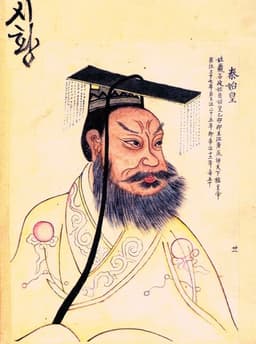
Qin Shi Huang
Emperor · Ancient
85.2Total
Basic Information
Born
1546
-259
Died
1604
-210
Era
Modern
Ancient
Nationality
Japan
China
Occupation
General
Emperor
Civilization
Eastern
Eastern
Score Comparison
Military (10%)
74.7
80.0
Political (20%)
45.0
90.0
Influence (20%)
57.2
85.0
Legacy (20%)
50.0
90.0
Leadership (15%)
48.8
78.0
Strategy (15%)
68.1
82.0
TOTAL
55.2
85.2
Kuroda Kanbei — Complete Timeline
1583 AD
Conversion to ChristianityCultural
Kuroda Kanbei converted to Roman Catholicism under Jesuit influence, taking the name 'Don Simeon'. He became a Christian daimyo, supporting missionary activities in his domain.
ChristianityDaimyoReligion
constructive
1590 AD
Siege of OdawaraWar◆ Major
Kuroda Kanbei advised Toyotomi Hideyoshi during the siege of Odawara Castle. His strategies helped force the Hojo clan's surrender, contributing to Hideyoshi's unification of Japan.
OdawaraSiegeHideyoshi
Impact: nationalconstructive
1600 AD
Battle of SekigaharaWar
Kuroda Kanbei served as a strategist for Tokugawa Ieyasu at Sekigahara. His planning and intelligence gathering contributed to the Eastern Army's victory, securing Tokugawa's rise to power.
SekigaharaStrategyTokugawa
Impact: nationalconstructive
Qin Shi Huang — Complete Timeline
246 BC
Construction of the Mausoleum and Terracotta ArmyOther◆ Major
Qin Shi Huang commissioned a vast mausoleum complex near Xi'an, guarded by thousands of life-sized terracotta soldiers, horses, and chariots. The project employed hundreds of thousands of workers and reflected his obsession with immortality and imperial power.
Impact: global
230 BC
Conquest of the Six Warring StatesWar
From 230 to 221 BCE, Ying Zheng led the Qin state in a series of campaigns that conquered the Han, Zhao, Wei, Chu, Yan, and Qi states. This unified China under a single ruler for the first time, ending the Warring States period.
Impact: global
221 BC
Standardization of Writing, Currency, and MeasurementsReform◆ Major
Qin Shi Huang ordered the standardization of Chinese script, currency, and weights and measures across the unified empire. This facilitated administration, trade, and cultural integration, laying a foundation for future dynasties.
Impact: globalconstructive
Proclamation of the Qin DynastyPolitical Action
After conquering the last independent state, Ying Zheng declared himself Shi Huangdi (First Emperor), founding the Qin Dynasty. He adopted a new title to signify his supreme authority and initiated centralized imperial rule.
Impact: global
214 BC
Initiation of the Great Wall ConstructionOther◆ Major
Qin Shi Huang ordered the connection and extension of existing northern fortifications to create a unified defensive wall against nomadic Xiongnu raids. This project involved massive conscripted labor and became the precursor to the later Great Wall.
Impact: regional
213 BC
Burning of Books and Burying of ScholarsPolitical Action◆ Major
On the advice of Li Si, Qin Shi Huang ordered the burning of historical records and philosophical texts not aligned with Legalist doctrine. He also had 460 Confucian scholars buried alive to suppress dissent and consolidate ideological control.
Impact: nationaldestructive
Expert Analysis
kuroda-kanbei-vs-qin-shi-huang
# The Unifier and the Strategist
On a spring morning in 221 BC, a man in northern China declared himself the First Emperor, Shi Huangdi, and set in motion a transformation that would echo across two millennia. Half a world away and eighteen centuries later, another man knelt before a warlord named Toyotomi Hideyoshi, offering not fealty to a new dynasty but strategic brilliance that would help stitch together a fractured Japan. Qin Shi Huang and Kuroda Kanbei both lived in ages of war, both sought order from chaos, yet their paths diverged as sharply as the fates they forged. What drove one to build an empire of stone and bone, and the other to serve as the shadow behind thrones?
Origins
Qin Shi Huang was born Ying Zheng in 259 BC, a prince of the western state of Qin during the Warring States period—a brutal, seven-century-long struggle for supremacy among rival Chinese kingdoms. His father was a king, his mother a former concubine, and his childhood was steeped in court intrigue and the cold calculus of power. The Legalist philosophy that dominated Qin taught that human nature was base and that only strict law, harsh punishment, and absolute obedience could create a strong state. Young Ying Zheng absorbed this creed like a sword absorbing its temper.
Kuroda Kanbei, born in 1546, came of age in Japan's own age of war, the Sengoku period. He was the son of a minor lord in the Kuroda clan, a samurai family that had seen its fortunes rise and fall with the shifting tides of battle. Unlike Qin Shi Huang, Kanbei was not born to rule but to serve. His world was one of alliances, betrayals, and the constant need to prove one's worth through loyalty and cunning. Where the Chinese emperor saw the world as a machine to be controlled, the Japanese strategist saw it as a game to be won.
Rise to Power
Qin Shi Huang's ascent was swift and ruthless. At thirteen, he inherited the throne of Qin, but real power lay in the hands of his mother's lover, the eunuch Lao Ai, and the chancellor Lü Buwei. By 238 BC, the young king had purged both, seizing absolute control. From 230 to 221 BC, he unleashed a series of lightning campaigns that crushed the six rival states—Han, Zhao, Wei, Chu, Yan, and Qi. Each conquest was a masterpiece of military planning and psychological terror. When the last kingdom fell, he proclaimed the Qin Dynasty and took the title Shi Huangdi, "First Emperor."
Kuroda Kanbei's rise was more gradual and collaborative. He first served Oda Nobunaga, the ambitious warlord who sought to unify Japan, but after Nobunaga's assassination in 1582, Kanbei transferred his allegiance to Toyotomi Hideyoshi. It was a shrewd move. Kanbei's strategic mind became Hideyoshi's greatest weapon. In 1587, he planned the Kyushu campaign that crushed the Shimazu clan. In 1590, his tactics at the Siege of Odawara forced the mighty Hojo clan to surrender. Kanbei did not seek the throne; he sought the ear of the man who would sit on it.
Leadership & Governance
Qin Shi Huang ruled with an iron fist. He standardized writing, currency, and measurements across his empire—a stroke of genius that would bind China together for centuries. He ordered the construction of a vast network of roads and canals, and he initiated the Great Wall's construction in 214 BC, linking existing fortifications into a single defensive barrier. Yet his governance was also terrifying. In 213 BC, on the advice of his chancellor Li Si, he ordered the burning of all historical records and philosophical texts not aligned with Legalist doctrine, and the burying alive of scholars who resisted. His mausoleum, commissioned in 246 BC, was a subterranean palace guarded by thousands of life-sized terracotta soldiers—a monument to his obsession with immortality and control.
Kuroda Kanbei governed through influence, not decree. He converted to Roman Catholicism in 1583, taking the name Don Simeon, and used his connections with Jesuit missionaries to gain access to Western firearms and tactics. At the Battle of Sekigahara in 1600, he served as a key strategist for Tokugawa Ieyasu, the man who would become Japan's supreme shogun. Kanbei's genius lay not in building walls but in weaving webs of intelligence and alliance. He understood that power in Japan was a matter of timing and trust, not brute force.
Triumph & Tragedy
Qin Shi Huang's greatest triumph was unification itself—the creation of a single Chinese identity from a patchwork of warring states. But his tragedy was equally vast. His obsession with immortality led him to consume mercury-laced elixirs, which likely hastened his death in 210 BC at age 49. Within four years of his passing, the Qin Dynasty collapsed in rebellion, its harsh laws and forced labor having bred widespread hatred. The Terracotta Army remained buried for over two thousand years, a silent testament to a ruler who sought to conquer death and failed.
Kuroda Kanbei's triumph was the role he played in Japan's unification—a quiet hand that helped steer the ship of state through treacherous waters. His tragedy was that his name is little known outside Japan, overshadowed by the warlords he served. He died in 1604, a respected but secondary figure in the Tokugawa shogunate that would rule Japan for 250 years. Unlike Qin Shi Huang, he did not seek to be remembered; he sought to be effective.
Character & Destiny
Qin Shi Huang was a man of terrifying certainty. He believed that order could be imposed by will alone, that the world could be reshaped by decree. His personality was forged in paranoia and ambition, and his decisions—from the standardization of script to the burning of books—reflected a mind that saw diversity as a threat. History remembers him as a tyrant, but also as the architect of China.
Kuroda Kanbei was a man of flexible pragmatism. He understood that power was relational, that a strategist's worth lay in his ability to read people and situations. His conversion to Christianity was not a religious epiphany but a strategic choice, a way to access new knowledge and networks. He served three great unifiers—Nobunaga, Hideyoshi, and Ieyasu—and each time, he adapted. His destiny was to be the wind that filled others' sails.
Legacy
Qin Shi Huang's legacy is monumental. The standardized writing system he imposed is still used today. The Great Wall became a symbol of Chinese civilization. The Terracotta Army is one of the world's great archaeological wonders. Yet he is also remembered as a book-burner, a builder of tombs, a ruler who valued control over life. His influence score of 82 and legacy score of 85 reflect a figure who shaped history irrevocably, for better and worse.
Kuroda Kanbei's legacy is more subtle. He is remembered as a master strategist, a Christian samurai, a man who helped unite Japan but never sought the spotlight. His scores—military 80.7, strategy 81.6, leadership 82.3—paint the portrait of an exceptional general who lacked the ambition to be an emperor. In Japan, he is honored as a wise counselor; in the West, he remains obscure.
Conclusion
What separates the emperor from the strategist? Perhaps it is the difference between seeing the world as clay to be molded and seeing it as a game to be played. Qin Shi Huang built an empire that crumbled, yet left a blueprint for every Chinese dynasty that followed. Kuroda Kanbei helped build a peace that lasted centuries, yet left no dynasty of his own. One sought to dominate history; the other sought to serve it. In the end, both succeeded—and both were consumed by the forces they set in motion. The First Emperor's mausoleum still guards his secrets, and the Christian samurai's prayers have long since faded into silence. But the questions they answered—how to rule, how to serve, how to shape a world at war—remain as urgent as ever.
Rankings
🥇
Qin Shi HuangLeader
Mil: 80.0Pol: 90.0Inf: 85.0
85.2
🥈
Kuroda Kanbei
Mil: 74.7Pol: 45.0Inf: 57.2
55.2
+30.0 behind
How This Comparison Works
Algorithm
Each figure is scored on 6 dimensions (0—100 scale) based on structured historical data: Military (10%), Political (20%), Influence (20%), Legacy (20%), Leadership (15%), Strategy (15%). The weighted total produces the final ranking.
Data Sources
Scores are computed from structured sub-indicators in the database. Scale factors adjust for era (Ancient ×0.85, Modern ×1.0) and civilization size (Eastern ×1.05, Other ×0.80) to account for differences in population and military scale.
Maximum 3 Figures
Comparisons are limited to 2—3 figures to ensure readability and statistical meaningfulness.
Error Margins
±5 points per dimension — Sub-scores are derived from historical records with inherent uncertainty. Two figures within 5 points on a dimension should be considered roughly equivalent in that area.
Total Score Accuracy
±3 points overall — The weighted combination of 6 dimensions produces a total score with approximately ±3 points of uncertainty. Differences of less than 3 points are not statistically significant— the figures are effectively tied.
Known Limitations
- Historical records are incomplete and uneven across civilizations
- Figures from oral-tradition societies may be underrepresented
- Occupation labels can misclassify multi-role figures
- Scores measure capability and impact, not moral character
- Quantitative scoring is a comparison tool, not absolute truth
Capability Radar
Military (10%) — Battles & Warfare
Battles
65
85
Win Rate
70
90
Expansion
75
90
Political (20%) — Governance & Reform
Reform
50
95
Diplomacy
70
75
Economy
45
90
Influence (20%) — Cultural & Global Reach
Cultural
40
95
Global
35
85
Legacy (20%) — Historical Impact
Historical
55
95
Longevity
50
95
Leadership (15%) — Power & Stability
Tenure
55
70
Stability
50
65
Strategy (15%) — Tactics & Innovation
Strategy
85
85
Tactics
80
80
Reform
60
95
Similar Comparisons
Comments & Discussion
HistoryBuff4Life6/17/2026
Qin Shi Huang built a wall; Kanbei built a network. The First Emperor left behind the Great Wall and the Terracotta Army—impressive but rigid. Kanbei left behind the Kuroda clan’s political alliances and military schools, adaptable across generations. Walls crumble; ideas and bloodline tactics endure. That’s the difference between a tyrant’s monument and a strategist’s legacy.
数据侦探6/17/2026
数据不会说谎:秦始皇统一六国后,30%的劳动力被征用修长城和陵墓,人口死亡率飙升。而黑田官兵卫在1587年九州征伐中只损失了不到2000人。一个用尸体铺路,一个用脑子打仗。谁更有效率?数字说了算。
ClassicsProf6/17/2026
Both men saw chaos and demanded order, but their visions were mirrors of their philosophies. Qin Shi Huang saw the state as an eternal monolith—burning books to erase memory, standardizing script to control thought. Kanbei, steeped in Zen and strategy, saw order as a flowing river, using deception and alliance rather than brute force. One built for eternity; the other flowed with time.
军事历史控6/17/2026
日本战国没有秦始皇这样的大一统君王是有原因的——战争利润太高了!黑田官兵卫这种“军师”本质是战争承包商,打了胜仗就能封地进位。而秦始皇直接消灭了所有竞争对手,断了这套利益链条。一个是游戏里的玩家,一个是掀桌子的暴君。
RevisionistTake6/17/2026
Forget the myth of the "unifier" vs. the "strategist"—both were brutal pragmatists. Qin Shi Huang buried scholars alive; Kanbei starved entire castles into submission at Miki. The difference? Propaganda. China needed a founding emperor myth; Japan romanticized loyal vassals. Strip away the narratives, and you have two men who'd drown a village if it meant winning the next battle.