Loading...
King Sejong the Great vs Mindaugas
King Sejong the Great leads by 29.5 pts · 2 figures compared
…

King Sejong the Great
Emperor · Medieval
74.9Total
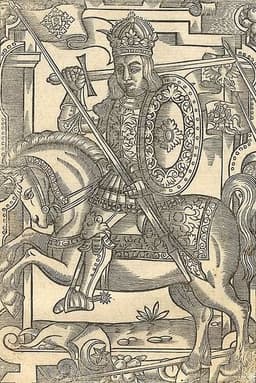
Mindaugas
Emperor · Medieval
45.4Total
Basic Information
Born
1397
1203
Died
1450
1263
Era
Medieval
Medieval
Nationality
Korea
Lithuania
Occupation
Emperor
Emperor
Civilization
Eastern
Western
Score Comparison
Military (10%)
55.0
20.0
Political (20%)
78.0
43.7
Influence (20%)
85.0
54.1
Legacy (20%)
75.0
48.3
Leadership (15%)
78.0
51.9
Strategy (15%)
60.0
35.0
TOTAL
74.9
45.4
King Sejong the Great — Complete Timeline
1441 AD
Development of the Cheugugi (Rain Gauge)Invention◆ Major
Sejong's court invented the cheugugi, the world's first standardized rain gauge, to improve agricultural planning and tax assessment. This scientific instrument was distributed across the kingdom, enabling systematic weather data collection and enhancing state capacity to manage crop yields.
Scientific InstrumentAgricultureInnovation
Impact: nationalconstructive
1443 AD
Creation of Hangul (Hunminjeongeum)Invention
King Sejong oversaw the creation of Hangul, the Korean alphabet, promulgated in 1446 as the Hunminjeongeum. The script was designed to be easily learned by commoners, dramatically increasing literacy rates and fostering a distinct Korean cultural identity, separate from Chinese characters.
AlphabetLiteracyCultural Identity
Impact: nationalconstructive
1446 AD
Promulgation of the Gyeongguk Daejeon (National Code)Reform◆ Major
Sejong initiated the compilation of the Gyeongguk Daejeon, a comprehensive legal code that systematized Joseon's government and laws. Although completed after his death, it became the foundational legal document of the dynasty, centralizing royal authority and standardizing administration.
Legal ReformGovernanceJoseon Dynasty
Impact: nationalconstructive
Mindaugas — Complete Timeline
1240 AD
Unification of Lithuanian TribesPolitical Action◆ Major
Mindaugas unified the Lithuanian tribes under his rule, overcoming rival chieftains. This consolidation laid the foundation for the Grand Duchy of Lithuania.
UnificationLithuania
Impact: regionalconstructive
1251 AD
Conversion to ChristianityCultural◆ Major
Mindaugas converted to Roman Catholicism to gain papal support against the Teutonic Knights and internal rivals. This conversion was politically motivated and did not lead to widespread Christianization of Lithuania.
ConversionReligion
Impact: regional
1253 AD
Coronation as King of LithuaniaPolitical Action
Mindaugas was crowned King of Lithuania, the first and only king in Lithuanian history. The coronation was recognized by Pope Innocent IV, legitimizing Lithuania as a Christian kingdom.
CoronationLithuania
Impact: regionalconstructive
1263 AD
AssassinationPolitical Action◆ Major
Mindaugas was assassinated by his nephew Treniota and Duke Daumantas. His death ended the Kingdom of Lithuania and plunged the state into civil war, reversing the Christianization process.
AssassinationCivil War
Impact: regionaltragic
Expert Analysis
Origins
King Sejong the Great (1397–1450) was born as the third son of King Taejong of the Joseon Dynasty. His mother, Queen Wongyeong, came from a powerful noble family. Sejong received a rigorous Confucian education, excelling in literature and philosophy from a young age. His early exposure to statecraft under his father's strict rule shaped his meticulous governance style.
Mindaugas (c. 1203–1263) emerged from the pagan Lithuanian tribal aristocracy. Little is known of his early life, but he likely rose as a local chieftain in the early 13th century. Lithuania was a fragmented land of warring tribes, threatened by the Teutonic Knights and the Livonian Order. Mindaugas's formative years were spent consolidating power through alliances and warfare.
Rise to Power
Sejong ascended the throne in 1418 at age 21, following the abdication of his father Taejong. Despite being the third son, his intellectual prowess and political acumen convinced Taejong to bypass his older brothers. Sejong immediately faced challenges from powerful Confucian scholars and the royal court, but he skillfully balanced factions. His early reign focused on stabilizing the economy and reforming the legal system.
Mindaugas rose to prominence by eliminating rivals. By the 1230s, he had united several Lithuanian tribes under his rule. In 1236, he defeated the Livonian Order at the Battle of Saule, a turning point that weakened the crusaders. To secure his position, he converted to Christianity in 1251 and was crowned King of Lithuania in 1253 by Pope Innocent IV. This diplomatic move gained papal protection against the Teutonic Knights.
Leadership & Governance
Sejong's leadership was characterized by intellectual innovation and bureaucratic centralization. He personally oversaw the creation of Hangul, the Korean alphabet, in 1443, promulgating it in 1446 as the Hunminjeongeum. This script, with 28 letters, was designed to promote literacy among commoners. He also initiated the compilation of the Gyeongguk Daejeon, a comprehensive legal code completed after his death. Sejong advanced science by ordering the development of the cheugugi (rain gauge) in 1442, the world's first standardized rain gauge, to improve agriculture. His political score of 78.0 reflects his effective governance.
Mindaugas's leadership was pragmatic and opportunistic. He converted to Christianity for political gain, but his rule remained authoritarian and tribal. He attempted to centralize power but relied on personal alliances rather than institutions. His military score of 20.0 indicates limited strategic success; his unification was fragile. He failed to create a lasting administrative system, leading to chaos after his death.
Triumph & Tragedy
Sejong's greatest triumph was the creation of Hangul, which revolutionized Korean literacy and culture. His scientific achievements, such as the rain gauge and astronomical instruments, boosted agricultural productivity. However, his reign saw the costly invasions of the Tsushima Island (1419) and the northern frontier, with limited territorial gains. His military score of 55.0 reflects mixed results. The Gyeongguk Daejeon, while comprehensive, was not fully implemented during his lifetime.
Mindaugas's triumph was unifying Lithuanian tribes and gaining papal recognition, establishing a short-lived kingdom. His conversion temporarily shielded Lithuania from crusader attacks. However, his tragedy was assassination in 1263 by his nephew Treniota and Duke Daumantas, following a revolt by pagan nobles. His death ended the kingdom, plunging Lithuania into civil war. His total score of 45.4 reflects his limited lasting impact.
Character & Destiny
Sejong was a scholar-king, deeply committed to Confucian ideals and the welfare of his people. His decision to create Hangul stemmed from empathy for the illiterate masses. He was methodical and patient, often overruling conservative scholars. His character fostered cultural flourishing but also led to overextension in military campaigns.
Mindaugas was a pragmatic and ruthless leader, willing to abandon paganism for political survival. His conversion alienated many pagan nobles, leading to his downfall. He lacked the vision to build institutions, relying on personal power. His destiny was cut short by betrayal, a common fate for medieval rulers who failed to consolidate legitimacy.
Legacy
Sejong's legacy is immense: Hangul is the foundation of Korean identity, used by 77 million people. His scientific instruments and legal code shaped Joseon for centuries. He is revered as one of Korea's greatest monarchs, with a total score of 74.9. His influence score of 85.0 reflects his enduring cultural impact.
Mindaugas's legacy is more ambiguous. He is remembered as the first and only king of Lithuania, a symbol of early statehood. However, his kingdom collapsed, and his conversion was reversed. He scored 48.3 in legacy. His unification paved the way for the Grand Duchy of Lithuania, but his immediate impact was limited.
Conclusion
King Sejong the Great had a far greater impact than Mindaugas. Sejong's creation of Hangul and scientific advancements transformed Korean society and continue to influence the world. Mindaugas's unification of Lithuania was significant but short-lived, and his failure to establish lasting institutions undermined his achievements. With a total score of 74.9 versus 45.4, Sejong's legacy is more profound and enduring. Sejong stands as a model of enlightened governance, while Mindaugas remains a transitional figure in Lithuanian history.
Rankings
🥇
King Sejong the GreatLeader
Mil: 55.0Pol: 78.0Inf: 85.0
74.9
🥈
Mindaugas
Mil: 20.0Pol: 43.7Inf: 54.1
45.4
+29.5 behind
How This Comparison Works
Algorithm
Each figure is scored on 6 dimensions (0—100 scale) based on structured historical data: Military (10%), Political (20%), Influence (20%), Legacy (20%), Leadership (15%), Strategy (15%). The weighted total produces the final ranking.
Data Sources
Scores are computed from structured sub-indicators in the database. Scale factors adjust for era (Ancient ×0.85, Modern ×1.0) and civilization size (Eastern ×1.05, Other ×0.80) to account for differences in population and military scale.
Maximum 3 Figures
Comparisons are limited to 2—3 figures to ensure readability and statistical meaningfulness.
Error Margins
±5 points per dimension — Sub-scores are derived from historical records with inherent uncertainty. Two figures within 5 points on a dimension should be considered roughly equivalent in that area.
Total Score Accuracy
±3 points overall — The weighted combination of 6 dimensions produces a total score with approximately ±3 points of uncertainty. Differences of less than 3 points are not statistically significant— the figures are effectively tied.
Known Limitations
- Historical records are incomplete and uneven across civilizations
- Figures from oral-tradition societies may be underrepresented
- Occupation labels can misclassify multi-role figures
- Scores measure capability and impact, not moral character
- Quantitative scoring is a comparison tool, not absolute truth
Capability Radar
Military (10%) — Battles & Warfare
Battles
30
35
Win Rate
40
40
Expansion
20
50
Political (20%) — Governance & Reform
Reform
90
35
Diplomacy
70
55
Economy
85
30
Influence (20%) — Cultural & Global Reach
Cultural
95
45
Global
85
20
Legacy (20%) — Historical Impact
Historical
90
50
Longevity
95
40
Leadership (15%) — Power & Stability
Tenure
80
40
Stability
85
25
Strategy (15%) — Tactics & Innovation
Strategy
40
45
Tactics
35
30
Reform
50
25
Similar Comparisons
Comments & Discussion
No comments yet. Be the first to share your thoughts!