Loading...
Mindaugas vs Napoleon Bonaparte
Napoleon Bonaparte leads by 25.5 pts · 2 figures compared
…
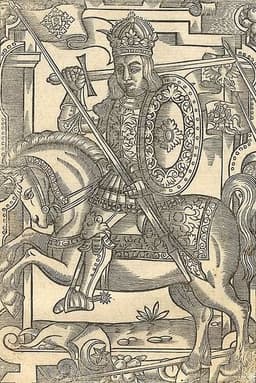
Mindaugas
Emperor · Medieval
45.4Total

Napoleon Bonaparte
General · Modern
70.9Total
Basic Information
Born
1203
1769
Died
1263
1821
Era
Medieval
Modern
Nationality
Lithuania
France
Occupation
Emperor
General
Civilization
Western
Western
Score Comparison
Military (10%)
20.0
94.0
Political (20%)
43.7
72.0
Influence (20%)
54.1
40.0
Legacy (20%)
48.3
80.0
Leadership (15%)
51.9
78.0
Strategy (15%)
35.0
90.0
TOTAL
45.4
70.9
Mindaugas — Complete Timeline
1240 AD
Unification of Lithuanian TribesPolitical Action◆ Major
Mindaugas unified the Lithuanian tribes under his rule, overcoming rival chieftains. This consolidation laid the foundation for the Grand Duchy of Lithuania.
UnificationLithuania
Impact: regionalconstructive
1251 AD
Conversion to ChristianityCultural◆ Major
Mindaugas converted to Roman Catholicism to gain papal support against the Teutonic Knights and internal rivals. This conversion was politically motivated and did not lead to widespread Christianization of Lithuania.
ConversionReligion
Impact: regional
1253 AD
Coronation as King of LithuaniaPolitical Action
Mindaugas was crowned King of Lithuania, the first and only king in Lithuanian history. The coronation was recognized by Pope Innocent IV, legitimizing Lithuania as a Christian kingdom.
CoronationLithuania
Impact: regionalconstructive
1263 AD
AssassinationPolitical Action◆ Major
Mindaugas was assassinated by his nephew Treniota and Duke Daumantas. His death ended the Kingdom of Lithuania and plunged the state into civil war, reversing the Christianization process.
AssassinationCivil War
Impact: regionaltragic
Napoleon Bonaparte — Complete Timeline
1799 AD
Coup of 18 BrumaireOther◆ Major
Napoleon Bonaparte, with support from his brother Lucien and key political figures, overthrew the Directory in a bloodless coup. He established the Consulate with himself as First Consul, effectively becoming the ruler of France. This event ended the French Revolution's most unstable period.
French RevolutionCoupRise to Power
Impact: regional
1804 AD
Promulgation of the Napoleonic CodeOther◆ Major
Napoleon enacted the Civil Code of the French, known as the Napoleonic Code, a comprehensive set of laws that replaced the fragmented feudal legal systems. The code established legal equality, protected property rights, and secularized law. It became the basis for legal systems in many European and world countries.
Legal ReformNapoleonic CodeCivil Law
Impact: globalconstructive
1805 AD
Battle of AusterlitzWar◆ Major
Napoleon's Grande Arm
Napoleonic WarsBattleDecisive Victory
Impact: global
1812 AD
Invasion of RussiaWar◆ Major
Napoleon led the Grande Arm
Napoleonic WarsInvasionDisaster
Impact: globaldestructive
1815 AD
Battle of WaterlooWar◆ Major
Napoleon's French army was defeated by the combined forces of the Duke of Wellington's Anglo-Allied army and Gebhard Leberecht von Bl
Napoleonic WarsBattleFinal Defeat
Impact: globaldestructive
Expert Analysis
mindaugas-vs-napoleon-bonaparte
# The Emperor and the King: Two Paths to Power in the Crucible of History
On a June morning in 1815, Napoleon Bonaparte watched his empire crumble in the muddy fields of Waterloo. Nearly six centuries earlier, in the forests of Lithuania, a different kind of ruler met his end—Mindaugas, the first and only king of his people, was struck down by his own kin. One died in exile, the other by an assassin’s blade. Both had risen from chaos, but their fates reveal how the same ambition can lead to radically different ends when played out on different stages.
Origins
Napoleon was born in 1769 on the Mediterranean island of Corsica, a place that had only recently become French. His family was minor nobility, but his world was one of Enlightenment ideas, revolutionary ferment, and the crumbling of old orders. He attended military school in mainland France, absorbing the mathematics and artillery tactics that would later reshape warfare. His era was one of opportunity—the French Revolution had torn down the aristocracy, and talent, not birth, now opened doors.
Mindaugas emerged in a very different world. Born around 1203 in the pagan forests of Lithuania, he inherited a land of warring tribes, surrounded by the Teutonic Knights and the Livonian Order—Christian crusaders who saw his people as heathens to be conquered. There were no universities, no Enlightenment salons, only the iron logic of survival. Where Napoleon was shaped by books and revolutions, Mindaugas was forged by blood feuds and the constant threat of annihilation.
Rise to Power
Napoleon’s ascent was meteoric. By 1796, at just 26, he commanded the French army in Italy, winning victories that stunned Europe. His 1799 coup made him First Consul, and by 1804 he crowned himself Emperor. Each step was calculated, each victory a stepping stone. He understood that in revolutionary France, a general who delivered glory could become a king.
Mindaugas rose differently. In 1240, he unified the Lithuanian tribes by force and diplomacy, overcoming rival chieftains who had ruled for generations. His power was not won on distant battlefields but in the dense forests and marshlands of his homeland. He could not simply conquer—he had to negotiate, marry, and sometimes murder his way to supremacy. The turning point came in 1251, when he converted to Roman Catholicism, a move that was less about faith than strategy. By accepting baptism, he gained papal recognition and a crown.
Leadership & Governance
As emperor, Napoleon was a whirlwind of reform. His Napoleonic Code standardized French law, abolished feudal privileges, and established merit-based advancement. He built roads, founded banks, and centralized education. On the battlefield, his military genius was unmatched—he could read terrain like a poem, moving armies with a speed that left enemies reeling. His score of 94 in military and 93 in strategy reflects a commander who redefined warfare.
Mindaugas ruled with a different hand. His political score of 72 and leadership of 76.9 suggest a shrewd operator, but his military score of 52.2 reveals a leader who relied more on alliances than conquest. He could not march into Prussia; he had to play the Teutonic Knights against the Pope, the pagan tribes against the Christians. His kingdom was a fragile balancing act, held together by personal loyalty and the fear of the cross.
Triumph & Tragedy
Napoleon’s greatest moment came at Austerlitz in 1805, where he crushed the Austrian and Russian armies in a battle that became a textbook of military art. His empire stretched from Spain to Poland. But his tragedy was hubris—the invasion of Russia in 1812, the disastrous retreat, the exile to Elba, and finally Waterloo in 1815. He died in 1821 on Saint Helena, a prisoner of the British, his legacy a mix of glory and ruin.
Mindaugas’ triumph was his coronation in 1253, when he became the first and only king of Lithuania. For a brief moment, his pagan homeland was recognized as a Christian kingdom. But his tragedy came swiftly. In 1263, his nephew Treniota and Duke Daumantas assassinated him, plunging Lithuania back into chaos. His kingdom crumbled, and it would take centuries for Lithuania to reemerge as a major power.
Character & Destiny
Napoleon was driven by an insatiable will. “Impossible is a word to be found only in the dictionary of fools,” he once said. He believed he could bend history to his ambition. His personality—brilliant, ruthless, and endlessly energetic—shaped every decision. But that same will led him to overreach, to believe that even the Russian winter could be conquered.
Mindaugas was more pragmatic, a survivor in a brutal world. He converted to Christianity not out of conviction but necessity, a move that earned him a crown but alienated his pagan subjects. His assassination was not a dramatic battle but a quiet betrayal—the price of ruling a kingdom built on shifting loyalties.
Legacy
Napoleon left a continent transformed. The Napoleonic Code still influences legal systems worldwide. He inspired nationalism, modern warfare, and the idea that one man could reshape the world. His legacy score of 78 reflects a figure who still sparks debate—tyrant or reformer, genius or madman.
Mindaugas left a different legacy. He is remembered as the father of Lithuania, the king who dared to unite his people. His influence score of 72 and legacy of 64.1 are modest, but they represent something profound: the first flicker of a nation that would survive centuries of occupation. Today, he is a symbol of Lithuanian identity, a reminder that even a single king can plant the seed of a people.
Conclusion
Two men, separated by six centuries, each navigating the treacherous waters of power. Napoleon built an empire that shook the world, only to see it crumble. Mindaugas built a kingdom that lasted barely a decade, yet his name endures. Their stories remind us that greatness is not measured only in conquests or reforms, but in the courage to rise from obscurity and the wisdom to know when ambition must yield to survival. In the end, both were prisoners of their time—and of their own choices.
Rankings
🥇
Napoleon BonaparteLeader
Mil: 94.0Pol: 72.0Inf: 40.0
70.9
🥈
Mindaugas
Mil: 20.0Pol: 43.7Inf: 54.1
45.4
+25.5 behind
How This Comparison Works
Algorithm
Each figure is scored on 6 dimensions (0—100 scale) based on structured historical data: Military (10%), Political (20%), Influence (20%), Legacy (20%), Leadership (15%), Strategy (15%). The weighted total produces the final ranking.
Data Sources
Scores are computed from structured sub-indicators in the database. Scale factors adjust for era (Ancient ×0.85, Modern ×1.0) and civilization size (Eastern ×1.05, Other ×0.80) to account for differences in population and military scale.
Maximum 3 Figures
Comparisons are limited to 2—3 figures to ensure readability and statistical meaningfulness.
Error Margins
±5 points per dimension — Sub-scores are derived from historical records with inherent uncertainty. Two figures within 5 points on a dimension should be considered roughly equivalent in that area.
Total Score Accuracy
±3 points overall — The weighted combination of 6 dimensions produces a total score with approximately ±3 points of uncertainty. Differences of less than 3 points are not statistically significant— the figures are effectively tied.
Known Limitations
- Historical records are incomplete and uneven across civilizations
- Figures from oral-tradition societies may be underrepresented
- Occupation labels can misclassify multi-role figures
- Scores measure capability and impact, not moral character
- Quantitative scoring is a comparison tool, not absolute truth
Capability Radar
Military (10%) — Battles & Warfare
Battles
35
95
Win Rate
40
90
Expansion
50
95
Political (20%) — Governance & Reform
Reform
35
95
Diplomacy
55
80
Economy
30
85
Influence (20%) — Cultural & Global Reach
Cultural
45
85
Global
20
90
Legacy (20%) — Historical Impact
Historical
50
95
Longevity
40
90
Leadership (15%) — Power & Stability
Tenure
40
85
Stability
25
70
Strategy (15%) — Tactics & Innovation
Strategy
45
95
Tactics
30
98
Reform
25
92
Similar Comparisons
Comments & Discussion
No comments yet. Be the first to share your thoughts!