Loading...
This comparison has not been analyzed yet.
One-time AI generation (~1 minute). Scores and timeline are already available below.
Julius Maada Bio vs Semyon Budyonny
Semyon Budyonny leads by 2.4 pts · 2 figures compared
…
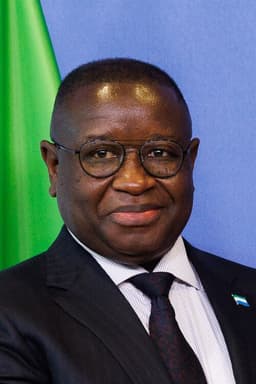
Julius Maada Bio
General · Modern
51.2Total

Semyon Budyonny
General · Modern
53.6Total
Basic Information
Born
1964
1883
Died
—
1973
Era
Modern
Modern
Nationality
Sierra Leone
USSR
Occupation
General
General
Civilization
Other
Western
Score Comparison
Military (10%)
50.0
47.5
Political (20%)
45.0
43.7
Influence (20%)
53.3
58.0
Legacy (20%)
45.0
50.0
Leadership (15%)
70.0
62.0
Strategy (15%)
43.7
60.0
TOTAL
51.2
53.6
Julius Maada Bio — Complete Timeline
1992 AD
1992 Sierra Leonean coup d'étatPolitical Action◆ Major
Julius Maada Bio was a member of the National Provisional Ruling Council (NPRC) that overthrew President Joseph Momoh in a military coup. Bio served as a key figure in the junta, which promised to end the civil war but faced criticism for human rights abuses.
CoupSierra LeoneCivil War
Impact: nationaldestructive
1996 AD
Brief tenure as head of statePolitical Action◆ Major
Bio led a palace coup within the NPRC in January 1996, becoming head of state. He oversaw the transition to civilian rule, handing over power to Ahmad Tejan Kabbah after elections in March 1996, a move that earned him praise for restoring democracy.
TransitionDemocracyCoup
Impact: nationalconstructive
2018 AD
Election as President of Sierra LeonePolitical Action◆ Major
Bio won the 2018 Sierra Leonean presidential election as the candidate of the Sierra Leone People's Party, defeating Samura Kamara in a runoff. His victory marked a return to power for the SLPP after a decade in opposition.
ElectionSierra LeonePresidency
Impact: nationalconstructive
2023 AD
Re-election amid economic challengesPolitical Action◆ Major
Bio was re-elected in 2023 with 56.6% of the vote, but the election was disputed by the opposition. His second term has been marked by economic difficulties, including high inflation and debt, as well as allegations of authoritarianism.
ElectionSierra LeoneEconomy
Impact: national
Semyon Budyonny — Complete Timeline
1919 AD
Creation of the 1st Cavalry ArmyPolitical Action◆ Major
Budyonny organized and commanded the 1st Cavalry Army (Konarmiya) during the Russian Civil War. This mobile force became a key instrument for the Bolsheviks, defeating White Army forces in Ukraine and Poland.
Russian Civil WarCavalryBolshevik
Impact: nationalconstructive
1920 AD
Battle of WarsawWar
Budyonny's 1st Cavalry Army fought in the Polish-Soviet War. His forces were defeated at the Battle of Komar
Polish-Soviet WarDefeatCavalry
Impact: regionaltragic
1939 AD
Appointment as Deputy People's Commissar of DefensePolitical Action
Budyonny was appointed Deputy People's Commissar of Defense of the USSR. This position placed him in the high command during the early stages of World War II, though his cavalry-focused tactics were increasingly outdated.
Soviet High CommandPre-War
Impact: national
1941 AD
Battle of KievWar◆ Major
Budyonny commanded the Southwestern Front during the German encirclement of Kiev. He failed to secure permission to withdraw, resulting in the loss of over 600,000 Soviet troops captured. This was one of the largest encirclements in history.
World War IIEncirclementDefeat
Impact: regionaltragic
This comparison has not been analyzed yet.
One-time AI generation (~1 minute). Scores and timeline are already available below.
Rankings
🥇
Semyon BudyonnyLeader
Mil: 47.5Pol: 43.7Inf: 58.0
53.6
🥈
Julius Maada Bio
Mil: 50.0Pol: 45.0Inf: 53.3
51.2
+2.4 behind
How This Comparison Works
Algorithm
Each figure is scored on 6 dimensions (0—100 scale) based on structured historical data: Military (10%), Political (20%), Influence (20%), Legacy (20%), Leadership (15%), Strategy (15%). The weighted total produces the final ranking.
Data Sources
Scores are computed from structured sub-indicators in the database. Scale factors adjust for era (Ancient ×0.85, Modern ×1.0) and civilization size (Eastern ×1.05, Other ×0.80) to account for differences in population and military scale.
Maximum 3 Figures
Comparisons are limited to 2—3 figures to ensure readability and statistical meaningfulness.
Error Margins
±5 points per dimension — Sub-scores are derived from historical records with inherent uncertainty. Two figures within 5 points on a dimension should be considered roughly equivalent in that area.
Total Score Accuracy
±3 points overall — The weighted combination of 6 dimensions produces a total score with approximately ±3 points of uncertainty. Differences of less than 3 points are not statistically significant— the figures are effectively tied.
Known Limitations
- Historical records are incomplete and uneven across civilizations
- Figures from oral-tradition societies may be underrepresented
- Occupation labels can misclassify multi-role figures
- Scores measure capability and impact, not moral character
- Quantitative scoring is a comparison tool, not absolute truth
Capability Radar
Military (10%) — Battles & Warfare
Battles
15
55
Win Rate
20
40
Expansion
5
50
Political (20%) — Governance & Reform
Reform
50
40
Diplomacy
55
30
Economy
45
20
Influence (20%) — Cultural & Global Reach
Cultural
30
45
Global
20
35
Legacy (20%) — Historical Impact
Historical
35
50
Longevity
25
40
Leadership (15%) — Power & Stability
Tenure
55
60
Stability
40
25
Strategy (15%) — Tactics & Innovation
Strategy
20
35
Tactics
25
45
Reform
10
60
Similar Comparisons
Comments & Discussion
No comments yet. Be the first to share your thoughts!