Loading...
Joseph Kabila vs Yashwantrao Chavan
Yashwantrao Chavan leads by 11.2 pts · 2 figures compared
…
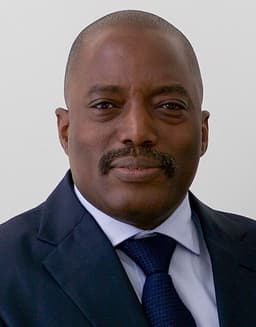
Joseph Kabila
Politician · Modern
47.2Total

Yashwantrao Chavan
Politician · Modern
58.4Total
Basic Information
Born
1971
1913
Died
—
1984
Era
Modern
Modern
Nationality
Congo
India
Occupation
Politician
Politician
Civilization
Other
Indian
Score Comparison
Military (10%)
20.0
37.9
Political (20%)
40.8
72.0
Influence (20%)
49.4
58.0
Legacy (20%)
40.8
50.0
Leadership (15%)
74.0
72.0
Strategy (15%)
54.6
60.0
TOTAL
47.2
58.4
Joseph Kabila — Complete Timeline
2001 AD
Became President of the Democratic Republic of the CongoPolitical Action◆ Major
Joseph Kabila became President of the DRC at age 29 after his father Laurent Kabila's assassination. He inherited a country embroiled in the Second Congo War and faced the challenge of ending the conflict.
PresidencySuccessionDRC
Impact: national
2002 AD
Signed Sun City AgreementPolitical Action
Kabila's government signed the Sun City Agreement, a peace deal that ended the Second Congo War. The agreement established a transitional government and paved the way for democratic elections.
Peace AgreementSecond Congo WarTransition
Impact: regionalconstructive
2006 AD
Won First Democratic Elections in DRCPolitical Action◆ Major
Joseph Kabila won the first democratic presidential elections in the DRC since independence, defeating Jean-Pierre Bemba in a runoff. The elections were largely peaceful but marred by allegations of irregularities.
ElectionsDemocracyDRC
Impact: nationalconstructive
2016 AD
Refused to Step Down After 2016 ElectionsPolitical Action◆ Major
Kabila's refusal to step down after his constitutional term limit expired in 2016 sparked political crisis and protests. He remained in power until 2019, citing delays in organizing elections.
Constitutional CrisisTerm LimitsPolitical Instability
Impact: nationaldestructive
2019 AD
Peacefully Transferred Power to Félix TshisekediPolitical Action
Joseph Kabila peacefully transferred power to opposition leader F
Power TransferDemocracyDRC
Impact: nationalconstructive
Yashwantrao Chavan — Complete Timeline
1960 AD
Became First Chief Minister of MaharashtraPolitical Action◆ Major
Yashwantrao Chavan became the first Chief Minister of the newly formed state of Maharashtra after the bifurcation of Bombay State. He led the state through its formative years, focusing on industrial development and cooperative movements.
Chief MinisterMaharashtraState Formation
Impact: regionalconstructive
1971 AD
Served as Defence Minister during the 1971 Indo-Pakistan WarWar◆ Major
As Defence Minister, Chavan oversaw India's military operations during the war that led to the creation of Bangladesh. The war resulted in a decisive Indian victory and the largest military surrender since World War II.
Indo-Pakistan WarDefence MinisterBangladesh Liberation
Impact: regionalconstructive
1973 AD
Served as Finance Minister and Presented the 'Black Budget'Political Action
As Finance Minister, Chavan presented the 1973-74 Union Budget, which became known as the 'Black Budget' due to its large fiscal deficit. The budget included measures to nationalize coal mines and impose a ceiling on urban land holdings.
Finance MinisterBudgetEconomic Policy
Impact: national
1979 AD
Served as Deputy Prime Minister of IndiaPolitical Action◆ Major
Chavan served as Deputy Prime Minister under Prime Minister Morarji Desai in the Janata Party government. He also held the Home Ministry portfolio, dealing with internal security and political stability during a turbulent period.
Deputy Prime MinisterHome MinisterJanata Party
Impact: nationalconstructive
Expert Analysis
Origins
Joseph Kabila was born on June 4, 1971, in Hewa Bora, Congo, the son of Laurent-Désiré Kabila, a rebel leader who later became president. He received military training in Tanzania and China, but his formal education was limited. In contrast, Yashwantrao Balwantrao Chavan was born on March 12, 1913, in Devrashtre, British India, into a farming family. He earned a law degree from the University of Bombay and was deeply influenced by the Indian independence movement.
Rise to Power
Joseph Kabila rose to power abruptly after his father's assassination on January 16, 2001. At age 29, he became president of the Democratic Republic of the Congo (DRC), inheriting a country engulfed in the Second Congo War. His early years were marked by efforts to consolidate power and negotiate peace. Yashwantrao Chavan's rise was gradual. He became the first Chief Minister of Maharashtra on May 1, 1960, after the state's formation. He later served as Defence Minister during the 1971 Indo-Pakistan War, and as Finance Minister, presenting the 'Black Budget' in 1973. He reached the pinnacle as Deputy Prime Minister in 1979.
Leadership & Governance
Joseph Kabila's leadership was authoritarian. He signed the Sun City Agreement in 2002, ending the war, but his governance was marked by corruption and human rights abuses. He won the first democratic elections in 2006 but refused to step down after his term expired in 2016, sparking a crisis. His political score is 40.8, reflecting weak democratic institutions. Yashwantrao Chavan scored 72.0 in political acumen. He was a consensus-builder, implementing land reforms and industrial policies in Maharashtra. As Defence Minister, he oversaw India's victory in 1971, and as Home Minister, he handled internal security. His leadership style was democratic and inclusive.
Triumph & Tragedy
Kabila's greatest triumph was the peaceful transfer of power to Félix Tshisekedi in 2019, a rare event in Congo. His tragedy was the failure to develop the country, leaving it mired in poverty and conflict. Chavan's triumph was his role in India's 1971 war victory, which led to Bangladesh's creation. His tragedy was the 'Black Budget' of 1973, which caused inflation and hardship. Despite this, his legacy as a builder of institutions remains.
Character & Destiny
Joseph Kabila was secretive and pragmatic, often described as a shadowy figure. His character—shaped by his father's assassination—made him cautious but also resistant to change. He scored 74.0 in leadership, but his inability to democratize fully led to crises. Yashwantrao Chavan was a scholarly politician, known for his integrity and intellectual depth. His leadership score of 72.0 reflects his ability to navigate complex political landscapes. He was a loyal Congressman until the Emergency, after which he joined the Janata Party.
Legacy
Joseph Kabila's legacy is mixed: he ended a war and oversaw a peaceful transition, but his rule entrenched corruption and instability. His total score is 47.2. Yashwantrao Chavan's legacy is more positive: he shaped Maharashtra's identity, contributed to India's military success, and served as a statesman. His total score is 58.4. Chavan's influence endures through the institutions he helped build.
Conclusion
Yashwantrao Chavan had greater impact. His political score (72.0) and leadership (72.0) far exceed Kabila's (40.8 and 74.0 respectively, but in less critical contexts). Chavan's contributions to India's democracy and security are lasting, while Kabila's Congo remains fragile. The 11.2-point gap in total scores reflects this: Chavan's 58.4 vs Kabila's 47.2. Chavan's legacy is one of democratic consolidation; Kabila's is of missed potential.
Rankings
🥇
Yashwantrao ChavanLeader
Mil: 37.9Pol: 72.0Inf: 58.0
58.4
🥈
Joseph Kabila
Mil: 20.0Pol: 40.8Inf: 49.4
47.2
+11.2 behind
How This Comparison Works
Algorithm
Each figure is scored on 6 dimensions (0—100 scale) based on structured historical data: Military (10%), Political (20%), Influence (20%), Legacy (20%), Leadership (15%), Strategy (15%). The weighted total produces the final ranking.
Data Sources
Scores are computed from structured sub-indicators in the database. Scale factors adjust for era (Ancient ×0.85, Modern ×1.0) and civilization size (Eastern ×1.05, Other ×0.80) to account for differences in population and military scale.
Maximum 3 Figures
Comparisons are limited to 2—3 figures to ensure readability and statistical meaningfulness.
Error Margins
±5 points per dimension — Sub-scores are derived from historical records with inherent uncertainty. Two figures within 5 points on a dimension should be considered roughly equivalent in that area.
Total Score Accuracy
±3 points overall — The weighted combination of 6 dimensions produces a total score with approximately ±3 points of uncertainty. Differences of less than 3 points are not statistically significant— the figures are effectively tied.
Known Limitations
- Historical records are incomplete and uneven across civilizations
- Figures from oral-tradition societies may be underrepresented
- Occupation labels can misclassify multi-role figures
- Scores measure capability and impact, not moral character
- Quantitative scoring is a comparison tool, not absolute truth
Capability Radar
Military (10%) — Battles & Warfare
Battles
15
41
Win Rate
20
49
Expansion
10
51
Political (20%) — Governance & Reform
Reform
30
60
Diplomacy
40
70
Economy
25
55
Influence (20%) — Cultural & Global Reach
Cultural
15
50
Global
20
40
Legacy (20%) — Historical Impact
Historical
25
55
Longevity
20
45
Leadership (15%) — Power & Stability
Tenure
65
65
Stability
20
60
Strategy (15%) — Tactics & Innovation
Strategy
15
51
Tactics
10
58
Reform
25
60
Similar Comparisons
Comments & Discussion
No comments yet. Be the first to share your thoughts!