Loading...
Hugo Chavez vs Yashwantrao Chavan
Yashwantrao Chavan leads by 7.5 pts · 2 figures compared
…
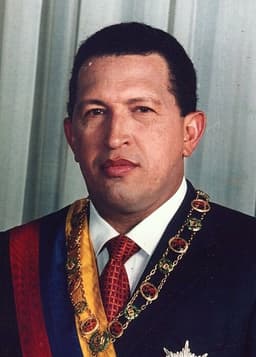
Hugo Chavez
Politician · Modern
50.9Total

Yashwantrao Chavan
Politician · Modern
58.4Total
Basic Information
Born
1954
1913
Died
—
1984
Era
Modern
Modern
Nationality
Venezuela
India
Occupation
Politician
Politician
Civilization
Western
Indian
Score Comparison
Military (10%)
10.0
37.9
Political (20%)
62.7
72.0
Influence (20%)
56.7
58.0
Legacy (20%)
49.2
50.0
Leadership (15%)
68.0
72.0
Strategy (15%)
38.3
60.0
TOTAL
50.9
58.4
Hugo Chavez — Complete Timeline
1992 AD
Failed 1992 coup attemptPolitical Action◆ Major
Chávez, then a lieutenant colonel, led a failed military coup against President Carlos Andrés Pérez. The coup was crushed, and Chávez was imprisoned. His televised speech accepting responsibility made him a national figure and martyr for the poor.
CoupImprisonmentPolitical Rise
Impact: national
1998 AD
Election as President of VenezuelaPolitical Action
Chávez won the presidential election with 56% of the vote, running on a platform of anti-corruption and social justice. His victory marked the beginning of the Bolivarian Revolution, a leftist movement aimed at transforming Venezuela's political and economic system.
ElectionBolivarian RevolutionPopulism
Impact: nationalconstructive
2001 AD
Nationalization of oil industryReform◆ Major
Chávez enacted a new Hydrocarbons Law that increased state control over the oil industry, raising royalties and taxes on foreign companies. He also reasserted control over PDVSA, the state oil company, using oil revenues to fund social programs.
NationalizationOilEconomic Policy
Impact: nationalconstructive
2002 AD
2002 coup attempt and return to powerPolitical Action◆ Major
Chávez was briefly overthrown in a coup led by business and military sectors, but was restored to power after 47 hours due to mass protests and loyalist military units. The coup attempt deepened political polarization in Venezuela.
CoupPolitical CrisisReturn
Impact: national
2004 AD
Creation of the Bolivarian Alliance for the Americas (ALBA)Political Action◆ Major
Chávez founded ALBA as an alternative to the Free Trade Area of the Americas, promoting regional integration based on solidarity, barter, and social welfare. The alliance included Cuba, Bolivia, and other leftist governments in Latin America.
Regional IntegrationSocialismAnti-imperialism
Impact: regionalconstructive
Yashwantrao Chavan — Complete Timeline
1960 AD
Became First Chief Minister of MaharashtraPolitical Action◆ Major
Yashwantrao Chavan became the first Chief Minister of the newly formed state of Maharashtra after the bifurcation of Bombay State. He led the state through its formative years, focusing on industrial development and cooperative movements.
Chief MinisterMaharashtraState Formation
Impact: regionalconstructive
1971 AD
Served as Defence Minister during the 1971 Indo-Pakistan WarWar◆ Major
As Defence Minister, Chavan oversaw India's military operations during the war that led to the creation of Bangladesh. The war resulted in a decisive Indian victory and the largest military surrender since World War II.
Indo-Pakistan WarDefence MinisterBangladesh Liberation
Impact: regionalconstructive
1973 AD
Served as Finance Minister and Presented the 'Black Budget'Political Action
As Finance Minister, Chavan presented the 1973-74 Union Budget, which became known as the 'Black Budget' due to its large fiscal deficit. The budget included measures to nationalize coal mines and impose a ceiling on urban land holdings.
Finance MinisterBudgetEconomic Policy
Impact: national
1979 AD
Served as Deputy Prime Minister of IndiaPolitical Action◆ Major
Chavan served as Deputy Prime Minister under Prime Minister Morarji Desai in the Janata Party government. He also held the Home Ministry portfolio, dealing with internal security and political stability during a turbulent period.
Deputy Prime MinisterHome MinisterJanata Party
Impact: nationalconstructive
Expert Analysis
Origins
Hugo Chávez was born on July 28, 1954, in Sabaneta, Barinas, Venezuela, to a poor family of schoolteachers. He entered the Venezuelan Academy of Military Sciences in 1971, graduating as a second lieutenant. His early exposure to leftist ideas and the poverty of rural Venezuela shaped his worldview. Chávez was influenced by Simón Bolívar and Marxist thought, which later informed his Bolivarian Revolution.
Yashwantrao Chavan was born on March 12, 1913, in Devrashtre, Satara, British India, into a peasant family. He was the first in his family to receive formal education, graduating from Rajaram College in Kolhapur and later earning a law degree from the University of Bombay. Chavan was deeply involved in the Indian independence movement, joining the Quit India Movement in 1942, which led to his imprisonment. His political mentor was Jawaharlal Nehru.
Rise to Power
Chávez's rise began with the 1992 coup attempt against President Carlos Andrés Pérez. As a lieutenant colonel, he led a failed coup on February 4, 1992, which was crushed, and he was imprisoned for two years. The coup attempt, though unsuccessful, made him a national figure. After his release, he founded the Fifth Republic Movement and won the presidency in 1998 with 56% of the vote, capitalizing on widespread discontent with traditional parties.
Chavan's rise was rooted in the Congress Party. He served as a minister in Bombay State before its bifurcation. In 1960, he became the first Chief Minister of Maharashtra, leading the state through its formative years. He later held key central portfolios: Defence Minister during the 1971 Indo-Pakistan War, Home Minister, Finance Minister, and Deputy Prime Minister from 1979 to 1980. His political acumen and loyalty to the Congress Party propelled him to national prominence.
Leadership & Governance
Chávez governed through centralization of power and nationalization. He enacted the 2001 Hydrocarbons Law, increasing state control over oil, and used oil revenues for social programs (Misiones). He faced a coup in 2002, was briefly ousted, but returned after protests. His governance style was confrontational, often clashing with the US and domestic opposition. He created the Bolivarian Alliance (ALBA) in 2004 as an alternative to US-led trade deals. His political score of 62.7 reflects his electoral dominance but also polarization.
Chavan was a pragmatic administrator. As Chief Minister, he focused on industrial development and cooperative movements. As Defence Minister, he oversaw India's victory in the 1971 war, which led to the creation of Bangladesh. His tenure as Finance Minister saw the 'Black Budget' of 1973-74 with a large deficit, but he also introduced progressive land reforms. Chavan's leadership score of 72.0 indicates his effectiveness in managing complex portfolios. He prioritized consensus-building and institutional stability.
Triumph & Tragedy
Chávez's greatest success was reducing poverty and inequality through social programs. Between 1999 and 2012, poverty fell from 50% to 30%, and literacy rates improved. His tragedy was economic mismanagement: oil dependency, inflation, and crime soared after his death. The 2002 coup attempt was a low point, though he survived. His strategy score of 38.3 reflects poorly planned economic policies.
Chavan's triumph was the 1971 war victory, which secured India's dominance in South Asia. He also successfully integrated Maharashtra's diverse regions. His tragedy was the 'Black Budget', which caused inflation and fiscal strain. He also faced criticism for his handling of the Emergency (1975-77) as a Congress loyalist. His legacy score of 50.0 is moderate, as he is respected but not iconic.
Character & Destiny
Chávez was charismatic, impulsive, and confrontational. His personality drove his rise but also polarized Venezuela. He scored 68.0 in leadership, but his strategic errors, like ignoring economic diversification, led to posthumous collapse. His destiny was tied to oil: when prices fell, his legacy crumbled.
Chavan was reserved, pragmatic, and institutional. He scored 72.0 in leadership, reflecting his ability to work within systems. His destiny was shaped by his loyalty to the Congress Party and his role in nation-building. He remained influential but never achieved the same global recognition as Chávez.
Legacy
Chávez's legacy is mixed: he inspired leftist movements in Latin America and improved social indicators, but his economic policies left Venezuela in crisis. His influence score of 56.7 shows global impact, but his military score of 10.0 underscores his non-military focus. The Bolivarian Revolution endures in some forms, but the country's collapse tarnishes his memory.
Chavan's legacy is that of a builder: he shaped Maharashtra's governance and contributed to India's security. His influence score of 58.0 reflects his regional and national importance. He is remembered as a competent administrator, not a revolutionary. His total score of 58.4 is higher than Chávez's 50.9.
Conclusion
Yashwantrao Chavan had greater impact in terms of institutional governance and national security. While Chávez's social programs were transformative, his economic failures and polarization undermined long-term gains. Chavan's higher total score (58.4 vs 50.9) reflects his more balanced leadership across multiple domains. Chávez's influence is more visible but fragile; Chavan's legacy is durable but less dramatic. Thus, Chavan is the more effective leader in terms of sustained, positive impact.
Rankings
🥇
Yashwantrao ChavanLeader
Mil: 37.9Pol: 72.0Inf: 58.0
58.4
🥈
Hugo Chavez
Mil: 10.0Pol: 62.7Inf: 56.7
50.9
+7.5 behind
How This Comparison Works
Algorithm
Each figure is scored on 6 dimensions (0—100 scale) based on structured historical data: Military (10%), Political (20%), Influence (20%), Legacy (20%), Leadership (15%), Strategy (15%). The weighted total produces the final ranking.
Data Sources
Scores are computed from structured sub-indicators in the database. Scale factors adjust for era (Ancient ×0.85, Modern ×1.0) and civilization size (Eastern ×1.05, Other ×0.80) to account for differences in population and military scale.
Maximum 3 Figures
Comparisons are limited to 2—3 figures to ensure readability and statistical meaningfulness.
Error Margins
±5 points per dimension — Sub-scores are derived from historical records with inherent uncertainty. Two figures within 5 points on a dimension should be considered roughly equivalent in that area.
Total Score Accuracy
±3 points overall — The weighted combination of 6 dimensions produces a total score with approximately ±3 points of uncertainty. Differences of less than 3 points are not statistically significant— the figures are effectively tied.
Known Limitations
- Historical records are incomplete and uneven across civilizations
- Figures from oral-tradition societies may be underrepresented
- Occupation labels can misclassify multi-role figures
- Scores measure capability and impact, not moral character
- Quantitative scoring is a comparison tool, not absolute truth
Capability Radar
Military (10%) — Battles & Warfare
Battles
0
41
Win Rate
0
49
Expansion
0
51
Political (20%) — Governance & Reform
Reform
70
60
Diplomacy
60
70
Economy
40
55
Influence (20%) — Cultural & Global Reach
Cultural
60
50
Global
55
40
Legacy (20%) — Historical Impact
Historical
55
55
Longevity
40
45
Leadership (15%) — Power & Stability
Tenure
75
65
Stability
30
60
Strategy (15%) — Tactics & Innovation
Strategy
0
51
Tactics
0
58
Reform
10
60
Similar Comparisons
Comments & Discussion
No comments yet. Be the first to share your thoughts!