Loading...
John II of France vs Radu the Great
Radu the Great leads by 5.9 pts · 2 figures compared
…
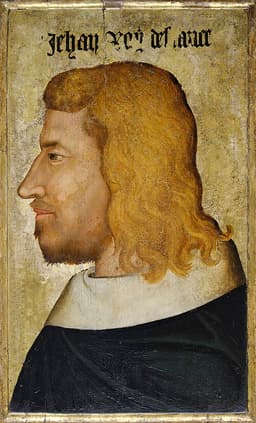
John II of France
Emperor · Medieval
37.5Total
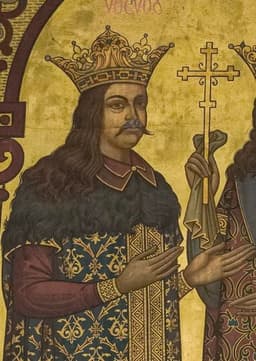
Radu the Great
Emperor · Medieval
43.4Total
Basic Information
Born
1319
1467
Died
1364
1508
Era
Medieval
Medieval
Nationality
France
Wallachia
Occupation
Emperor
Emperor
Civilization
Western
Western
Score Comparison
Military (10%)
22.6
21.2
Political (20%)
27.9
35.1
Influence (20%)
47.9
50.2
Legacy (20%)
40.8
41.7
Leadership (15%)
34.6
62.2
Strategy (15%)
36.8
36.8
TOTAL
37.5
43.4
John II of France — Complete Timeline
1356 AD
Battle of PoitiersWar
John II led a French army against the English under Edward the Black Prince at Poitiers. The French were defeated, and John was captured along with many nobles. This was a major disaster for France, leading to a ransom demand and political crisis.
BattleCaptureHundred Years' War
Impact: regionaltragic
1360 AD
Treaty of BrétignyPolitical Action◆ Major
John II, while still a prisoner in England, agreed to the Treaty of Br
TreatyRansomTerritorial Cession
Impact: regional
1364 AD
Return to England as PrisonerPolitical Action
After his release, John II voluntarily returned to England when a hostage, his son Louis, escaped captivity. John cited his honor and the terms of the Treaty of Br
HonorCaptivityDeath
Impact: nationaltragic
Radu the Great — Complete Timeline
1490 AD
Rebuilding of Wallachian ChurchesCultural◆ Major
Radu sponsored the construction and restoration of numerous churches and monasteries across Wallachia. His patronage of Orthodox art and architecture earned him the epithet 'the Great' and strengthened the church.
Church BuildingPatronage
Impact: nationalconstructive
1495 AD
Peaceful ReignPolitical Action◆ Major
Radu maintained a stable and peaceful reign, avoiding major wars with the Ottoman Empire and neighboring states. This stability allowed for economic growth and cultural development in Wallachia.
StabilityWallachia
Impact: nationalconstructive
1496 AD
Tribute to the Ottoman EmpirePolitical Action
Radu continued paying tribute to the Ottoman Empire, maintaining Wallachia's vassal status. This policy avoided conflict but limited Wallachian independence.
Ottoman TributeVassalage
Impact: national
1500 AD
Support for the Orthodox ChurchCultural
Radu granted lands and privileges to the Orthodox Church, including the establishment of new bishoprics. His support strengthened the church's role in Wallachian society.
Church SupportOrthodoxy
Impact: nationalconstructive
Expert Analysis
Origins
John II of France was born on April 16, 1319, in Le Mans, France, to King Philip VI and Joan of Burgundy. As a member of the Valois dynasty, he inherited a kingdom embroiled in the Hundred Years' War with England. His upbringing was aristocratic, focused on chivalric ideals and military training. Radu the Great, born in 1467, was the son of Vlad III Drăculea (Vlad the Impaler) and a Moldavian princess. He grew up in Wallachia amidst Ottoman influence, with his father's brutal reign and later exile to the Ottoman court shaping his pragmatic approach. Radu's education included both Orthodox Christian teachings and Ottoman administrative practices.
Rise to Power
John II became King of France in 1350 upon his father's death. His early reign was marked by conflict with England, culminating in the Battle of Poitiers on September 19, 1356. Leading a large army, John faced Edward the Black Prince, but poor strategy and discipline led to a decisive defeat. John was captured and held for ransom, a turning point that paralyzed French governance. Radu the Great rose to power in 1495 after the death of his half-brother Vlad IV. As the son of Vlad the Impaler, Radu benefited from Ottoman support and a period of relative calm in Wallachia. He secured his throne by paying tribute to the Ottoman sultan and avoiding conflict with powerful neighbors like Hungary and Poland.
Leadership & Governance
John II's leadership was defined by chivalric ideals but flawed execution. He personally led troops at Poitiers, but his tactical decisions—such as attacking on foot in muddy terrain—proved disastrous. As a ruler, he imposed heavy taxes to fund the war and his ransom, leading to widespread unrest. The Estates-General forced reforms, including the Grand Ordinance of 1357, which limited royal power. John's governance score of 34.6 reflects his inability to adapt. In contrast, Radu the Great scored 62.2 in leadership, prioritizing stability over expansion. He maintained peace with the Ottoman Empire through regular tribute, which allowed Wallachia to avoid invasion. Radu focused on internal development, patronizing the Orthodox Church and commissioning the rebuilding of churches and monasteries, such as the Dealu Monastery. His political score of 35.1, however, indicates limited independence due to vassalage.
Triumph & Tragedy
John II's greatest triumph was his adherence to chivalric honor: after his release, when his son Louis escaped captivity, John voluntarily returned to England in 1364, citing his pledge. This act earned him the epithet "the Good" and enhanced his reputation. His greatest tragedy was the Battle of Poitiers, where he lost not only the battle but also his freedom, leading to the humiliating Treaty of Brétigny (1360) that ceded vast territories to England. John died in London in 1364 as a prisoner. Radu the Great's triumph was his peaceful reign of 13 years, during which Wallachia prospered economically and culturally. He strengthened the Orthodox Church, earning a legacy as a church builder. His tragedy was the compromise of Wallachian sovereignty; his tribute payments and submission to the Ottomans limited his influence, and his death in 1508 led to succession struggles.
Character & Destiny
John II was a product of chivalric culture—brave but inflexible. His decision to fight at Poitiers reflected a desire for glory over strategic prudence. His voluntary return to captivity showed a rigid sense of honor, which historians view as both noble and impractical. His total score of 37.5 is dragged down by military (22.6) and political (27.9) failures. Radu the Great was pragmatic and cautious, shaped by his father's violent end and Ottoman dominance. He avoided war, focused on religion and construction, and maintained stability. His strategy score of 36.8 matches John's, but his leadership (62.2) and influence (50.2) exceed John's. Radu's character ensured a quiet reign but limited his historical footprint.
Legacy
John II's legacy is mixed: he is remembered as a symbol of chivalric failure, and the Treaty of Brétigny weakened France. However, his captivity spurred administrative reforms that eventually strengthened the monarchy. He scores 40.8 in legacy. Radu the Great's legacy is localized: he is celebrated in Romanian Orthodox history for his church patronage, with many buildings surviving today. His peaceful reign provided a model for later princes. His legacy score of 41.7 slightly edges John's. Radu's total score of 43.4 surpasses John's 37.5, reflecting more effective governance.
Conclusion
Radu the Great had a greater impact on his domain than John II. John's capture and the Treaty of Brétigny were disasters for France, while Radu's stability allowed Wallachia to thrive culturally. Although John's chivalric story is more famous, Radu's concrete achievements in church building and peacekeeping delivered tangible benefits. With a total score of 43.4 against John's 37.5, Radu's superior leadership and legacy make him the more effective ruler.
Rankings
🥇
Radu the GreatLeader
Mil: 21.2Pol: 35.1Inf: 50.2
43.4
🥈
John II of France
Mil: 22.6Pol: 27.9Inf: 47.9
37.5
+5.9 behind
How This Comparison Works
Algorithm
Each figure is scored on 6 dimensions (0—100 scale) based on structured historical data: Military (10%), Political (20%), Influence (20%), Legacy (20%), Leadership (15%), Strategy (15%). The weighted total produces the final ranking.
Data Sources
Scores are computed from structured sub-indicators in the database. Scale factors adjust for era (Ancient ×0.85, Modern ×1.0) and civilization size (Eastern ×1.05, Other ×0.80) to account for differences in population and military scale.
Maximum 3 Figures
Comparisons are limited to 2—3 figures to ensure readability and statistical meaningfulness.
Error Margins
±5 points per dimension — Sub-scores are derived from historical records with inherent uncertainty. Two figures within 5 points on a dimension should be considered roughly equivalent in that area.
Total Score Accuracy
±3 points overall — The weighted combination of 6 dimensions produces a total score with approximately ±3 points of uncertainty. Differences of less than 3 points are not statistically significant— the figures are effectively tied.
Known Limitations
- Historical records are incomplete and uneven across civilizations
- Figures from oral-tradition societies may be underrepresented
- Occupation labels can misclassify multi-role figures
- Scores measure capability and impact, not moral character
- Quantitative scoring is a comparison tool, not absolute truth
Capability Radar
Military (10%) — Battles & Warfare
Battles
20
10
Win Rate
10
10
Expansion
5
10
Political (20%) — Governance & Reform
Reform
20
30
Diplomacy
15
30
Economy
10
30
Influence (20%) — Cultural & Global Reach
Cultural
15
30
Global
10
10
Legacy (20%) — Historical Impact
Historical
25
30
Longevity
20
20
Leadership (15%) — Power & Stability
Tenure
30
40
Stability
10
40
Strategy (15%) — Tactics & Innovation
Strategy
10
10
Tactics
15
10
Reform
5
10
Similar Comparisons
Comments & Discussion
No comments yet. Be the first to share your thoughts!