Loading...
John II of France vs Napoleon Bonaparte
Napoleon Bonaparte leads by 33.4 pts · 2 figures compared
…
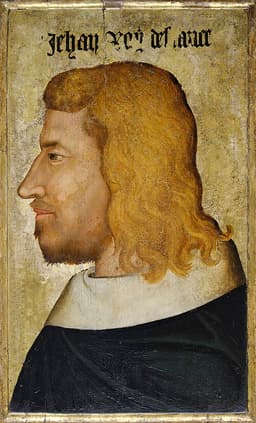
John II of France
Emperor · Medieval
37.5Total

Napoleon Bonaparte
General · Modern
70.9Total
Basic Information
Born
1319
1769
Died
1364
1821
Era
Medieval
Modern
Nationality
France
France
Occupation
Emperor
General
Civilization
Western
Western
Score Comparison
Military (10%)
22.6
94.0
Political (20%)
27.9
72.0
Influence (20%)
47.9
40.0
Legacy (20%)
40.8
80.0
Leadership (15%)
34.6
78.0
Strategy (15%)
36.8
90.0
TOTAL
37.5
70.9
John II of France — Complete Timeline
1356 AD
Battle of PoitiersWar
John II led a French army against the English under Edward the Black Prince at Poitiers. The French were defeated, and John was captured along with many nobles. This was a major disaster for France, leading to a ransom demand and political crisis.
BattleCaptureHundred Years' War
Impact: regionaltragic
1360 AD
Treaty of BrétignyPolitical Action◆ Major
John II, while still a prisoner in England, agreed to the Treaty of Br
TreatyRansomTerritorial Cession
Impact: regional
1364 AD
Return to England as PrisonerPolitical Action
After his release, John II voluntarily returned to England when a hostage, his son Louis, escaped captivity. John cited his honor and the terms of the Treaty of Br
HonorCaptivityDeath
Impact: nationaltragic
Napoleon Bonaparte — Complete Timeline
1799 AD
Coup of 18 BrumaireOther◆ Major
Napoleon Bonaparte, with support from his brother Lucien and key political figures, overthrew the Directory in a bloodless coup. He established the Consulate with himself as First Consul, effectively becoming the ruler of France. This event ended the French Revolution's most unstable period.
French RevolutionCoupRise to Power
Impact: regional
1804 AD
Promulgation of the Napoleonic CodeOther◆ Major
Napoleon enacted the Civil Code of the French, known as the Napoleonic Code, a comprehensive set of laws that replaced the fragmented feudal legal systems. The code established legal equality, protected property rights, and secularized law. It became the basis for legal systems in many European and world countries.
Legal ReformNapoleonic CodeCivil Law
Impact: globalconstructive
1805 AD
Battle of AusterlitzWar◆ Major
Napoleon's Grande Arm
Napoleonic WarsBattleDecisive Victory
Impact: global
1812 AD
Invasion of RussiaWar◆ Major
Napoleon led the Grande Arm
Napoleonic WarsInvasionDisaster
Impact: globaldestructive
1815 AD
Battle of WaterlooWar◆ Major
Napoleon's French army was defeated by the combined forces of the Duke of Wellington's Anglo-Allied army and Gebhard Leberecht von Bl
Napoleonic WarsBattleFinal Defeat
Impact: globaldestructive
Expert Analysis
john-ii-of-france-vs-napoleon-bonaparte
# The Emperor and the Captive King
On a June evening in 1815, Napoleon Bonaparte stood on a muddy ridge near Waterloo, watching his Imperial Guard march into cannon fire for the final time. Four and a half centuries earlier, another French king, John II, knelt in surrender on a field near Poitiers, handing his sword to the Black Prince. Both men lost everything on battlefields that would define their names—yet one became a legend of ambition and reform, while the other became a footnote, remembered chiefly for the manner of his captivity. What separates a conqueror from a cautionary tale? The answer lies not in victory or defeat, but in what a leader does with the years between his rise and his fall.
Origins
Napoleon Bonaparte was born in 1769 on the island of Corsica, a place that had only become French the year before. His family was minor nobility, poor enough that young Napoleon spoke French with an Italian accent that Parisians mocked. This outsider status forged in him a relentless hunger for recognition. He devoured military history and Enlightenment philosophy, believing that talent, not birth, should determine a man's destiny.
John II, born in 1319, inherited a throne steeped in medieval tradition. His father, Philip VI, had started the Hundred Years’ War against England, and John grew up in a world where kingship meant chivalry, piety, and the sacred bond between lord and vassal. He was brave, devout, and utterly convinced that honor mattered more than strategy. Where Napoleon learned from Caesar and Machiavelli, John learned from the *Song of Roland*.
Rise to Power
Napoleon’s ascent was a rocket. At twenty-four, he drove the British out of Toulon. At twenty-six, he crushed a royalist uprising in Paris with a “whiff of grapeshot.” At twenty-seven, he conquered Italy. Each victory was a stepping stone, and by 1804, he crowned himself Emperor of the French in Notre-Dame, taking the crown from the Pope’s hands to place it on his own head. He had no bloodline, no ancient claim—only his sword.
John’s rise was an inheritance. He became king in 1350 at age thirty-one, already shaped by the early disasters of the Hundred Years’ War. His father had lost the Battle of Crécy in 1346, and John spent his first years as king trying to restore French morale. He was not a man who seized opportunity; he was a man whom opportunity seized—and crushed.
Leadership & Governance
As a ruler, Napoleon was a revolutionary. The Napoleonic Code, enacted in 1804, swept away feudal privileges, established equality before the law, and protected property rights. It became the foundation of modern legal systems across Europe. He built schools, reformed taxation, and centralized the state. His military genius, with a strategy score of 93.0, was legendary: he divided his enemies, struck at their flanks, and turned battles into symphonies of maneuver. But his political score of 75.0 reflects a fatal flaw: he could conquer but not consolidate. He placed his brothers on thrones across Europe, but they ruled poorly, and his empire rested on his personal presence.
John II governed by medieval instinct. He created the franc, a gold coin meant to stabilize the economy, but he could not reform a feudal system that depended on noble loyalty. His military score of 16.7 is brutally low, and the Battle of Poitiers in 1356 proved why. John led a French army three times the size of the English force under Edward the Black Prince. He had the numbers, the terrain, and the advantage. But he lacked tactics. He ordered a dismounted cavalry charge through muddy ground, and his knights were slaughtered by English longbows. John himself was captured, and France lost its king.
Triumph & Tragedy
Napoleon’s greatest triumph was Austerlitz in 1805, where he crushed the Austrian and Russian armies in a battle so perfect it became a textbook example. His greatest tragedy was the invasion of Russia in 1812. He marched 600,000 men into the snow; fewer than 40,000 returned. His political score of 75.0 shows he understood power but not limits. He exiled himself to Elba in 1814, escaped in 1815, and fell forever at Waterloo.
John’s tragedy was not a single battle but a long captivity. After Poitiers, he was taken to England and held for four years. In 1360, he signed the Treaty of Brétigny, ceding vast territories in southwestern France for his freedom. But the story does not end there. When a hostage—his son Louis—escaped, John voluntarily returned to England to take his place, citing his word of honor. He died in London in 1364, a king who kept his promise but lost his kingdom.
Character & Destiny
Napoleon’s character was ambition incarnate. He once said, “Impossible is a word to be found only in the dictionary of fools.” He believed he could bend history to his will, and for a decade, he did. But his pride led him to overreach. He could not share power, could not accept defeat, and could not stop fighting even when peace was possible.
John’s character was honor without wisdom. He was brave, loyal, and chivalrous—qualities that made him a good knight but a poor king. His fate was sealed not by English arrows but by his inability to see that medieval honor could not stand against modern warfare. He died a prisoner, but he died a man of his word.
Legacy
Napoleon’s legacy score of 78.0 reflects a figure who reshaped Europe. The Napoleonic Code, the metric system, and modern nationalism all trace roots to his era. He is remembered as a military genius, a reformer, and a tyrant—a man who, as he said, “opened the gates of the temple of Janus” and never closed them.
John II’s legacy score of 53.9 is modest. He is remembered as John the Good, a king who kept his oath and died in captivity. His reign is a lesson in the limits of medieval kingship, a story of how honor without strategy leads to ruin.
Conclusion
Napoleon and John II were both French, both defeated, both captured. But Napoleon changed the world; John II could not change his own kingdom. The difference is not in their defeats—every leader falls—but in what they built before the fall. Napoleon’s ambition created a new Europe; John’s honor preserved an old one. One shaped the future; the other was shaped by the past. In the end, history remembers not the man who kept his word, but the man who dared to break the world—and remake it in his image.
Rankings
🥇
Napoleon BonaparteLeader
Mil: 94.0Pol: 72.0Inf: 40.0
70.9
🥈
John II of France
Mil: 22.6Pol: 27.9Inf: 47.9
37.5
+33.4 behind
How This Comparison Works
Algorithm
Each figure is scored on 6 dimensions (0—100 scale) based on structured historical data: Military (10%), Political (20%), Influence (20%), Legacy (20%), Leadership (15%), Strategy (15%). The weighted total produces the final ranking.
Data Sources
Scores are computed from structured sub-indicators in the database. Scale factors adjust for era (Ancient ×0.85, Modern ×1.0) and civilization size (Eastern ×1.05, Other ×0.80) to account for differences in population and military scale.
Maximum 3 Figures
Comparisons are limited to 2—3 figures to ensure readability and statistical meaningfulness.
Error Margins
±5 points per dimension — Sub-scores are derived from historical records with inherent uncertainty. Two figures within 5 points on a dimension should be considered roughly equivalent in that area.
Total Score Accuracy
±3 points overall — The weighted combination of 6 dimensions produces a total score with approximately ±3 points of uncertainty. Differences of less than 3 points are not statistically significant— the figures are effectively tied.
Known Limitations
- Historical records are incomplete and uneven across civilizations
- Figures from oral-tradition societies may be underrepresented
- Occupation labels can misclassify multi-role figures
- Scores measure capability and impact, not moral character
- Quantitative scoring is a comparison tool, not absolute truth
Capability Radar
Military (10%) — Battles & Warfare
Battles
20
95
Win Rate
10
90
Expansion
5
95
Political (20%) — Governance & Reform
Reform
20
95
Diplomacy
15
80
Economy
10
85
Influence (20%) — Cultural & Global Reach
Cultural
15
85
Global
10
90
Legacy (20%) — Historical Impact
Historical
25
95
Longevity
20
90
Leadership (15%) — Power & Stability
Tenure
30
85
Stability
10
70
Strategy (15%) — Tactics & Innovation
Strategy
10
95
Tactics
15
98
Reform
5
92
Similar Comparisons
Comments & Discussion
铁蹄书生6/17/2026
读史读的不是战绩,是气数。拿破仑败于滑铁卢,却留法典于千秋;约翰二世败于普瓦捷,只剩赎金账单供人耻笑。前者把法国从封建泥潭拖进现代;后者把王国押上骑士精神的赌桌。一个被放逐两次仍能改写欧洲地图;一个被俘后连赎金都凑不齐。历史很势利:建功者封神,守成者蒙尘。任你勇冠三军,输给时代才是真输。
Liberté, Égalité, Comptabilité6/17/2026
Let's fact-check: Napoleon's *Code Civil* still governs French law; John II's *Grandes Chroniques de France* gather dust in archives. John was captured at Poitiers (1356) and held for four years; Napoleon was exiled to Elba (1814) and returned within ten months. John's ransom (3 million écus) crippled France; Napoleon's *Mémorial de Sainte-Hélène* shaped modern political thought. The "captive king" narrative is romanticized—John was a prisoner of his own incompetence, not of fate. Napoleon's cap
马上沉思者6/17/2026
细究之下,拿破仑败于战略透支,约翰二世败于战术天真。前者在莫斯科寒冬前已预见崩溃,却赌性不改;后者在普瓦捷山坡上把骑兵当铁锤砸向长弓阵。一个输得轰轰烈烈,后世争论其得失;一个输得糊里糊涂,连黑太子爱德华都替他尴尬。拿破仑至少问过“如何不败”,约翰二世只怕在问“为何不骑士对决”。格局决定结局:前者是战略家的悲剧,后者是堂吉诃德的闹剧。
The Iron Gavel6/17/2026
Forget battlefield glory—judge by legacy. Napoleon rationalized the French state, centralized administration, and ended feudalism across Europe. John II... issued the *Ordonnance du 28 décembre 1355* to fund his ransom, debasing currency and sparking rebellion. Napoleon's defeat led to the Congress of Vienna and a balance of power; John's defeat led to the *Grande Jacquerie* and peasant uprising
Chronicler99156/17/2026
Data doesn't lie: Napoleon fielded armies with standardized logistics & the *Code Civil*, while John II literally bankrupted France to ransom himself after Poitiers (1356). Waterloo was a tactical masterstroke undone by weather & coordination; Poitiers was a tactical blunder from the start. Napoleon gave France institutions that survive; John gave Paris a hostage crisis. One is studied in war colleges; the other in cautionary tales about ransom payments. The numbers favor the Emperor—three milli