Loading...
John II of France vs Julius Caesar
Julius Caesar leads by 45.3 pts · 2 figures compared
…
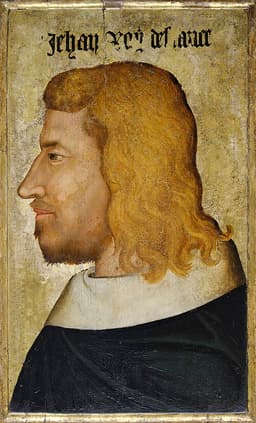
John II of France
Emperor · Medieval
37.5Total

Julius Caesar
General · Ancient
82.8Total
Basic Information
Born
1319
-100
Died
1364
-44
Era
Medieval
Ancient
Nationality
France
Roman Republic
Occupation
Emperor
General
Civilization
Western
Western
Score Comparison
Military (10%)
22.6
88.0
Political (20%)
27.9
78.0
Influence (20%)
47.9
85.0
Legacy (20%)
40.8
82.0
Leadership (15%)
34.6
80.0
Strategy (15%)
36.8
85.0
TOTAL
37.5
82.8
John II of France — Complete Timeline
1356 AD
Battle of PoitiersWar
John II led a French army against the English under Edward the Black Prince at Poitiers. The French were defeated, and John was captured along with many nobles. This was a major disaster for France, leading to a ransom demand and political crisis.
BattleCaptureHundred Years' War
Impact: regionaltragic
1360 AD
Treaty of BrétignyPolitical Action◆ Major
John II, while still a prisoner in England, agreed to the Treaty of Br
TreatyRansomTerritorial Cession
Impact: regional
1364 AD
Return to England as PrisonerPolitical Action
After his release, John II voluntarily returned to England when a hostage, his son Louis, escaped captivity. John cited his honor and the terms of the Treaty of Br
HonorCaptivityDeath
Impact: nationaltragic
Julius Caesar — Complete Timeline
58 BC
Gallic WarsWar◆ Major
Caesar, as proconsul of Gaul, launched a series of campaigns that conquered all of Gaul (modern France, Belgium, and parts of Switzerland). He fought numerous battles, including against the Helvetii, the Belgae, and the Gallic chieftain Vercingetorix. The wars brought immense wealth and a loyal army to Caesar.
Gallic WarsConquestRoman Expansion
Impact: regional
49 BC
Crossing the RubiconPolitical Action◆ Major
Caesar led Legio XIII across the Rubicon River into Italy, defying the Roman Senate's order to disband his army. This act triggered a civil war against Pompey and the Optimates, ultimately leading to Caesar's dictatorship and the end of the Roman Republic.
Roman Civil WarEnd of RepublicPower Struggle
Impact: global
48 BC
Battle of PharsalusWar◆ Major
Caesar's outnumbered army defeated the larger forces of Pompey the Great at Pharsalus in Greece. Caesar's tactical use of a reserve line to counter Pompey's cavalry charge proved decisive. Pompey fled to Egypt, where he was assassinated, leaving Caesar as the undisputed master of the Roman world.
Roman Civil WarBattleDecisive Victory
Impact: regional
44 BC
Appointment as Dictator for LifePolitical Action◆ Major
The Roman Senate appointed Caesar dictator perpetuo (dictator for life), granting him unprecedented personal power. This move concentrated military, legislative, and judicial authority in one person, effectively ending the Roman Republic's traditional system of checks and balances and alarming many senators.
DictatorshipEnd of RepublicPower Consolidation
Impact: regionaldestructive
Assassination on the Ides of MarchPolitical Action◆ Major
A group of Roman senators, led by Marcus Junius Brutus and Gaius Cassius Longinus, stabbed Caesar to death at a meeting of the Senate in the Theatre of Pompey. The assassination was intended to restore the Republic, but instead triggered another civil war that led to the rise of the Roman Empire.
AssassinationRoman PoliticsEnd of Republic
Impact: globaldestructive
Expert Analysis
john-ii-of-france-vs-julius-caesar
### The Gilded Cage and the Open Road: Why Caesar Changed the World and John II Could Not
History rarely offers a starker contrast than the one between Gaius Julius Caesar and John II of France. One man, a general of such audacity that he crossed a river and dared a republic to stop him, reshaping the Western world in the process. The other, a king so bound by a chivalric code that he willingly returned to a prison cell, leaving his kingdom poorer and his legend hollow. Both were men of their eras, but their eras demanded different things. Caesar’s Rome was a forge of ambition, where a single man could bend the world to his will. John’s France was a gilded cage of feudal obligation, where a king’s greatest act of honor was his quietest defeat. The difference between them is not merely one of talent, but of what they believed they owed to fortune, to their people, and to themselves.
**Origins**
Caesar was born into the twilight of the Roman Republic, a world of senatorial intrigue and endless conquest. His family, the Julii, claimed descent from the goddess Venus, but his branch was not wealthy. He learned early that in Rome, glory and debt were two sides of the same coin. He spent lavishly on games and bribes, borrowing against a future he was certain he could seize. His youth was marked by exile and piracy—he was captured by Cilician pirates, laughed at their ransom demand, and after his release, crucified them as promised. This was a man who treated risk as a plaything.
John II was born a king’s son in a France still reeling from the Black Death and the opening salvos of the Hundred Years’ War. His world was defined not by ambition but by duty. The French monarchy was a web of oaths, lands, and bloodlines. John was taught that a king’s virtue lay in piety, courage, and keeping his word. He was not stupid, but his imagination was bounded by the chivalric romances of his library. Where Caesar saw an open road, John saw a narrow path hedged by honor.
**Rise to Power**
Caesar’s path was a masterclass in political engineering. He forged the First Triumvirate with Pompey and Crassus, using their wealth and influence to secure a command in Gaul. Over eight years, he conquered a territory larger than Italy, writing his own propaganda in *The Gallic Wars*—a book that remains a classic of military literature and self-promotion. His crossing of the Rubicon in 49 BCE was a deliberate act of treason, a gamble that the Republic’s old guard would yield to his legions. The civil war that followed was brutal, but Caesar won. He was made dictator for life in 44 BCE.
John’s rise was far simpler: his father died, and he inherited the crown. There was no conspiracy, no brilliant campaign. He became king of a depleted realm in 1350, just as the war with England was grinding toward disaster. His moment of decision came not on a battlefield of his choosing, but at Poitiers in 1356. There, outmaneuvered by the English Black Prince, John led a desperate cavalry charge that failed. He was captured, along with much of the French nobility. His rise, in truth, was a fall.
**Leadership & Governance**
Caesar governed as he conquered: with speed, ruthlessness, and a keen eye for the symbolic. He reformed the calendar, gave land to his veterans, extended citizenship to provincials, and centralized power in his own hands. He pardoned many of his enemies, a calculated mercy that won him few friends and many resentments. His military genius was not just in tactics—the siege of Alesia remains a textbook example of counter-siege warfare—but in logistics and morale. He led from the front, ate with his men, and never asked them to do what he would not.
John’s governance was defined by absence. While a prisoner in England from 1356 to 1360, he negotiated the Treaty of Brétigny, which ceded vast territories in southwestern France to the English. His ransom was set at three million gold crowns—an impossible sum for a bankrupt kingdom. When he was finally released in 1360, he left his son Louis as a hostage. When Louis escaped, John did something astonishing: he voluntarily returned to English captivity in 1364, citing his word of honor. He died in London that same year. A noble gesture, perhaps, but it left France leaderless and humiliated.
**Triumph & Tragedy**
Caesar’s greatest triumph was his conquest of Gaul, which added a province that would become the heart of medieval Europe. His tragedy was the Ides of March—a brutal assassination by senators he had pardoned, men who feared his ambition. He fell at the foot of Pompey’s statue, stabbed twenty-three times. His last act was to pull his toga over his face, a gesture of dignity in a world he had remade.
John’s triumph was, if anything, his own captivity. In England, he conducted himself with such courtesy and dignity that his captors respected him. He founded the Order of the Star, a chivalric society, and wrote poetry. But his tragedy was that his honor cost his kingdom everything. His voluntary return to prison was a personal act of integrity that his subjects could not understand. He died a prisoner, and with him died the last hope of a strong French monarchy for a generation.
**Character & Destiny**
Caesar’s character was a blend of cold calculation and reckless charm. He believed he was destined to rule, and he shaped his destiny with every word and sword stroke. His famous line, “*Veni, vidi, vici*” (I came, I saw, I conquered), was not boastful—it was a statement of fact. He understood that in a world of men, the man who acts first and fastest wins.
John’s character was defined by a code that had become a cage. He was brave, pious, and true to his word. But in a world of shifting alliances and realpolitik, these virtues were liabilities. He could not see that honor, when it serves no one, is merely vanity. His destiny was not to conquer but to endure, and he endured with a grace that history has quietly forgotten.
**Legacy**
Caesar’s legacy is the Roman Empire. His adopted heir, Octavian, became Augustus, and the Republic became a monarchy that would endure for centuries. Every European emperor, from Charlemagne to Napoleon, would measure himself against Caesar. His name became a title: Kaiser, Tsar.
John’s legacy is a lesson in the limits of chivalry. He is remembered, if at all, as John the Good—a king who was good at nothing that mattered. The Treaty of Brétigny was soon repudiated, and the Hundred Years’ War dragged on for another century. His voluntary return to England is a historical curiosity, a footnote in the story of a kingdom that needed a warrior, not a martyr.
**Conclusion**
To compare Caesar and John is to see two different answers to the same question: what does it mean to lead? Caesar believed leadership was action—the relentless pursuit of power, the remaking of the world in one’s own image. John believed leadership was obligation—the faithful execution of a role, even unto death. One built an empire; the other built a prison for himself. In the end, history does not reward goodness. It rewards greatness, even when that greatness is terrifying. Caesar changed the world because he was willing to break it. John could not, because he was too good to try.
Rankings
🥇
Julius CaesarLeader
Mil: 88.0Pol: 78.0Inf: 85.0
82.8
🥈
John II of France
Mil: 22.6Pol: 27.9Inf: 47.9
37.5
+45.3 behind
How This Comparison Works
Algorithm
Each figure is scored on 6 dimensions (0—100 scale) based on structured historical data: Military (10%), Political (20%), Influence (20%), Legacy (20%), Leadership (15%), Strategy (15%). The weighted total produces the final ranking.
Data Sources
Scores are computed from structured sub-indicators in the database. Scale factors adjust for era (Ancient ×0.85, Modern ×1.0) and civilization size (Eastern ×1.05, Other ×0.80) to account for differences in population and military scale.
Maximum 3 Figures
Comparisons are limited to 2—3 figures to ensure readability and statistical meaningfulness.
Error Margins
±5 points per dimension — Sub-scores are derived from historical records with inherent uncertainty. Two figures within 5 points on a dimension should be considered roughly equivalent in that area.
Total Score Accuracy
±3 points overall — The weighted combination of 6 dimensions produces a total score with approximately ±3 points of uncertainty. Differences of less than 3 points are not statistically significant— the figures are effectively tied.
Known Limitations
- Historical records are incomplete and uneven across civilizations
- Figures from oral-tradition societies may be underrepresented
- Occupation labels can misclassify multi-role figures
- Scores measure capability and impact, not moral character
- Quantitative scoring is a comparison tool, not absolute truth
Capability Radar
Military (10%) — Battles & Warfare
Battles
20
95
Win Rate
10
92
Expansion
5
97
Political (20%) — Governance & Reform
Reform
20
90
Diplomacy
15
85
Economy
10
82
Influence (20%) — Cultural & Global Reach
Cultural
15
88
Global
10
94
Legacy (20%) — Historical Impact
Historical
25
95
Longevity
20
96
Leadership (15%) — Power & Stability
Tenure
30
75
Stability
10
60
Strategy (15%) — Tactics & Innovation
Strategy
10
94
Tactics
15
96
Reform
5
88
Similar Comparisons
Comments & Discussion
CAESAR'S_LEGIONNAIRE6/17/2026
Look, John II rode to Poitiers in full armor with his chevaliers, while Caesar rode with legions that actually won battles. John got captured, then called it chivalry when he went back to England. That's not honor—that's bad military planning. Caesar crossed the Rubicon, didn't ask permission, and reshaped history. John crossed the Channel, surrendered, and bankrupted France. One seized destiny; the other cowered in a tower. Give me the man who built bridges, not the one who bent knees.|en|
CLASSICS_SHED_CRITIC6/17/2026
别逗了,拿约翰二世跟凯撒比,就像是把铁砧和羽毛秤一起。凯撒干了什么?他玩转罗马元老院,征服高卢,改写历法,还让"我来,我见,我征服"成了千古名言。约翰呢?普瓦捷一战被俘,还觉得自己特高尚地回英国坐牢,留下一屁股赎金债务。这哪是荣誉,这是典型的中世纪自我麻醉。凯撒是变革的引擎,约翰是被时代碾碎的轮子。|zh|
THE_QUANTIFIED_HISTORIAN6/17/2026
Let's look at hard numbers. Caesar personally commanded 50,000+ legions across Gaul and won decisive battles like Alesia against a coalition of 80,000+ Gauls. John II's major engagement, Poitiers in 1356, saw 6,000 French dead vs 1,000 English losses, and John himself captured. John died in London in 1364, having accomplished zero territorial gains for France. Caesar conquered 800+ cities and left an empire. The data speaks: one was a force multiplier, the other a fiscal black hole.|en|
金笼骑士6/17/2026
约翰二世确实困在中世纪的金笼子里,但这不代表他一无是处。他创立了法国的"金羊毛骑士团",还试图改革货币和司法。可他最大的败笔是被俘后签了《布雷蒂尼条约》,割让了法国三分之一的领土。凯撒呢?他死在元老院的地板上,血流成河,但那是因为他激进改革激怒了既得利益者。约翰死于伦敦的萨伏伊宫,安静的沮丧。两种结局,一种悲剧伟大,一种平凡可悲。|zh|
THE_CRITICAL_REVISIONIST6/17/2026
Stop romanticizing Caesar's "glory"—he destabilized the Republic through civil war, destroyed political norms, and got himself assassinated. John II's capture at Poitiers was bad, but his ransom efforts at least tried to stabilize French monarchy. Caesar's "I came, I saw, I conquered" was just imperialist propaganda. He didn't reshape Western civilization alone; he broke it so Augustus