Loading...
John II of France vs Mahmud II of Mali
John II of France leads by 1.1 pts · 2 figures compared
…
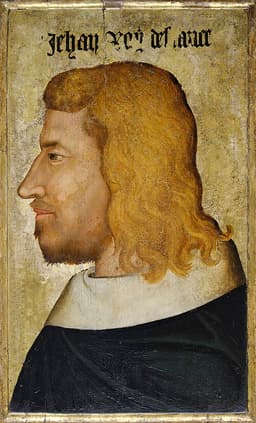
John II of France
Emperor · Medieval
37.5Total
Mahmud II of Mali
Emperor · Medieval
36.4Total
Basic Information
Born
1319
1400
Died
1364
1420
Era
Medieval
Medieval
Nationality
France
Mali Empire
Occupation
Emperor
Emperor
Civilization
Western
Other
Score Comparison
Military (10%)
22.6
14.9
Political (20%)
27.9
30.7
Influence (20%)
47.9
47.9
Legacy (20%)
40.8
37.5
Leadership (15%)
34.6
33.6
Strategy (15%)
36.8
39.6
TOTAL
37.5
36.4
John II of France — Complete Timeline
1356 AD
Battle of PoitiersWar
John II led a French army against the English under Edward the Black Prince at Poitiers. The French were defeated, and John was captured along with many nobles. This was a major disaster for France, leading to a ransom demand and political crisis.
BattleCaptureHundred Years' War
Impact: regionaltragic
1360 AD
Treaty of BrétignyPolitical Action◆ Major
John II, while still a prisoner in England, agreed to the Treaty of Br
TreatyRansomTerritorial Cession
Impact: regional
1364 AD
Return to England as PrisonerPolitical Action
After his release, John II voluntarily returned to England when a hostage, his son Louis, escaped captivity. John cited his honor and the terms of the Treaty of Br
HonorCaptivityDeath
Impact: nationaltragic
Expert Analysis
Origins
John II of France (1319-1364) was born into the Valois dynasty, son of Philip VI and Joan the Lame. He grew up in a court plagued by the Hundred Years' War and the Black Death. His education was typical for a medieval prince: chivalric training, Latin, and statecraft. His father's reign saw the disastrous Battle of Crécy (1346), setting a grim precedent.
Mahmud II of Mali (reigned c. 1480s-1490s) was a mansa of the Mali Empire, part of the Keita dynasty. Details of his early life are scarce, but he inherited an empire already in decline after the reign of Mansa Musa and the rise of the Songhai Empire. His formative years likely involved court intrigue in Niani, the capital.
Rise to Power
John II ascended the French throne in 1350 upon his father's death. His reign began with the ongoing war with England. He immediately faced challenges: a depleted treasury, a restless nobility, and the English threat under Edward III and the Black Prince. His coronation was marked by attempts to assert royal authority over fractious vassals.
Mahmud II became mansa after a period of internal strife. The Mali Empire had lost much of its western provinces to the rising Songhai. Mahmud's rise was likely through dynastic succession, but he inherited a crumbling state, with Tuareg nomads encroaching from the north and Songhai expanding from the east.
Leadership & Governance
John II's leadership was characterized by a rigid adherence to chivalric codes and a focus on personal honor over strategic pragmatism. He governed through a feudal system, relying on nobles who often pursued their own interests. His financial mismanagement led to coinage debasement and heavy taxes, fueling peasant revolts like the Jacquerie of 1358. He scored 34.6 in leadership and 27.9 in political skill.
Mahmud II's governance was marked by his inability to stem the empire's decline. He faced rebellions and lost control of key trade routes. Unlike his predecessor Mansa Musa, who centralized power, Mahmud's authority weakened. His political score of 30.7 reflects some diplomatic efforts but ultimately failure to hold the empire together.
Triumph & Tragedy
John II's greatest success was perhaps his handling of the post-Poitiers situation in terms of personal honor: he returned to English captivity after his son's escape, a gesture that bolstered his reputation among contemporaries. However, his tragedy was the Battle of Poitiers (1356), where he was captured along with many nobles. The subsequent Treaty of Brétigny (1360) ceded huge territories to England, a major loss for France. His military score of 22.6 reflects his poor generalship.
Mahmud II's reign saw the loss of Timbuktu to the Tuareg in the late 1400s, a catastrophic blow to Mali's prestige and economy. Timbuktu was a center of trade and learning. His failure to defend it shows his military weakness (score 14.9). There is no record of a major triumph; his reign is mostly defined by decline.
Character & Destiny
John II was known for his courage and sense of honor, but also for impulsiveness and poor judgment. At Poitiers, he refused to retreat, leading to capture. His voluntary return to England shows a fatalistic commitment to his word. These traits made him a tragic figure, but his decisions hastened France's humiliation.
Mahmud II's character is less documented, but his inability to act decisively against the Tuareg suggests either weakness or lack of resources. His destiny was to preside over the empire's final unraveling. The Mali Empire never recovered from losses during his reign.
Legacy
John II's legacy is mixed: he is remembered for the Treaty of Brétigny and his captivity, but also for the beginning of fiscal and administrative reforms that later kings built upon. His son Charles V learned from his father's mistakes and restored French fortunes. John's total score of 37.5 is slightly above Mahmud's 36.4.
Mahmud II's legacy is one of decline. The loss of Timbuktu marked the end of Mali's dominance over trans-Saharan trade. The empire fragmented, and by the 16th century, it was a shadow of its former self. He is a cautionary figure in West African history, representing the consequences of weak leadership.
Conclusion
While both rulers presided over decline, John II of France had a slightly greater impact on history. His capture at Poitiers and the Treaty of Brétigny reshaped the Hundred Years' War, leading to French reforms under Charles V. Mahmud II's reign was a chapter in the inevitable collapse of an empire already in decay. With a total score of 37.5 versus 36.4, John II's failures were more consequential for European history than Mahmud's for West Africa. John's story is better documented and his actions influenced later French state-building. Therefore, John II of France had a greater historical impact.
Rankings
🥇
John II of FranceLeader
Mil: 22.6Pol: 27.9Inf: 47.9
37.5
🥈
Mahmud II of Mali
Mil: 14.9Pol: 30.7Inf: 47.9
36.4
+1.1 behind
How This Comparison Works
Algorithm
Each figure is scored on 6 dimensions (0—100 scale) based on structured historical data: Military (10%), Political (20%), Influence (20%), Legacy (20%), Leadership (15%), Strategy (15%). The weighted total produces the final ranking.
Data Sources
Scores are computed from structured sub-indicators in the database. Scale factors adjust for era (Ancient ×0.85, Modern ×1.0) and civilization size (Eastern ×1.05, Other ×0.80) to account for differences in population and military scale.
Maximum 3 Figures
Comparisons are limited to 2—3 figures to ensure readability and statistical meaningfulness.
Error Margins
±5 points per dimension — Sub-scores are derived from historical records with inherent uncertainty. Two figures within 5 points on a dimension should be considered roughly equivalent in that area.
Total Score Accuracy
±3 points overall — The weighted combination of 6 dimensions produces a total score with approximately ±3 points of uncertainty. Differences of less than 3 points are not statistically significant— the figures are effectively tied.
Known Limitations
- Historical records are incomplete and uneven across civilizations
- Figures from oral-tradition societies may be underrepresented
- Occupation labels can misclassify multi-role figures
- Scores measure capability and impact, not moral character
- Quantitative scoring is a comparison tool, not absolute truth
Capability Radar
Military (10%) — Battles & Warfare
Battles
20
10
Win Rate
10
5
Expansion
5
5
Political (20%) — Governance & Reform
Reform
20
10
Diplomacy
15
10
Economy
10
15
Influence (20%) — Cultural & Global Reach
Cultural
15
15
Global
10
10
Legacy (20%) — Historical Impact
Historical
25
15
Longevity
20
10
Leadership (15%) — Power & Stability
Tenure
30
20
Stability
10
10
Strategy (15%) — Tactics & Innovation
Strategy
10
10
Tactics
15
10
Reform
5
5
Similar Comparisons
Comments & Discussion
No comments yet. Be the first to share your thoughts!