Loading...
Jia Xu vs Shen Buhai
Shen Buhai leads by 9.6 pts · 2 figures compared
…
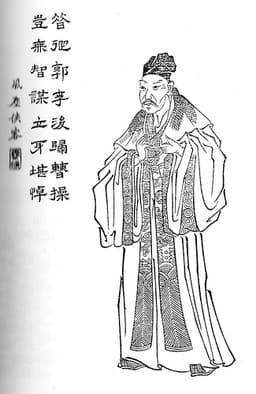
Jia Xu
Politician · Ancient
51.4Total

Shen Buhai
Politician · Ancient
61.0Total
Basic Information
Born
147
-400
Died
223
-337
Era
Ancient
Ancient
Nationality
China
China
Occupation
Politician
Politician
Civilization
Eastern
Eastern
Score Comparison
Military (10%)
45.0
39.4
Political (20%)
39.4
72.0
Influence (20%)
56.4
82.0
Legacy (20%)
50.0
55.0
Leadership (15%)
67.0
40.0
Strategy (15%)
43.3
60.0
TOTAL
51.4
61.0
Jia Xu — Complete Timeline
192 AD
Advised Li Jue and Guo Si to attack Chang'anWar◆ Major
After Dong Zhuo's death, Jia Xu advised his subordinates Li Jue and Guo Si to gather their troops and attack Chang'an rather than disbanding. This led to the capture of the capital and the restoration of their power, though it plunged the region into further chaos.
Han DynastyWarlord EraChang'an
Impact: nationaldestructive
199 AD
Switched allegiance to Cao CaoPolitical Action
Jia Xu left Zhang Xiu's service and joined Cao Cao, bringing with him strategic advice. Cao Cao welcomed him and later relied on his counsel for major decisions.
Cao CaoAllegiance ChangeAdvisor
Impact: national
200 AD
Advised Cao Cao to attack Yuan Shao at GuanduWar◆ Major
When Cao Cao hesitated to engage Yuan Shao due to lack of supplies, Jia Xu argued that Cao Cao's strategic acumen and the morale of his troops outweighed Yuan Shao's numerical advantage. Cao Cao followed the advice and won the Battle of Guandu.
Battle of GuanduCao CaoMilitary Advice
Impact: regionalconstructive
208 AD
Opposed Cao Cao's plan to attack Sun QuanPolitical Action
After Cao Cao's defeat at Red Cliffs, Jia Xu advised against a hasty second invasion of Jiangdong, arguing that Cao Cao should consolidate his gains first. Cao Cao did not follow this advice and suffered further setbacks.
Red CliffsCao CaoStrategic Advice
Impact: regionalconstructive
215 AD
Advised Cao Cao to invade Hanzhong via the Qinling MountainsWar
Jia Xu recommended that Cao Cao launch a campaign against Zhang Lu in Hanzhong using a mountain route. The campaign succeeded, and Cao Cao gained control of Hanzhong.
Hanzhong CampaignCao CaoMilitary Strategy
Impact: regionalconstructive
Shen Buhai — Complete Timeline
351 BC
Chancellorship under Marquis Zhao of HanPolitical Action◆ Major
Shen Buhai served as chancellor of the state of Han under Marquis Zhao. He implemented administrative reforms focused on bureaucratic efficiency, selection of capable officials, and strict enforcement of laws, laying the foundation for Legalist governance.
Han StateLegalist ReformBureaucracy
Impact: regionalconstructive
340 BC
Composition of the ShenziCultural◆ Major
Shen Buhai wrote the Shenzi, a text outlining his political philosophy emphasizing administrative techniques (shu) for rulers. The work advocated for the ruler to maintain power through control of bureaucracy and appointment of competent ministers, influencing later Legalist thought.
Legalist TextPolitical PhilosophyAdministrative Techniques
Impact: regionalconstructive
Expert Analysis
Origins
Jia Xu (147–224 CE) was born in Wuwei Commandery (modern Gansu) during the Eastern Han dynasty. Little is known of his early life, but he gained a reputation as a brilliant strategist while serving under minor warlords. His formative experiences occurred amid the collapse of Han authority, where survival depended on tactical acumen.
Shen Buhai (c. 400–337 BCE) was born in the state of Han during the Warring States period. He served as chancellor under Marquis Zhao of Han. His background was likely administrative, and he developed his philosophy of statecraft based on practical governance, not military conquest.
Rise to Power
Jia Xu rose to prominence after Dong Zhuo's death in 192 CE. Dong's subordinates Li Jue and Guo Si were about to disband when Jia Xu advised them to gather troops and attack Chang'an. They succeeded, capturing the capital and holding the emperor hostage. Jia Xu's counsel proved decisive, but he later distanced himself from their regime due to its brutality.
Shen Buhai gained power through appointment as chancellor of Han. He implemented administrative reforms that strengthened the state without expanding its territory. His rise was based on meritocratic principles, as he advocated for selecting officials based on ability rather than birth.
Leadership & Governance
Jia Xu operated as an advisor, not a ruler. His leadership style was indirect; he influenced decisions through precise counsel. For example, when Cao Cao hesitated at Guandu (200 CE), Jia Xu argued that Cao Cao's strategic superiority and troop morale outweighed Yuan Shao's numerical advantage. Cao Cao followed the advice and won a decisive victory. Jia Xu scored 67.0 in leadership, reflecting his ability to guide powerful figures.
Shen Buhai, as chancellor, directly governed. He emphasized administrative techniques (shu) to manage bureaucracy. His reforms included standardizing procedures and selecting officials based on performance. He scored 72.0 in political ability, higher than Jia Xu's 39.4, indicating his direct impact on statecraft.
Triumph & Tragedy
Jia Xu's greatest triumph was his counsel at Guandu, which helped Cao Cao defeat Yuan Shao and establish dominance. He also advised the successful Hanzhong campaign. However, his advice to Li Jue and Guo Si led to chaos and suffering. Jia Xu's tragedy was that his brilliance often served ruthless masters, and he failed to prevent the destruction caused by his own strategies.
Shen Buhai's triumph was transforming Han from a weak state into a more efficient bureaucracy, laying groundwork for Legalist reforms. His tragedy is that his writings are largely lost; only fragments survive. His ideas were overshadowed by Han Fei and Shang Yang, despite being foundational.
Character & Destiny
Jia Xu was pragmatic and cautious, often advising restraint. He opposed Cao Cao's plan to attack Sun Quan after Red Cliffs, warning against overreach. His character was shaped by survival instincts, leading him to serve multiple masters. He died naturally at 77, a rare fate for a strategist in turbulent times.
Shen Buhai was methodical and focused on systems. He believed that a ruler should remain detached, using techniques to control officials. His destiny was to be remembered as a theorist rather than a practitioner, as his reforms did not survive the fall of Han.
Legacy
Jia Xu's legacy is as a master strategist whose advice was almost always correct. He influenced later military thought, though he is less known than Zhuge Liang. His score of 50.0 in legacy reflects his limited fame outside sinology.
Shen Buhai's legacy is more profound. His ideas on administrative techniques influenced Chinese governance for centuries. He scored 82.0 in influence, the highest among the two, because his philosophy shaped Legalism and imperial bureaucracy. The Shenzi, though fragmentary, remains a key text.
Conclusion
While Jia Xu was a brilliant tactician with a 51.4 total score, Shen Buhai's 61.0 total reflects his greater impact on political philosophy and governance. Shen Buhai's ideas about bureaucratic efficiency and meritocracy outlasted any single military campaign. His influence on Han Fei and subsequent Chinese statecraft makes him the more significant figure. Jia Xu's counsel shaped battles, but Shen Buhai shaped systems.
Rankings
🥇
Shen BuhaiLeader
Mil: 39.4Pol: 72.0Inf: 82.0
61.0
🥈
Jia Xu
Mil: 45.0Pol: 39.4Inf: 56.4
51.4
+9.6 behind
How This Comparison Works
Algorithm
Each figure is scored on 6 dimensions (0—100 scale) based on structured historical data: Military (10%), Political (20%), Influence (20%), Legacy (20%), Leadership (15%), Strategy (15%). The weighted total produces the final ranking.
Data Sources
Scores are computed from structured sub-indicators in the database. Scale factors adjust for era (Ancient ×0.85, Modern ×1.0) and civilization size (Eastern ×1.05, Other ×0.80) to account for differences in population and military scale.
Maximum 3 Figures
Comparisons are limited to 2—3 figures to ensure readability and statistical meaningfulness.
Error Margins
±5 points per dimension — Sub-scores are derived from historical records with inherent uncertainty. Two figures within 5 points on a dimension should be considered roughly equivalent in that area.
Total Score Accuracy
±3 points overall — The weighted combination of 6 dimensions produces a total score with approximately ±3 points of uncertainty. Differences of less than 3 points are not statistically significant— the figures are effectively tied.
Known Limitations
- Historical records are incomplete and uneven across civilizations
- Figures from oral-tradition societies may be underrepresented
- Occupation labels can misclassify multi-role figures
- Scores measure capability and impact, not moral character
- Quantitative scoring is a comparison tool, not absolute truth
Capability Radar
Military (10%) — Battles & Warfare
Battles
10
40
Win Rate
15
41
Expansion
5
49
Political (20%) — Governance & Reform
Reform
10
75
Diplomacy
70
50
Economy
10
60
Influence (20%) — Cultural & Global Reach
Cultural
30
60
Global
20
50
Legacy (20%) — Historical Impact
Historical
50
70
Longevity
40
65
Leadership (15%) — Power & Stability
Tenure
30
40
Stability
40
55
Strategy (15%) — Tactics & Innovation
Strategy
70
49
Tactics
60
53
Reform
5
54
Similar Comparisons
Comments & Discussion
No comments yet. Be the first to share your thoughts!