Loading...
Janos Kadar vs Julius Caesar
Julius Caesar leads by 26.3 pts · 2 figures compared
…
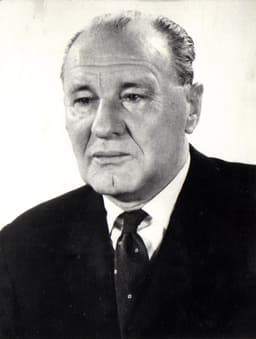
Janos Kadar
Politician · Modern
56.5Total

Julius Caesar
General · Ancient
82.8Total
Basic Information
Born
1912
-100
Died
1989
-44
Era
Modern
Ancient
Nationality
Hungary
Roman Republic
Occupation
Politician
General
Civilization
Western
Western
Score Comparison
Military (10%)
49.8
88.0
Political (20%)
60.0
78.0
Influence (20%)
56.4
85.0
Legacy (20%)
49.2
82.0
Leadership (15%)
79.8
80.0
Strategy (15%)
41.7
85.0
TOTAL
56.5
82.8
Janos Kadar — Complete Timeline
1956 AD
Appointment as First Secretary of the Hungarian Socialist Workers' PartyPolitical Action◆ Major
Kadar was appointed First Secretary after the Soviet invasion crushed the Hungarian Revolution. He initially supported the revolution but then collaborated with the Soviets, a move that defined his controversial legacy.
Communist leadership1956 Revolution
Impact: national
1958 AD
Execution of Imre NagyPolitical Action◆ Major
Kadar's government tried and executed former Prime Minister Imre Nagy for his role in the 1956 Revolution. This act solidified Kadar's power but also made him a deeply unpopular figure among many Hungarians.
Political repression1956 Revolution
Impact: nationaltragic
1968 AD
Introduction of Goulash CommunismReform◆ Major
Kadar introduced the New Economic Mechanism, a series of market-oriented reforms that allowed limited private enterprise and consumer goods. This 'goulash communism' improved living standards and made Hungary the most liberal country in the Eastern Bloc.
Economic reformLiberalization
Impact: nationalconstructive
1988 AD
Resignation from PowerPolitical Action◆ Major
Facing economic stagnation and growing political opposition, Kadar was forced to resign as party leader. He was replaced by a reformist faction, marking the end of his 32-year rule.
Fall of communism
Impact: national
Julius Caesar — Complete Timeline
58 BC
Gallic WarsWar◆ Major
Caesar, as proconsul of Gaul, launched a series of campaigns that conquered all of Gaul (modern France, Belgium, and parts of Switzerland). He fought numerous battles, including against the Helvetii, the Belgae, and the Gallic chieftain Vercingetorix. The wars brought immense wealth and a loyal army to Caesar.
Gallic WarsConquestRoman Expansion
Impact: regional
49 BC
Crossing the RubiconPolitical Action◆ Major
Caesar led Legio XIII across the Rubicon River into Italy, defying the Roman Senate's order to disband his army. This act triggered a civil war against Pompey and the Optimates, ultimately leading to Caesar's dictatorship and the end of the Roman Republic.
Roman Civil WarEnd of RepublicPower Struggle
Impact: global
48 BC
Battle of PharsalusWar◆ Major
Caesar's outnumbered army defeated the larger forces of Pompey the Great at Pharsalus in Greece. Caesar's tactical use of a reserve line to counter Pompey's cavalry charge proved decisive. Pompey fled to Egypt, where he was assassinated, leaving Caesar as the undisputed master of the Roman world.
Roman Civil WarBattleDecisive Victory
Impact: regional
44 BC
Appointment as Dictator for LifePolitical Action◆ Major
The Roman Senate appointed Caesar dictator perpetuo (dictator for life), granting him unprecedented personal power. This move concentrated military, legislative, and judicial authority in one person, effectively ending the Roman Republic's traditional system of checks and balances and alarming many senators.
DictatorshipEnd of RepublicPower Consolidation
Impact: regionaldestructive
Assassination on the Ides of MarchPolitical Action◆ Major
A group of Roman senators, led by Marcus Junius Brutus and Gaius Cassius Longinus, stabbed Caesar to death at a meeting of the Senate in the Theatre of Pompey. The assassination was intended to restore the Republic, but instead triggered another civil war that led to the rise of the Roman Empire.
AssassinationRoman PoliticsEnd of Republic
Impact: globaldestructive
Expert Analysis
janos-kadar-vs-julius-caesar
# The Dictator's Paradox
On a spring morning in 44 BCE, the most powerful man in the Roman world fell bleeding at the feet of his enemies, his body pierced twenty-three times by senators he had once called friends. Eighteen centuries later, in a Budapest gripped by winter in 1956, a man who had just helped crush a revolution with Soviet tanks took power, not knowing he would spend the next three decades trying to find a middle path between tyranny and freedom. Julius Caesar and János Kádár: one conquered the known world and died for his ambition; the other inherited a broken nation and ruled it into a quiet, gray stability. What drove two such different outcomes, and what can they tell us about the nature of power itself?
Origins
Caesar was born into the twilight of the Roman Republic, a world of senatorial intrigues, slave revolts, and the crumbling of ancient traditions. His family, the Julii, claimed descent from the goddess Venus, but they were not among the wealthiest or most powerful. The young Caesar learned early that in Rome, glory and debt were two sides of the same coin. He borrowed fortunes to stage lavish games and public spectacles, understanding that popularity could be purchased before it was earned.
Kádár, by contrast, entered the world in 1912 as the illegitimate son of a chambermaid in the declining Austro-Hungarian Empire. He grew up in poverty, apprenticed as a typewriter repairman, and found his purpose in the underground communist movement of the 1930s. Where Caesar was born into a world of marble and rhetoric, Kádár was forged in the grim workshops of Budapest and the prisons of Hungary's wartime fascist regime. One man's universe was expanding with conquest; the other's was contracting under occupation.
Rise to Power
Caesar's ascent was a masterpiece of calculated risk. He climbed the traditional Roman ladder of offices—quaestor, aedile, praetor—but he also formed the First Triumvirate with Pompey and Crassus, an alliance that bypassed the Senate's authority. His appointment as governor of Gaul gave him the army he needed. For nine years, he fought, wrote, and conquered, turning the Gallic tribes into a personal legend and a loyal legion.
Kádár's rise was more brutal. In 1956, when Hungarian revolutionaries briefly overthrew Soviet control, Kádár initially appeared to support them. Then Soviet tanks rolled in, and he switched sides. On November 4, 1956, he was appointed First Secretary of the Hungarian Socialist Workers' Party, effectively installed by Moscow. He had watched his predecessor Imre Nagy try to chart an independent course, and he had seen the result. Kádár chose survival.
Leadership & Governance
Caesar governed as a military genius and a political reformer. His military score of 88.0 reflects campaigns that rewrote the rules of war: the siege of Alesia, the crossing of the Rubicon, the lightning victory at Pharsalus. But his political score of 78.0 tells a more complicated story. As dictator, he reformed the calendar, extended citizenship to provincials, and launched public works projects. Yet he centralized power so completely that the Republic could not survive him. He was a brilliant builder who demolished the foundations.
Kádár governed with a political score of 71.5 and a military score of only 37.5—a leader who never commanded armies but mastered the art of survival within a system. His "Goulash Communism," introduced with the New Economic Mechanism of 1968, allowed limited private enterprise, consumer goods, and a degree of cultural freedom unmatched in the Soviet bloc. He traded political loyalty for material comfort. Where Caesar demanded glory, Kádár offered peace. The Hungarians called it "the happiest barracks in the camp."
Triumph & Tragedy
Caesar's greatest triumph was Gaul—the conquest of a vast territory, the writing of his own legend in the *Commentaries*, the creation of a loyal army that would follow him anywhere. His tragedy was the Ides of March, 44 BCE, when the senators who feared his kingship murdered him, triggering another cycle of civil war that ended the Republic forever.
Kádár's triumph was stability. After the bloodshed of 1956, he gave Hungary two decades of relative prosperity and personal freedom. His tragedy was that the system he perfected could not reform itself. By 1988, facing economic stagnation and rising opposition, he was forced to resign. He died in 1989, just months before the Berlin Wall fell and the entire Soviet empire he had served collapsed.
Character & Destiny
Caesar was audacity incarnate. He crossed the Rubicon with the words "the die is cast," gambling everything on a single throw. He pardoned his enemies, promoted talent regardless of birth, and believed his own myth until the daggers proved him mortal. His character drove him to reach for absolute power, and that same character made his assassination inevitable.
Kádár was caution itself. He had seen friends executed, revolutions crushed, and the price of defiance. He chose to work within the cage, opening the door a crack rather than trying to break the lock. His character—shaped by poverty, imprisonment, and the terror of Stalinism—made him a survivor, not a conqueror. He kept his country quiet, and for that, history judges him with a legacy score of 67.7, respectable but not heroic.
Legacy
Caesar's legacy is everywhere. His name became a title—Kaiser, Tsar—and his reforms shaped Western governance. His assassination made him a martyr, and his adopted son Octavian became Augustus, the first emperor. Caesar's total score of 83.3 reflects a man who changed the world, for better and worse.
Kádár's legacy is more modest. He is remembered in Hungary with ambivalence: a dictator who chose pragmatism over terror, who gave his people refrigerators and holidays but never freedom. His score of 61.4 is the mark of a competent manager of decline, not a shaper of ages.
Conclusion
Caesar and Kádár are separated by two thousand years and an unbridgeable gulf of ambition. One died because he reached too high; the other faded because he aimed too low. Yet both faced the same fundamental question: how much power can one person hold without destroying the very thing they seek to rule? Caesar answered by grasping for everything and losing it all. Kádár answered by holding tight to something small and keeping it safe. In the end, we remember Caesar for his brilliance and his fall. We remember Kádár, if at all, for having kept his people warm while they waited for a better world. History, perhaps, has room for both kinds of leaders—but it gives its laurels only to those who dare.
Rankings
🥇
Julius CaesarLeader
Mil: 88.0Pol: 78.0Inf: 85.0
82.8
🥈
Janos Kadar
Mil: 49.8Pol: 60.0Inf: 56.4
56.5
+26.3 behind
How This Comparison Works
Algorithm
Each figure is scored on 6 dimensions (0—100 scale) based on structured historical data: Military (10%), Political (20%), Influence (20%), Legacy (20%), Leadership (15%), Strategy (15%). The weighted total produces the final ranking.
Data Sources
Scores are computed from structured sub-indicators in the database. Scale factors adjust for era (Ancient ×0.85, Modern ×1.0) and civilization size (Eastern ×1.05, Other ×0.80) to account for differences in population and military scale.
Maximum 3 Figures
Comparisons are limited to 2—3 figures to ensure readability and statistical meaningfulness.
Error Margins
±5 points per dimension — Sub-scores are derived from historical records with inherent uncertainty. Two figures within 5 points on a dimension should be considered roughly equivalent in that area.
Total Score Accuracy
±3 points overall — The weighted combination of 6 dimensions produces a total score with approximately ±3 points of uncertainty. Differences of less than 3 points are not statistically significant— the figures are effectively tied.
Known Limitations
- Historical records are incomplete and uneven across civilizations
- Figures from oral-tradition societies may be underrepresented
- Occupation labels can misclassify multi-role figures
- Scores measure capability and impact, not moral character
- Quantitative scoring is a comparison tool, not absolute truth
Capability Radar
Military (10%) — Battles & Warfare
Battles
29
95
Win Rate
32
92
Expansion
34
97
Political (20%) — Governance & Reform
Reform
65
90
Diplomacy
70
85
Economy
60
82
Influence (20%) — Cultural & Global Reach
Cultural
40
88
Global
40
94
Legacy (20%) — Historical Impact
Historical
50
95
Longevity
45
96
Leadership (15%) — Power & Stability
Tenure
75
75
Stability
55
60
Strategy (15%) — Tactics & Innovation
Strategy
36
94
Tactics
40
96
Reform
45
88
Similar Comparisons
Comments & Discussion
CRASUS'S GHOST6/17/2026
Comparing Caesar to Kádár is like comparing a wildfire to a dying ember. Caesar didn't stumble into power; he conquered Gaul, crossed the Rubicon, and remade Rome through sheer audacity. Kádár, by contrast, was a Soviet pawn who crushed Hungary's 1956 revolution with Soviet tanks and then ruled through bureaucratic inertia. One reshaped civilization; the other just kept his chair warm for Moscow. Don't conflate ambition with survival.
元老院的叹息6/17/2026
一个征服者,一个妥协者,这根本是关公战秦琼。恺撒在元老院被刺了二十三刀,那是权力巅峰的代价——他死得像个英雄。而卡达尔是苏联的提线木偶,靠坦克镇压同胞上台,统治三十年换来"灰浆泡饭"的稳定。恺撒至少留下了历法和高卢战记,卡达尔留下了什么?匈牙利人管那叫"最欢乐的营房"。选择你的诗人,而不是你的狱卒。
LIVY'S APPRENTICE6/17/2026
By Roman standards, Kádár is barely a footnote. Caesar's legacy—the Julian calendar, the Romanization of Gaul, even his assassination's political theater—echoes still. Kádár's "goulash communism" was a desperate bribe for loyalty, collapsing within a decade of his death. When I read the Commentarii, I see a general who wrote his own history. Kádár couldn't even control his own narrative. One built an empire; the other managed an occupation. Choose your monument.
沉默的问卷6/17/2026
别拿罗马的辉煌来粉饰东欧的灰暗。数据不会撒谎:公元前44年罗马人口只有100万左右,恺撒却推动了横跨三洲的变革;而1956年匈牙利近千万人口,卡达尔只带来了年均2%的经济增长和数万政治犯——这是"稳定"吗?更是停滞。恺撒死于抱负,卡达尔死于病榻。算算投入产出比,野心家的覆灭可比冷暴力的永生高贵多了。
FORUM'S CRITIC6/17/2026
Yes, Caesar's reforms were monumental, but he was also a populist who destroyed a functioning Republic for personal glory. Kádár, despite his bloody origin, gave Hungarians relative stability and even some consumer goods—a trade-off many accepted. Caesar's bridge over the Rhine is impressive; Kádár's 1968 New Economic Mechanism quietly improved millions of lives without a single triumph. Not every ruler needs a triumph; sometimes you just need a functioning refrigerator.