Loading...
Jacques Chirac vs Julius Caesar
Julius Caesar leads by 22.1 pts · 2 figures compared
…
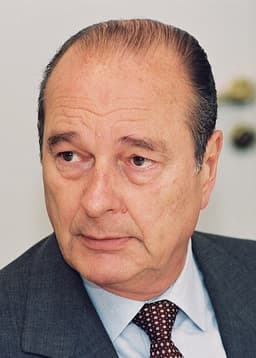
Jacques Chirac
Politician · Modern
60.7Total

Julius Caesar
General · Ancient
82.8Total
Basic Information
Born
1932
-100
Died
—
-44
Era
Modern
Ancient
Nationality
France
Roman Republic
Occupation
Politician
General
Civilization
Western
Western
Score Comparison
Military (10%)
10.0
88.0
Political (20%)
72.0
78.0
Influence (20%)
82.0
85.0
Legacy (20%)
50.0
82.0
Leadership (15%)
78.0
80.0
Strategy (15%)
41.7
85.0
TOTAL
60.7
82.8
Jacques Chirac — Complete Timeline
1995 AD
Election as President of FrancePolitical Action◆ Major
Chirac was elected President of France, defeating Socialist candidate Lionel Jospin. His victory ended 14 years of Socialist presidency under Mitterrand, and he promised to reduce unemployment and social divisions.
ElectionPresidencyPolitical Change
Impact: national
Recognition of France's Role in the HolocaustPolitical Action◆ Major
Chirac officially recognized the French state's responsibility for the deportation of Jews during World War II, reversing the previous official position that the Vichy regime was not legitimate. This marked a significant shift in French historical memory.
HolocaustVichy FranceHistorical Memory
Impact: nationalconstructive
2003 AD
Opposition to the Iraq WarPolitical Action◆ Major
Chirac led France's opposition to the US-led invasion of Iraq, threatening to veto a UN Security Council resolution authorizing force. His stance garnered international support and strained Franco-American relations, but was popular in France and the Arab world.
Iraq WarForeign PolicyUN Security Council
Impact: global
Julius Caesar — Complete Timeline
58 BC
Gallic WarsWar◆ Major
Caesar, as proconsul of Gaul, launched a series of campaigns that conquered all of Gaul (modern France, Belgium, and parts of Switzerland). He fought numerous battles, including against the Helvetii, the Belgae, and the Gallic chieftain Vercingetorix. The wars brought immense wealth and a loyal army to Caesar.
Gallic WarsConquestRoman Expansion
Impact: regional
49 BC
Crossing the RubiconPolitical Action◆ Major
Caesar led Legio XIII across the Rubicon River into Italy, defying the Roman Senate's order to disband his army. This act triggered a civil war against Pompey and the Optimates, ultimately leading to Caesar's dictatorship and the end of the Roman Republic.
Roman Civil WarEnd of RepublicPower Struggle
Impact: global
48 BC
Battle of PharsalusWar◆ Major
Caesar's outnumbered army defeated the larger forces of Pompey the Great at Pharsalus in Greece. Caesar's tactical use of a reserve line to counter Pompey's cavalry charge proved decisive. Pompey fled to Egypt, where he was assassinated, leaving Caesar as the undisputed master of the Roman world.
Roman Civil WarBattleDecisive Victory
Impact: regional
44 BC
Appointment as Dictator for LifePolitical Action◆ Major
The Roman Senate appointed Caesar dictator perpetuo (dictator for life), granting him unprecedented personal power. This move concentrated military, legislative, and judicial authority in one person, effectively ending the Roman Republic's traditional system of checks and balances and alarming many senators.
DictatorshipEnd of RepublicPower Consolidation
Impact: regionaldestructive
Assassination on the Ides of MarchPolitical Action◆ Major
A group of Roman senators, led by Marcus Junius Brutus and Gaius Cassius Longinus, stabbed Caesar to death at a meeting of the Senate in the Theatre of Pompey. The assassination was intended to restore the Republic, but instead triggered another civil war that led to the rise of the Roman Empire.
AssassinationRoman PoliticsEnd of Republic
Impact: globaldestructive
Expert Analysis
jacques-chirac-vs-julius-caesar
### Two Paths to Power, Two Ends of a World
On a winter day in 49 BCE, a Roman general stood at the bank of a small, unassuming river in northern Italy. The Rubicon was a boundary, not just of geography, but of law. To cross it with an army was treason. Julius Caesar, in his early fifties, paused. He knew the gamble. On the other side lay either supreme power or a traitor’s death. He crossed.
Two thousand years later, in the spring of 1995, a tall, affable French politician named Jacques Chirac walked into the Élysée Palace in Paris. His path had been long, winding through mayoralties and prime ministerial terms, a master of the political game. There was no river to cross, no legion at his back. The prize was a republic’s highest office, won by ballot, not blade. Both men sought to reshape their worlds. One would build an empire from the ruins of a republic. The other would preserve a republic from the ambitions of an empire. Their stories are a study in how power, ambition, and the times that produce them can lead to radically different destinies.
### Origins: The Republic and the Banlieue
Caesar was born into the patrician class of a dying republic, a world of senatorial intrigue, street violence, and relentless expansion. His family, the Julii, claimed descent from the goddess Venus, but their political fortunes had waned. From childhood, he breathed the air of competition—for office, for glory, for survival. His was an age where a man’s worth was measured in conquered provinces and chained kings.
Chirac, by contrast, was born in 1932 in the 5th arrondissement of Paris, the son of a bank manager and a mother who was a homemaker. His background was comfortable but not aristocratic. He grew up in a France recovering from depression and facing the shadow of Nazi Germany. He studied at the elite Sciences Po and the École Nationale d’Administration (ENA), the factories of the French administrative elite. Where Caesar learned to command men in battle, Chirac learned to navigate committees and ministries. One was forged in the crucible of war, the other in the corridors of bureaucracy.
### Rise to Power: The Sword and the Ballot
Caesar’s rise was a masterpiece of military and political calculation. He secured the governorship of Gaul in 58 BCE and spent the next eight years conquering a territory that stretched from the Rhine to the Atlantic. The Gallic Wars were not just a campaign; they were a personal empire-building project. He enriched himself, trained a fiercely loyal army, and wrote his own propaganda in the *Commentarii de Bello Gallico*, a text that remains a classic of military literature. When the Senate ordered him to disband his army, he refused. The Rubicon crossing in 49 BCE was the final, irreversible step. He marched on Rome, defeated his rival Pompey, and within four years was declared dictator for life.
Chirac’s path was slower, more cautious, and entirely electoral. He first ran for president in 1981 and lost badly to François Mitterrand. He tried again in 1988 and lost again. His victory in 1995 came at his third attempt, at the age of 62, after serving as Prime Minister twice. He was a survivor, not a revolutionary. His power came from the ballot box, from coalition-building, and from a deep understanding of French provincial politics. There was no single, dramatic crossing; his rise was a long, patient accumulation of influence.
### Leadership & Governance: The Reformer and the Veto
As ruler, Caesar was a whirlwind of reform. He centralized the administration of the Republic, reformed the calendar (creating the Julian calendar, the basis of our modern one), granted citizenship to people in the provinces, and initiated massive public works. He was a military genius, but his political wisdom lay in understanding that the old Republic was too small for the empire it had become. He tried to govern by consensus, but his methods—accumulating offices, appointing allies to the Senate, accepting divine honors—were those of a monarch in republican clothing. His strategy was conquest and consolidation; his leadership, charismatic and ruthless.
Chirac’s governance was defined by pragmatism and, at times, by principle. Domestically, he pursued pension and tax reforms, but his presidency is most remembered for foreign policy. In 1995, he made a historic gesture: he formally recognized the French state’s responsibility for the deportation of Jews during World War II, a step his predecessors had avoided. It was a moral accounting that required no army. His greatest moment came in 2003, when he led the international opposition to the US-led invasion of Iraq. He threatened to veto the UN resolution, arguing that war was not the answer. It was a lonely stand, but it earned him global respect and defined his legacy. His strategy was diplomacy and international law; his leadership, stubborn and defiant.
### Triumph & Tragedy: The Ides and the Veto
Caesar’s triumph was absolute. He conquered Gaul, defeated his enemies, and stood at the summit of the Roman world. His tragedy was the Ides of March, 44 BCE, when a conspiracy of senators, fearing his ambition, stabbed him to death in the Senate chamber. He died at the height of his power, leaving a republic in chaos and a legacy that would be claimed by his adopted son, Octavian, the first Roman emperor. His failure was not military but political: he could not transform his personal power into a stable, lasting institution.
Chirac’s triumph was his principled stand against the Iraq War, a moment that made him a global symbol of resistance to American unilateralism. His tragedy was more subtle. His domestic reforms were often blocked or watered down. His second term was marred by political scandals and a sense of drift. He left office in 2007 with approval ratings low, his grand vision for France unfulfilled. He died in 2019, respected but not mourned as a transformative leader. His failure was the inability to translate his diplomatic courage into lasting domestic change.
### Character & Destiny: The Gambler and the Survivor
Caesar was a gambler. He risked everything on the Rubicon, on the Battle of Pharsalus, on the political gamble of accepting a crown. His personality was audacious, arrogant, and utterly convinced of his own destiny. He wrote his own story, literally and figuratively. His decisions were driven by a hunger for glory (*gloria*) that was the highest virtue of his class. That hunger made him great, and it killed him.
Chirac was a survivor. He adapted, shifted left and right, and outlasted his rivals. His personality was affable, pragmatic, and deeply human. He was known for his love of Japanese art and his ability to charm anyone in a room. His decisions were driven by a sense of duty to France and a desire to be seen as a statesman. He was not a gambler; he was a chess player, always calculating the next move. His caution saved him from disaster but also prevented him from achieving the kind of monumental transformation Caesar sought.
### Legacy: Empire and Example
Caesar’s legacy is the Roman Empire. His name became a title—Kaiser, Tsar—for emperors for two millennia. The Julian calendar lasted 1,600 years. His writings are still read. He changed the course of Western civilization. But his legacy is also a warning: that the concentration of power in one man can destroy a republic.
Chirac’s legacy is more modest but no less significant. He is remembered as the man who said no to the Iraq War, a stand that resonates today. He is remembered for acknowledging France’s wartime guilt, a step toward national healing. He did not build an empire; he helped preserve a republic and a vision of international order based on law. His legacy is an example, not a monument.
### The River and the Ballot
Standing at the Rubicon, Caesar knew that the river was a point of no return. He crossed, and the world changed. Chirac never faced such a river. His battles were fought in committee rooms and on television screens. Both men sought to leave their mark on history. Caesar’s mark is a scar on the earth, a deep wound that became a foundation. Chirac’s is a line drawn in the sand, a gesture of defiance that, for a moment, held back a tide. One built with blood and iron; the other with words and law. The question their lives leave us is not which was greater, but which world we prefer to live in.
Rankings
🥇
Julius CaesarLeader
Mil: 88.0Pol: 78.0Inf: 85.0
82.8
🥈
Jacques Chirac
Mil: 10.0Pol: 72.0Inf: 82.0
60.7
+22.1 behind
How This Comparison Works
Algorithm
Each figure is scored on 6 dimensions (0—100 scale) based on structured historical data: Military (10%), Political (20%), Influence (20%), Legacy (20%), Leadership (15%), Strategy (15%). The weighted total produces the final ranking.
Data Sources
Scores are computed from structured sub-indicators in the database. Scale factors adjust for era (Ancient ×0.85, Modern ×1.0) and civilization size (Eastern ×1.05, Other ×0.80) to account for differences in population and military scale.
Maximum 3 Figures
Comparisons are limited to 2—3 figures to ensure readability and statistical meaningfulness.
Error Margins
±5 points per dimension — Sub-scores are derived from historical records with inherent uncertainty. Two figures within 5 points on a dimension should be considered roughly equivalent in that area.
Total Score Accuracy
±3 points overall — The weighted combination of 6 dimensions produces a total score with approximately ±3 points of uncertainty. Differences of less than 3 points are not statistically significant— the figures are effectively tied.
Known Limitations
- Historical records are incomplete and uneven across civilizations
- Figures from oral-tradition societies may be underrepresented
- Occupation labels can misclassify multi-role figures
- Scores measure capability and impact, not moral character
- Quantitative scoring is a comparison tool, not absolute truth
Capability Radar
Military (10%) — Battles & Warfare
Battles
0
95
Win Rate
0
92
Expansion
0
97
Political (20%) — Governance & Reform
Reform
60
90
Diplomacy
70
85
Economy
55
82
Influence (20%) — Cultural & Global Reach
Cultural
50
88
Global
60
94
Legacy (20%) — Historical Impact
Historical
55
95
Longevity
40
96
Leadership (15%) — Power & Stability
Tenure
75
75
Stability
65
60
Strategy (15%) — Tactics & Innovation
Strategy
0
94
Tactics
0
96
Reform
5
88
Similar Comparisons
Comments & Discussion
Caesar'sLegion6/17/2026
Chirac playing Caesar? Please. Chirac spent decades climbing a bureaucratic ladder while Caesar conquered Gaul in his 40s. Chirac's legacy is saying "non" to Iraq—brave, sure, but Caesar crossed the Rubicon knowing it meant civil war. One man gambled everything on a single river crossing; the other gambled on opinion polls. Chirac preserved a republic; Caesar destroyed one to build an empire. Different games entirely.
罗马铁蹄6/17/2026
拿希拉克比凯撒简直是对历史的侮辱。凯撒在高卢征战九年,屠杀百万,征服数百城池。希拉克在巴黎当市长,修了座博物馆。这就是差别——一个是缔造帝国,一个是搞市政工程。别拿政务官和征服者相提并论,就像拿水枪和大炮比较威力。
DataSkeptic996/17/2026
I'd love to see the stats on this comparison. Chirac's approval rating at peak: maybe 60%. Caesar's? Literally dictator for life. Chirac had 12 years in power; Caesar had about 4 as absolute ruler before getting stabbed 23 times. Survival rate favors Chirac, but impact metrics? Caesar's name is still a title 2,000 years later. Context matters, but the data says one built an enduring brand, the other got a museum named after him in his own lifetime.
历史祛魅师6/17/2026
"两个权力之路"?太浪漫化了。希拉克1995年当选靠的是分裂右翼,而不是什么共和理想。凯撒过卢比孔河也不是什么传奇时刻——那是政治赌博,不是命运召唤。两人都是权力动物,只是时代给了不同工具:选票箱和军团。别把他们包装成哲学对立;说到底都是政客,一个更幸运地活在民主时代免于被刺,另一个没那么走运。
ClassicsBuff6/17/2026
The comparison misses the deeper structural irony. Caesar's Rome had no concept of "legitimate opposition"—his crossing the Rubicon was inevitable in a system where losers got proscribed and killed. Chirac operated in a Fifth Republic where losing an election just means waiting five years. Caesar couldn't have imagined that. Their "ambition" is incomparable because the stakes were fundamentally different: one risked exile, the other risked proscription lists. That's not personality—that's instit