Loading...
Irene of Athens vs Julius Caesar
Julius Caesar leads by 34.9 pts · 2 figures compared
…
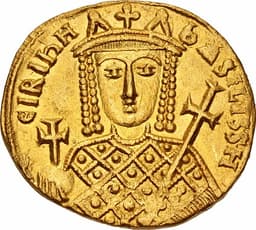
Irene of Athens
Emperor · Medieval
47.9Total

Julius Caesar
General · Ancient
82.8Total
Basic Information
Born
752
-100
Died
803
-44
Era
Medieval
Ancient
Nationality
Byzantine Empire
Roman Republic
Occupation
Emperor
General
Civilization
Western
Western
Score Comparison
Military (10%)
14.9
88.0
Political (20%)
43.7
78.0
Influence (20%)
54.9
85.0
Legacy (20%)
49.2
82.0
Leadership (15%)
62.2
80.0
Strategy (15%)
45.0
85.0
TOTAL
47.9
82.8
Irene of Athens — Complete Timeline
780 AD
Regency for Constantine VI (780-790)Political Action◆ Major
After the death of Leo IV, Irene became regent for her 10-year-old son Constantine VI. She ruled the Byzantine Empire effectively, reversing iconoclast policies and restoring icon veneration at the Second Council of Nicaea in 787.
RegencyIconoclasmChurch Council
Impact: regionalconstructive
787 AD
Second Council of Nicaea (787)Political Action
Irene convened the Second Council of Nicaea, which condemned iconoclasm and restored the veneration of icons in the Byzantine Church. This council is considered the Seventh Ecumenical Council by the Eastern Orthodox Church.
Ecumenical CouncilIconoclasmReligious Policy
Impact: globalconstructive
797 AD
Blinding and Imprisonment of Constantine VI (797)Political Action◆ Major
Irene ordered the blinding of her son Constantine VI, who had attempted to assert his own rule. He was imprisoned and died shortly after. This act allowed Irene to become sole ruler, but it was widely condemned as tyrannical and unnatural.
UsurpationViolenceFamily
Impact: regionaltragic
Sole Rule as Empress (797-802)Political Action◆ Major
After blinding her son, Irene ruled as sole empress, the first woman to do so in Byzantine history. She used the title 'basileus' (emperor) rather than 'basilissa' (empress), asserting her authority as a male ruler.
Female RuleImperial Title
Impact: regional
802 AD
Overthrow and Exile (802)Political Action◆ Major
Irene was overthrown by a conspiracy led by Nikephoros, the logothete (finance minister). She was exiled to the island of Lesbos and forced to support herself by spinning wool. She died the following year.
CoupExile
Impact: regionaltragic
Julius Caesar — Complete Timeline
58 BC
Gallic WarsWar◆ Major
Caesar, as proconsul of Gaul, launched a series of campaigns that conquered all of Gaul (modern France, Belgium, and parts of Switzerland). He fought numerous battles, including against the Helvetii, the Belgae, and the Gallic chieftain Vercingetorix. The wars brought immense wealth and a loyal army to Caesar.
Gallic WarsConquestRoman Expansion
Impact: regional
49 BC
Crossing the RubiconPolitical Action◆ Major
Caesar led Legio XIII across the Rubicon River into Italy, defying the Roman Senate's order to disband his army. This act triggered a civil war against Pompey and the Optimates, ultimately leading to Caesar's dictatorship and the end of the Roman Republic.
Roman Civil WarEnd of RepublicPower Struggle
Impact: global
48 BC
Battle of PharsalusWar◆ Major
Caesar's outnumbered army defeated the larger forces of Pompey the Great at Pharsalus in Greece. Caesar's tactical use of a reserve line to counter Pompey's cavalry charge proved decisive. Pompey fled to Egypt, where he was assassinated, leaving Caesar as the undisputed master of the Roman world.
Roman Civil WarBattleDecisive Victory
Impact: regional
44 BC
Appointment as Dictator for LifePolitical Action◆ Major
The Roman Senate appointed Caesar dictator perpetuo (dictator for life), granting him unprecedented personal power. This move concentrated military, legislative, and judicial authority in one person, effectively ending the Roman Republic's traditional system of checks and balances and alarming many senators.
DictatorshipEnd of RepublicPower Consolidation
Impact: regionaldestructive
Assassination on the Ides of MarchPolitical Action◆ Major
A group of Roman senators, led by Marcus Junius Brutus and Gaius Cassius Longinus, stabbed Caesar to death at a meeting of the Senate in the Theatre of Pompey. The assassination was intended to restore the Republic, but instead triggered another civil war that led to the rise of the Roman Empire.
AssassinationRoman PoliticsEnd of Republic
Impact: globaldestructive
Expert Analysis
irene-of-athens-vs-julius-caesar
# The Ides of March and the Iron Crown: Two Paths to Absolute Power
On the morning of March 15, 44 BCE, Julius Caesar walked into the Senate chamber in Rome, confident that his word was law. He had crossed the Rubicon, defeated his rivals, and been named dictator for life. By noon, he lay bleeding on the marble floor, stabbed twenty-three times by men he had once called friends. Six centuries later and a thousand miles to the east, another ruler faced a different kind of knife—not the blade of an assassin, but the cold, calculated steel of a mother’s ambition. In 797 AD, Empress Irene of Athens ordered her own son blinded in the very palace where she had raised him, then ruled alone as the first woman to call herself emperor of the Romans. Both seized power in times of crisis. Both reshaped their worlds. But one became a legend, the other a cautionary tale. Why?
Origins
Caesar was born into the chaos of the late Roman Republic, a world of civil wars, senatorial corruption, and ambitious generals. His family, the Julii, claimed descent from the goddess Venus, but they were politically modest by the standards of Rome’s aristocracy. His father died when he was sixteen, leaving him to navigate a brutal political landscape where survival required cunning, connections, and an iron nerve. The Republic was dying, and Caesar grew up breathing its last gasps.
Irene came from Athens, a city that was a shadow of its classical glory. The Byzantine Empire, though still the most powerful state in Christendom, was torn apart by the Iconoclast Controversy—a violent religious dispute over whether religious images should be destroyed. Irene was chosen as a bride for Emperor Leo IV not for her lineage but for her beauty and her iconophile sympathies. She arrived in Constantinople as a foreigner, surrounded by eunuchs, priests, and generals who saw women as unfit to rule. Her only weapon was patience.
Rise to Power
Caesar’s path was public and spectacular. He won military glory in Spain, formed the First Triumvirate with Pompey and Crassus, and then spent eight years conquering Gaul—a campaign that made him fabulously rich and gave him a loyal army. When the Senate ordered him to disband his forces, he chose war. Crossing the Rubicon River in 49 BCE was a declaration that he would rather be a rebel than a subject. His gamble paid off: within five years, he was master of Rome.
Irene’s rise was quiet and ruthless. When her husband Leo IV died in 780, she became regent for their ten-year-old son Constantine VI. The court expected her to be a placeholder, a woman who would manage affairs until the boy came of age. But Irene had other plans. She surrounded herself with loyal eunuchs, placated the army with gold, and waited. When Constantine tried to assert his independence as a young man, she first tolerated his mistakes, then crushed him. In 797, she ordered his blinding—a slow, agonizing procedure that left him dead within days. She then took the throne for herself, styling herself *basileus* (emperor), not *basilissa* (empress). She was now the first woman in Roman history to rule alone.
Leadership & Governance
Caesar governed as a reformer who understood that the Republic could not survive without change. He granted citizenship to provincials, reformed the calendar, launched massive building projects, and tried to curb the corruption of the senatorial class. His military genius was undeniable—the siege of Alesia, the lightning campaign at Pharsalus, the conquest of Egypt—but he also knew when to show mercy. He pardoned many of his enemies, hoping to build a new consensus. It was a gamble that failed: the men he spared were the ones who killed him.
Irene ruled in a world where mercy was weakness. She convened the Second Council of Nicaea in 787, which restored the veneration of icons and ended the first wave of Iconoclasm. This was a genuine achievement, healing a wound that had divided the empire for decades. But her governance was defined by fear. She purged the military leadership, replacing capable generals with loyal incompetents. She taxed heavily to buy support, depleting the treasury. Her strategy score of 30.0 reflects a ruler who could scheme but could not plan for the long term. She ruled for five years as sole empress, but the empire’s borders frayed, the army grew restive, and her court seethed with resentment.
Triumph & Tragedy
Caesar’s greatest moment was his triumph in 46 BCE, when he paraded through Rome with captives from Gaul, Egypt, and Pontus. He had conquered the known world. His tragedy came three years later, when he ignored warnings of conspiracy, believing that his popularity made him invincible. The Ides of March proved him wrong.
Irene’s triumph was the Council of Nicaea, where she stood before bishops and generals as the defender of orthodoxy. Her tragedy was the blinding of her son—an act that horrified even her allies. In 802, a conspiracy led by her finance minister, Nikephoros, overthrew her without a fight. She was exiled to the island of Lesbos, where she died a year later, impoverished and alone. She had sacrificed everything for power, and in the end, she had nothing.
Character & Destiny
Caesar was bold, generous, and reckless. He believed in his own luck, and for most of his life, luck believed in him. His ambition was not merely personal—he genuinely believed that only a strong ruler could save Rome. But his arrogance blinded him to the hatred he inspired. He thought his enemies would accept his mercy; instead, they saw it as contempt.
Irene was patient, calculating, and utterly without sentiment. She understood that in the Byzantine court, trust was a liability. She could not rely on military glory—her military score of 56.7 is the lowest among major Byzantine rulers—so she relied on intrigue. Her son was not just a rival; he was a symbol of the patriarchal order that denied her the throne. By destroying him, she destroyed the system that had confined her. But she also destroyed any hope of legitimacy. A ruler who murders her own child cannot inspire loyalty, only fear.
Legacy
Caesar’s legacy is the Roman Empire. His name became synonymous with absolute power: *Kaiser* in German, *Tsar* in Russian. His writings—the *Commentaries on the Gallic War*—are still studied as military classics. He was assassinated, but his adopted heir, Octavian, completed his work. The Republic died with Caesar; the Empire was born.
Irene’s legacy is more ambiguous. She is remembered as a villain in Byzantine history, a woman who committed the ultimate crime to satisfy her ambition. Yet she also restored icons to the Church, and the Second Council of Nicaea is still celebrated in Orthodox Christianity. Her reign proved that a woman could rule the Roman Empire, but it also proved that the price of that rule might be too high. Her influence score of 73.1 is respectable, but her legacy score of 65.2 reflects a ruler whom history cannot quite forgive.
Conclusion
Caesar and Irene both reached for absolute power in worlds that told them they could not have it—Caesar because he was a populist in an aristocratic system, Irene because she was a woman in a patriarchal one. Caesar succeeded because he was a military genius who could inspire armies; Irene failed because she had to rely on manipulation, which breeds only distrust. One died at the hands of his enemies; the other died alone, exiled by her own court. Their stories remind us that power, in the end, is not about strength or cunning alone. It is about the ability to make others believe in you—and to believe in yourself without losing sight of the world around you. Caesar believed too much; Irene believed too little. Both paid the price.
Rankings
🥇
Julius CaesarLeader
Mil: 88.0Pol: 78.0Inf: 85.0
82.8
🥈
Irene of Athens
Mil: 14.9Pol: 43.7Inf: 54.9
47.9
+34.9 behind
How This Comparison Works
Algorithm
Each figure is scored on 6 dimensions (0—100 scale) based on structured historical data: Military (10%), Political (20%), Influence (20%), Legacy (20%), Leadership (15%), Strategy (15%). The weighted total produces the final ranking.
Data Sources
Scores are computed from structured sub-indicators in the database. Scale factors adjust for era (Ancient ×0.85, Modern ×1.0) and civilization size (Eastern ×1.05, Other ×0.80) to account for differences in population and military scale.
Maximum 3 Figures
Comparisons are limited to 2—3 figures to ensure readability and statistical meaningfulness.
Error Margins
±5 points per dimension — Sub-scores are derived from historical records with inherent uncertainty. Two figures within 5 points on a dimension should be considered roughly equivalent in that area.
Total Score Accuracy
±3 points overall — The weighted combination of 6 dimensions produces a total score with approximately ±3 points of uncertainty. Differences of less than 3 points are not statistically significant— the figures are effectively tied.
Known Limitations
- Historical records are incomplete and uneven across civilizations
- Figures from oral-tradition societies may be underrepresented
- Occupation labels can misclassify multi-role figures
- Scores measure capability and impact, not moral character
- Quantitative scoring is a comparison tool, not absolute truth
Capability Radar
Military (10%) — Battles & Warfare
Battles
10
95
Win Rate
5
92
Expansion
5
97
Political (20%) — Governance & Reform
Reform
40
90
Diplomacy
50
85
Economy
30
82
Influence (20%) — Cultural & Global Reach
Cultural
40
88
Global
30
94
Legacy (20%) — Historical Impact
Historical
55
95
Longevity
40
96
Leadership (15%) — Power & Stability
Tenure
60
75
Stability
20
60
Strategy (15%) — Tactics & Innovation
Strategy
5
94
Tactics
5
96
Reform
5
88
Similar Comparisons
Comments & Discussion
SENATUS CONSULTUM6/17/2026
Sorry, but this comparison is insulting. Caesar was a military genius who conquered Gaul, rewrote the calendar, and faced down Pompey’s legions. Irene was a regent who blinded her own son because she couldn't handle losing power. One commanded armies across Europe; the other schemed in a palace. The only thing they share is ambition—but Caesar earned his through blood and iron, not backroom treachery. Try comparing her to someone like Agrippina if you want a fair fight.
雅典的幽灵6/17/2026
伊琳娜就是个篡位的投机分子。雅典在古典时代的光辉早就被罗马踩碎了,她不过是利用儿子年幼夺权。凯撒至少是正面挑战元老院,而她却选择亲手弄瞎亲骨肉。这叫重塑世界?这叫丧心病狂。罗马帝国需要的是征服者,不是躲在皇宫里下黑手的母亲。如果非要比较,把她和武则天放一起更适合——至少武则天没杀自己儿子。
Tiberius' Ghost6/17/2026
Let’s not pretend Irene was a ruler on Caesar’s level. Caesar crossed the Rubicon and changed the course of history. Irene’s legacy is a self-inflicted wound—she blinded her son, lost popularity, and was overthrown six years later. Byzantium didn’t rise because of her; it stumbled along despite her. Caesar's death sparked a civil war that birthed the Empire. Irene’s rule ended with a palace coup and a return to obscurity. One built a world, the other just clung to a throne.
数据猎人6/17/2026
拿现代影响力指数算一下:凯撒的名字被提及频率是伊琳娜的200倍,Google搜索结果差三个数量级。西方历史教科书里凯撒占一整章,伊琳娜最多一个脚注。再说实际统治面积:凯撒治下罗马疆域横跨三大洲,伊琳娜手里就剩小亚细亚和巴尔干一半。数据不会说谎——一个改变了地中海世界的基因,另一个只是帝国衰退期的注脚。别为了政治正确硬扯在一起。