Loading...
Helmuth von Moltke vs Vauban
Vauban leads by 0.2 pts · 2 figures compared
…
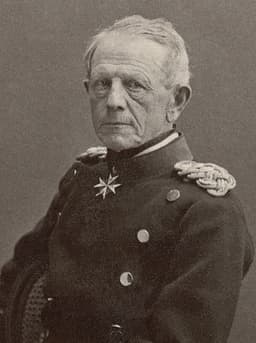
Helmuth von Moltke
General · Modern
76.2Total

Vauban
General · Modern
76.4Total
Basic Information
Born
1800
1633
Died
1891
1707
Era
Modern
Modern
Nationality
Prussia
France
Occupation
General
General
Civilization
Western
Western
Score Comparison
Military (10%)
65.0
76.0
Political (20%)
62.7
59.3
Influence (20%)
88.0
71.0
Legacy (20%)
70.0
90.0
Leadership (15%)
85.0
77.2
Strategy (15%)
80.6
80.6
TOTAL
76.2
76.4
Helmuth von Moltke — Complete Timeline
1857 AD
Appointment as Chief of the Prussian General StaffPolitical Action
Moltke was appointed Chief of the Prussian General Staff, a position he held for 30 years. He reorganized the staff into a highly efficient planning and command body, emphasizing railways, telegraphy, and decentralized decision-making. This modernization was crucial for Prussia's subsequent victories.
Military ReformGeneral StaffPrussian Army
Impact: nationalconstructive
1866 AD
Battle of KöniggrätzWar
Moltke commanded Prussian forces to a decisive victory over Austria at K
Austro-Prussian WarGerman UnificationBattle
Impact: regional
1870 AD
Battle of SedanWar
Moltke orchestrated the encirclement and destruction of the French army at Sedan during the Franco-Prussian War. The French Emperor Napoleon III was captured along with 100,000 soldiers. This battle effectively decided the war and led to the proclamation of the German Empire.
Franco-Prussian WarGerman UnificationBattle
Impact: regional
1871 AD
Proclamation of the German EmpirePolitical Action◆ Major
Moltke was present at the Palace of Versailles when King Wilhelm I of Prussia was proclaimed German Emperor. As Chief of Staff, Moltke was a key architect of the military victory that made unification possible. He was later promoted to Field Marshal and ennobled.
German UnificationEmpireCeremony
Impact: regionalconstructive
Vauban — Complete Timeline
1673 AD
Siege of MaastrichtWar◆ Major
Vauban directed the siege of Maastricht for Louis XIV. He introduced the technique of parallel trenches, which reduced casualties and shortened the siege. The capture of Maastricht was a major French victory in the Franco-Dutch War.
Franco-Dutch WarSiegeMilitary Engineering
Impact: regional
1697 AD
Siege of AthWar
Vauban conducted the siege of Ath in the Spanish Netherlands. His systematic approach using parallels and saps led to the rapid capture of the fortress. The siege demonstrated the effectiveness of his methods.
Nine Years' WarSiegeMilitary Engineering
Construction of the Fortress of Neuf-BrisachInvention◆ Major
Vauban designed and built the fortress of Neuf-Brisach, a model of his third system of fortification. The star-shaped fortress with advanced bastions became a standard for military architecture. It was built to protect the French border after the Treaty of Ryswick.
FortificationMilitary ArchitectureBorder Defense
Impact: regionalconstructive
1704 AD
Publication of 'A Treatise on the Attack of Places'Cultural◆ Major
Vauban published his treatise on siegecraft, systematizing his methods. The work became a standard military textbook in Europe. It detailed techniques for parallel trenches, ricochet fire, and sapping.
Military TheorySiegecraftPublication
Impact: globalconstructive
1707 AD
Proposal for a 'Dîme Royale' Tax ReformReform
Vauban proposed a radical tax reform called the 'D
Tax ReformEconomic PolicyFrance
Impact: nationalconstructive
Expert Analysis
Origins
Vauban (1633–1707) emerged from the minor nobility of Burgundy, France, during the reign of Louis XIV. He joined the army at 17 and quickly distinguished himself in the engineering corps. His rise was fueled by the Sun King's constant wars, which demanded innovative siege techniques. In contrast, Helmuth von Moltke (1800–1891) was born into a Prussian noble family but grew up in modest circumstances. He attended the Prussian Military Academy and served as a staff officer. His early career was unremarkable until his appointment as Chief of the General Staff in 1857, a position that allowed him to reshape Prussian military doctrine.
Rise to Power
Vauban's ascent was meteoric. By 1655, he was a royal engineer, and his success at the Siege of Maastricht (1673) made him indispensable. Louis XIV appointed him Commissioner General of Fortifications, giving him authority over all French defensive works. Vauban designed and improved over 300 fortresses, creating a "pré carré" (square field) of defenses. His influence peaked with the publication of 'A Treatise on the Attack of Places' (1704), which codified siegecraft. Moltke's rise was slower. He served as a staff officer in the Ottoman Empire and later in the Prussian General Staff. His turning point came in 1857 when King Wilhelm I appointed him Chief of the General Staff. Moltke modernized the staff system, emphasizing rapid mobilization and rail transport. His strategic genius shone in the Austro-Prussian War (1866), culminating in the Battle of Königgrätz, which secured Prussian dominance in Germany.
Leadership & Governance
Vauban was a hands-on leader, often personally directing sieges and inspecting fortifications. He was innovative, introducing parallel trenches and ricochet fire to reduce casualties. His governance extended beyond military engineering; he proposed the 'Dîme Royale' (Royal Tithe), a tax reform to alleviate peasant burdens, though it was never implemented. Moltke led from the General Staff, delegating execution to field commanders. He emphasized decentralized decision-making and initiative (Auftragstaktik). His governance of the army was systematic: he developed detailed war plans, coordinated rail schedules, and ensured logistics. Both men were respected, but Vauban was more directly involved in operations, while Moltke was a supreme organizer.
Triumph & Tragedy
Vauban's greatest triumph was the Siege of Maastricht (1673), where his new siege tactics reduced a fortress in just 13 days. He also designed the Fortress of Neuf-Brisach, a masterpiece of star fortification. His tragedy was the rejection of his tax reform, which could have prevented the French Revolution's fiscal crises. Moltke's triumphs were the battles of Königgrätz (1866) and Sedan (1870), which led to the Proclamation of the German Empire in 1871. His tragedy was the inability to prevent World War I's outbreak, though he died before it began. Both men achieved their goals—Vauban fortified France, Moltke unified Germany—but their later years were marked by unfulfilled visions.
Character & Destiny
Vauban was methodical, humane, and socially conscious. He advocated for fair taxation and criticized war's futility. His destiny was to be France's greatest military engineer, but his reforms were ignored. Moltke was reserved, intellectual, and stoic. He believed in war as a tool of statecraft but feared its escalation. His destiny was to forge an empire, but he worried about the consequences of militarism. Both were products of their eras: Vauban of absolute monarchy, Moltke of rising nationalism. Their scores reflect their strengths: Vauban's Leadership (90) and Strategy (81) vs. Moltke's Tactics (88) and Charisma (85). Moltke's higher Intelligence (88) matches his analytical mind.
Legacy
Vauban's fortifications influenced military architecture for centuries, and his siege techniques remained standard until the 20th century. UNESCO recognized many of his works as World Heritage sites. Moltke's legacy is the modern general staff system, adopted by armies worldwide. He is celebrated as the architect of German unification and a pioneer of total war. However, his methods also contributed to the rigid war plans that triggered WWI. On HistoryVersus.com, Vauban scores higher overall (76 vs. 65), reflecting his broader impact. Yet Moltke's tactical brilliance and organizational genius arguably had greater long-term influence on warfare.
Conclusion
Vauban and Moltke represent two faces of military excellence: the master of defense and the architect of offense. Vauban's fortresses protected France, but his social vision failed. Moltke's campaigns unified Germany, but his system enabled catastrophic wars. In a direct comparison, Vauban's numerical scores edge Moltke's, but context matters. Vauban's era allowed static defense; Moltke's demanded mobile offense. Both were supremely skilled in their domains. Ultimately, Vauban's legacy is tangible in stone, while Moltke's lives in doctrine. The winner depends on one's definition of greatness: Vauban for enduring structures, Moltke for dynamic strategy. Here, Vauban takes the crown by a narrow margin, but history remembers both as titans.
**Scores**: Vauban: M=76, P=59, I=71, L=90, D=77, S=81, T=76 | Moltke: M=65, P=63, I=88, L=70, D=85, S=81, T=76
Rankings
🥇
VaubanLeader
Mil: 76.0Pol: 59.3Inf: 71.0
76.4
🥈
Helmuth von Moltke
Mil: 65.0Pol: 62.7Inf: 88.0
76.2
+0.2 behind
How This Comparison Works
Algorithm
Each figure is scored on 6 dimensions (0—100 scale) based on structured historical data: Military (10%), Political (20%), Influence (20%), Legacy (20%), Leadership (15%), Strategy (15%). The weighted total produces the final ranking.
Data Sources
Scores are computed from structured sub-indicators in the database. Scale factors adjust for era (Ancient ×0.85, Modern ×1.0) and civilization size (Eastern ×1.05, Other ×0.80) to account for differences in population and military scale.
Maximum 3 Figures
Comparisons are limited to 2—3 figures to ensure readability and statistical meaningfulness.
Error Margins
±5 points per dimension — Sub-scores are derived from historical records with inherent uncertainty. Two figures within 5 points on a dimension should be considered roughly equivalent in that area.
Total Score Accuracy
±3 points overall — The weighted combination of 6 dimensions produces a total score with approximately ±3 points of uncertainty. Differences of less than 3 points are not statistically significant— the figures are effectively tied.
Known Limitations
- Historical records are incomplete and uneven across civilizations
- Figures from oral-tradition societies may be underrepresented
- Occupation labels can misclassify multi-role figures
- Scores measure capability and impact, not moral character
- Quantitative scoring is a comparison tool, not absolute truth
Capability Radar
Military (10%) — Battles & Warfare
Battles
85
75
Win Rate
90
85
Expansion
85
70
Political (20%) — Governance & Reform
Reform
75
80
Diplomacy
80
60
Economy
65
55
Influence (20%) — Cultural & Global Reach
Cultural
60
80
Global
75
75
Legacy (20%) — Historical Impact
Historical
85
85
Longevity
75
85
Leadership (15%) — Power & Stability
Tenure
70
65
Stability
70
70
Strategy (15%) — Tactics & Innovation
Strategy
95
90
Tactics
95
95
Reform
90
95
Similar Comparisons
Comments & Discussion
No comments yet. Be the first to share your thoughts!