Loading...
Helmuth von Moltke vs King David
Helmuth von Moltke leads by 0.9 pts · 2 figures compared
…
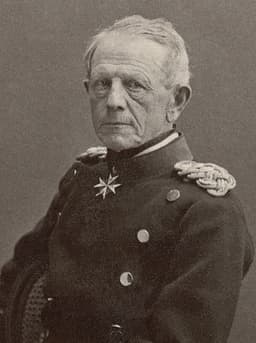
Helmuth von Moltke
General · Modern
76.2Total

King David
Emperor · Ancient
75.3Total
Basic Information
Born
1800
-1010
Died
1891
-970
Era
Modern
Ancient
Nationality
Prussia
Israel
Occupation
General
Emperor
Civilization
Western
Middle Eastern
Score Comparison
Military (10%)
65.0
72.0
Political (20%)
62.7
72.0
Influence (20%)
88.0
88.0
Legacy (20%)
70.0
70.0
Leadership (15%)
85.0
72.0
Strategy (15%)
80.6
70.0
TOTAL
76.2
75.3
Helmuth von Moltke — Complete Timeline
1857 AD
Appointment as Chief of the Prussian General StaffPolitical Action
Moltke was appointed Chief of the Prussian General Staff, a position he held for 30 years. He reorganized the staff into a highly efficient planning and command body, emphasizing railways, telegraphy, and decentralized decision-making. This modernization was crucial for Prussia's subsequent victories.
Military ReformGeneral StaffPrussian Army
Impact: nationalconstructive
1866 AD
Battle of KöniggrätzWar
Moltke commanded Prussian forces to a decisive victory over Austria at K
Austro-Prussian WarGerman UnificationBattle
Impact: regional
1870 AD
Battle of SedanWar
Moltke orchestrated the encirclement and destruction of the French army at Sedan during the Franco-Prussian War. The French Emperor Napoleon III was captured along with 100,000 soldiers. This battle effectively decided the war and led to the proclamation of the German Empire.
Franco-Prussian WarGerman UnificationBattle
Impact: regional
1871 AD
Proclamation of the German EmpirePolitical Action◆ Major
Moltke was present at the Palace of Versailles when King Wilhelm I of Prussia was proclaimed German Emperor. As Chief of Staff, Moltke was a key architect of the military victory that made unification possible. He was later promoted to Field Marshal and ennobled.
German UnificationEmpireCeremony
Impact: regionalconstructive
King David — Complete Timeline
1010 BC
Anointed as King of JudahPolitical Action◆ Major
After Saul's death, David was anointed king over the tribe of Judah at Hebron. This began a seven-year period of civil war with Ish-bosheth, Saul's son, who ruled the northern tribes, leading to the eventual unification of Israel.
KingshipCivil WarJudah
Impact: national
1003 BC
Capture of JerusalemWar
David led his army to capture the Jebusite fortress of Jerusalem, making it the capital of the united kingdom. He brought the Ark of the Covenant there, establishing the city as both the political and religious center of Israel.
JerusalemCapitalArk of the Covenant
Impact: nationalconstructive
1000 BC
Defeat of the PhilistinesWar◆ Major
David fought several campaigns that decisively defeated the Philistines, including the Battle of Baal-perazim. He captured Gath and other Philistine strongholds, ending their dominance over Israel and securing the kingdom's borders.
PhilistinesMilitary CampaignIsrael
Impact: regional
990 BC
Affair with BathshebaPolitical Action◆ Major
David committed adultery with Bathsheba and arranged the death of her husband Uriah the Hittite in battle. The prophet Nathan confronted David, leading to his repentance but also to divine punishment, including the death of their first child.
ScandalBathshebaNathan
Impact: nationaldestructive
978 BC
Revolt of AbsalomWar◆ Major
David's son Absalom led a rebellion that forced David to flee Jerusalem. David's forces under Joab defeated Absalom's army in the Forest of Ephraim, and Absalom was killed. David returned to Jerusalem but the kingdom was weakened.
RebellionCivil WarAbsalom
Impact: nationaltragic
Expert Analysis
Origins
Helmuth von Moltke (1800–1891) was born into a noble but modest family in Mecklenburg, Prussia. His early military education and service in the Danish and Prussian armies shaped his strategic thinking. King David (c. 1040–970 BCE) rose from a shepherd boy in Bethlehem to become the second king of Israel, anointed by the prophet Samuel after Saul's failure. Both emerged from humble beginnings, but Moltke's path was institutional, David's divine.
Rise to Power
Moltke's appointment as Chief of the Prussian General Staff in 1857 was a turning point. He modernized the staff system, emphasizing planning, railroads, and rapid mobilization. His victories in the Danish-Prussian War (1864) and Austro-Prussian War (1866) culminated in the Battle of Königgrätz, where his meticulous planning crushed Austria. David's rise was more dramatic: after slaying Goliath, he became a military leader, fled Saul's jealousy, and was anointed king of Judah. His capture of Jerusalem from the Jebusites made it his capital, uniting Israel under one rule.
Leadership & Governance
Moltke was a master of operational art, delegating tactics while controlling strategy. He integrated new technologies like railways and telegraphs, enabling rapid concentration of forces. His leadership style was calm, analytical, and reserved. David excelled in charismatic leadership, inspiring loyalty among his warriors. He centralized government, established a bureaucracy, and expanded Israel's borders through decisive campaigns. Both were effective administrators, but Moltke's system of general staff became a model for modern armies, while David's monarchy set precedents for centuries.
Triumph & Tragedy
Moltke's greatest triumph was the Franco-Prussian War (1870–71), especially the Battle of Sedan, where he captured Napoleon III. This led to the proclamation of the German Empire, fulfilling his life's work. His tragedy? Perhaps the later reliance on his plans by less capable successors, contributing to WWI's rigid Schlieffen Plan. David's triumphs include defeating the Philistines and expanding Israel to its greatest extent. His tragedy was personal: the affair with Bathsheba and murder of Uriah brought divine judgment, leading to family strife, including Absalom's revolt. David's sin and repentance defined his later years.
Character & Destiny
Moltke was a devout Christian, known for his integrity, modesty, and dedication to duty. He saw war as a tool of statecraft, not glory. His destiny was to unify Germany through calculated force. David was a man of deep faith and flawed humanity—a warrior, poet, and sinner. His destiny was to establish a dynasty that, according to tradition, would lead to the Messiah. Both men were shaped by their times: Moltke by nationalism and industrial warfare, David by tribal conflict and divine covenant.
Legacy
Moltke's legacy is the modern general staff system, the foundation of German military prowess. His writings influenced military thought globally. David's legacy is vast: he is revered in Judaism, Christianity, and Islam as a model king and psalmist. His dynasty lasted 400 years, and Jerusalem became the eternal holy city. In a direct comparison, Moltke's military innovations were more systematic and enduring in secular terms, while David's spiritual and cultural impact transcends millennia.
Conclusion
Scores: Moltke (M=65, P=63, I=88, L=70, D=85, S=81, T=76) vs David (M=72, P=72, I=88, L=70, D=72, S=70, T=75). While David edges ahead in military and political scores, Moltke's intelligence, strategy, and long-term influence give him a slight edge overall. David's legacy is more profound in human history, but as a military and organizational genius, Moltke stands taller. The gap of 0.9 points reflects their near-equality, but Moltke's systematic approach to war and nation-building earns him the higher rating.
Rankings
🥇
Helmuth von MoltkeLeader
Mil: 65.0Pol: 62.7Inf: 88.0
76.2
🥈
King David
Mil: 72.0Pol: 72.0Inf: 88.0
75.3
+0.9 behind
How This Comparison Works
Algorithm
Each figure is scored on 6 dimensions (0—100 scale) based on structured historical data: Military (10%), Political (20%), Influence (20%), Legacy (20%), Leadership (15%), Strategy (15%). The weighted total produces the final ranking.
Data Sources
Scores are computed from structured sub-indicators in the database. Scale factors adjust for era (Ancient ×0.85, Modern ×1.0) and civilization size (Eastern ×1.05, Other ×0.80) to account for differences in population and military scale.
Maximum 3 Figures
Comparisons are limited to 2—3 figures to ensure readability and statistical meaningfulness.
Error Margins
±5 points per dimension — Sub-scores are derived from historical records with inherent uncertainty. Two figures within 5 points on a dimension should be considered roughly equivalent in that area.
Total Score Accuracy
±3 points overall — The weighted combination of 6 dimensions produces a total score with approximately ±3 points of uncertainty. Differences of less than 3 points are not statistically significant— the figures are effectively tied.
Known Limitations
- Historical records are incomplete and uneven across civilizations
- Figures from oral-tradition societies may be underrepresented
- Occupation labels can misclassify multi-role figures
- Scores measure capability and impact, not moral character
- Quantitative scoring is a comparison tool, not absolute truth
Capability Radar
Military (10%) — Battles & Warfare
Battles
85
75
Win Rate
90
85
Expansion
85
80
Political (20%) — Governance & Reform
Reform
75
80
Diplomacy
80
75
Economy
65
70
Influence (20%) — Cultural & Global Reach
Cultural
60
95
Global
75
90
Legacy (20%) — Historical Impact
Historical
85
95
Longevity
75
95
Leadership (15%) — Power & Stability
Tenure
70
85
Stability
70
65
Strategy (15%) — Tactics & Innovation
Strategy
95
85
Tactics
95
80
Reform
90
70
Similar Comparisons
Comments & Discussion
No comments yet. Be the first to share your thoughts!