Loading...
This comparison has not been analyzed yet.
One-time AI generation (~1 minute). Scores and timeline are already available below.
Harold Macmillan vs Rajkumari Amrit Kaur
Rajkumari Amrit Kaur leads by 1.7 pts · 2 figures compared
…
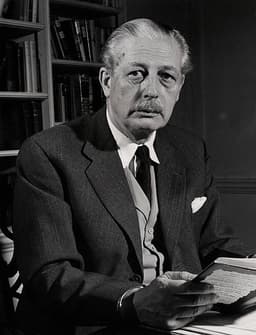
Harold Macmillan
Politician · Modern
58.4Total

Rajkumari Amrit Kaur
Politician · Modern
60.1Total
Basic Information
Born
1894
1889
Died
1986
1964
Era
Modern
Modern
Nationality
United Kingdom
India
Occupation
Politician
Politician
Civilization
Western
Indian
Score Comparison
Military (10%)
50.0
52.6
Political (20%)
72.0
72.0
Influence (20%)
60.0
55.0
Legacy (20%)
50.0
54.0
Leadership (15%)
72.0
72.0
Strategy (15%)
43.1
60.0
TOTAL
58.4
60.1
Harold Macmillan — Complete Timeline
1957 AD
Elected Prime MinisterPolitical Action
Macmillan succeeded Anthony Eden as Prime Minister after the Suez Crisis. He led the Conservative Party to a landslide victory in the 1959 general election, consolidating his power.
Prime MinisterConservative Party
Impact: national
Delivered 'You've Never Had It So Good' SpeechCultural◆ Major
Macmillan gave a speech in Bedford stating that Britons had 'never had it so good,' referring to post-war prosperity. The phrase became emblematic of his premiership and the era of rising living standards.
SpeechEconomic Prosperity
Impact: nationalconstructive
Signed the Treaty of RomePolitical Action◆ Major
Macmillan's government signed the Treaty of Rome, establishing the European Economic Community (EEC). However, the UK did not join at this time, as Macmillan prioritized the European Free Trade Association (EFTA).
European IntegrationEEC
Impact: global
1960 AD
Wind of Change SpeechCultural◆ Major
Macmillan delivered the 'Wind of Change' speech to the South African Parliament, acknowledging the rise of African nationalism and the inevitability of decolonization. This signaled Britain's shift away from empire.
DecolonizationAfrica
Impact: global
1963 AD
Profumo AffairPolitical Action◆ Major
The Profumo affair, a sex scandal involving War Minister John Profumo, damaged Macmillan's government. Macmillan's handling of the crisis was criticized, contributing to his resignation later that year.
ScandalGovernment
Impact: nationaldestructive
Resigned as Prime MinisterPolitical Action◆ Major
Macmillan resigned as Prime Minister in October 1963, citing ill health. He was succeeded by Alec Douglas-Home. His resignation marked the end of a premiership defined by prosperity and decolonization.
ResignationConservative Party
Impact: national
Rajkumari Amrit Kaur — Complete Timeline
1931 AD
Participated in Round Table ConferencePolitical Action◆ Major
Kaur was a delegate to the Second Round Table Conference in London, representing Indian women's interests. She advocated for women's suffrage and social reforms in the constitutional discussions.
Round Table ConferenceWomen's Suffrage
Impact: nationalconstructive
1942 AD
Imprisoned for Quit India MovementPolitical Action
Kaur was arrested and imprisoned for her participation in the Quit India Movement. She spent several months in jail, continuing her activism for Indian independence.
Quit IndiaImprisonment
Impact: nationalconstructive
1947 AD
Appointed India's first Health MinisterPolitical Action
Rajkumari Amrit Kaur was appointed as the first Minister of Health in independent India. She served until 1957, overseeing the establishment of public health infrastructure and medical education.
Health PolicyWomen in Government
Impact: nationalconstructive
1956 AD
Founded the All India Institute of Medical Sciences (AIIMS)Reform◆ Major
Kaur was instrumental in founding the All India Institute of Medical Sciences in New Delhi, a premier medical institution. She secured funding and support from international organizations, including the Rockefeller Foundation.
Medical EducationHealthcare
Impact: nationalconstructive
This comparison has not been analyzed yet.
One-time AI generation (~1 minute). Scores and timeline are already available below.
Rankings
🥇
Rajkumari Amrit KaurLeader
Mil: 52.6Pol: 72.0Inf: 55.0
60.1
🥈
Harold Macmillan
Mil: 50.0Pol: 72.0Inf: 60.0
58.4
+1.7 behind
How This Comparison Works
Algorithm
Each figure is scored on 6 dimensions (0—100 scale) based on structured historical data: Military (10%), Political (20%), Influence (20%), Legacy (20%), Leadership (15%), Strategy (15%). The weighted total produces the final ranking.
Data Sources
Scores are computed from structured sub-indicators in the database. Scale factors adjust for era (Ancient ×0.85, Modern ×1.0) and civilization size (Eastern ×1.05, Other ×0.80) to account for differences in population and military scale.
Maximum 3 Figures
Comparisons are limited to 2—3 figures to ensure readability and statistical meaningfulness.
Error Margins
±5 points per dimension — Sub-scores are derived from historical records with inherent uncertainty. Two figures within 5 points on a dimension should be considered roughly equivalent in that area.
Total Score Accuracy
±3 points overall — The weighted combination of 6 dimensions produces a total score with approximately ±3 points of uncertainty. Differences of less than 3 points are not statistically significant— the figures are effectively tied.
Known Limitations
- Historical records are incomplete and uneven across civilizations
- Figures from oral-tradition societies may be underrepresented
- Occupation labels can misclassify multi-role figures
- Scores measure capability and impact, not moral character
- Quantitative scoring is a comparison tool, not absolute truth
Capability Radar
Military (10%) — Battles & Warfare
Battles
28
43
Win Rate
31
46
Expansion
36
47
Political (20%) — Governance & Reform
Reform
55
75
Diplomacy
70
60
Economy
65
50
Influence (20%) — Cultural & Global Reach
Cultural
40
55
Global
50
50
Legacy (20%) — Historical Impact
Historical
50
60
Longevity
40
55
Leadership (15%) — Power & Stability
Tenure
60
65
Stability
60
55
Strategy (15%) — Tactics & Innovation
Strategy
40
53
Tactics
40
58
Reform
45
57
Similar Comparisons
Comments & Discussion
No comments yet. Be the first to share your thoughts!