Loading...
Harold Macmillan vs Julius Caesar
Julius Caesar leads by 24.4 pts · 2 figures compared
…
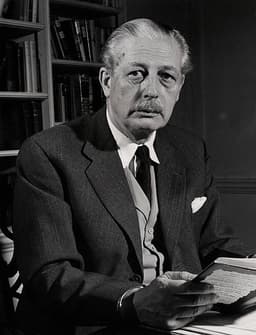
Harold Macmillan
Politician · Modern
58.4Total

Julius Caesar
General · Ancient
82.8Total
Basic Information
Born
1894
-100
Died
1986
-44
Era
Modern
Ancient
Nationality
United Kingdom
Roman Republic
Occupation
Politician
General
Civilization
Western
Western
Score Comparison
Military (10%)
50.0
88.0
Political (20%)
72.0
78.0
Influence (20%)
60.0
85.0
Legacy (20%)
50.0
82.0
Leadership (15%)
72.0
80.0
Strategy (15%)
43.1
85.0
TOTAL
58.4
82.8
Harold Macmillan — Complete Timeline
1957 AD
Elected Prime MinisterPolitical Action
Macmillan succeeded Anthony Eden as Prime Minister after the Suez Crisis. He led the Conservative Party to a landslide victory in the 1959 general election, consolidating his power.
Prime MinisterConservative Party
Impact: national
Delivered 'You've Never Had It So Good' SpeechCultural◆ Major
Macmillan gave a speech in Bedford stating that Britons had 'never had it so good,' referring to post-war prosperity. The phrase became emblematic of his premiership and the era of rising living standards.
SpeechEconomic Prosperity
Impact: nationalconstructive
Signed the Treaty of RomePolitical Action◆ Major
Macmillan's government signed the Treaty of Rome, establishing the European Economic Community (EEC). However, the UK did not join at this time, as Macmillan prioritized the European Free Trade Association (EFTA).
European IntegrationEEC
Impact: global
1960 AD
Wind of Change SpeechCultural◆ Major
Macmillan delivered the 'Wind of Change' speech to the South African Parliament, acknowledging the rise of African nationalism and the inevitability of decolonization. This signaled Britain's shift away from empire.
DecolonizationAfrica
Impact: global
1963 AD
Profumo AffairPolitical Action◆ Major
The Profumo affair, a sex scandal involving War Minister John Profumo, damaged Macmillan's government. Macmillan's handling of the crisis was criticized, contributing to his resignation later that year.
ScandalGovernment
Impact: nationaldestructive
Resigned as Prime MinisterPolitical Action◆ Major
Macmillan resigned as Prime Minister in October 1963, citing ill health. He was succeeded by Alec Douglas-Home. His resignation marked the end of a premiership defined by prosperity and decolonization.
ResignationConservative Party
Impact: national
Julius Caesar — Complete Timeline
58 BC
Gallic WarsWar◆ Major
Caesar, as proconsul of Gaul, launched a series of campaigns that conquered all of Gaul (modern France, Belgium, and parts of Switzerland). He fought numerous battles, including against the Helvetii, the Belgae, and the Gallic chieftain Vercingetorix. The wars brought immense wealth and a loyal army to Caesar.
Gallic WarsConquestRoman Expansion
Impact: regional
49 BC
Crossing the RubiconPolitical Action◆ Major
Caesar led Legio XIII across the Rubicon River into Italy, defying the Roman Senate's order to disband his army. This act triggered a civil war against Pompey and the Optimates, ultimately leading to Caesar's dictatorship and the end of the Roman Republic.
Roman Civil WarEnd of RepublicPower Struggle
Impact: global
48 BC
Battle of PharsalusWar◆ Major
Caesar's outnumbered army defeated the larger forces of Pompey the Great at Pharsalus in Greece. Caesar's tactical use of a reserve line to counter Pompey's cavalry charge proved decisive. Pompey fled to Egypt, where he was assassinated, leaving Caesar as the undisputed master of the Roman world.
Roman Civil WarBattleDecisive Victory
Impact: regional
44 BC
Appointment as Dictator for LifePolitical Action◆ Major
The Roman Senate appointed Caesar dictator perpetuo (dictator for life), granting him unprecedented personal power. This move concentrated military, legislative, and judicial authority in one person, effectively ending the Roman Republic's traditional system of checks and balances and alarming many senators.
DictatorshipEnd of RepublicPower Consolidation
Impact: regionaldestructive
Assassination on the Ides of MarchPolitical Action◆ Major
A group of Roman senators, led by Marcus Junius Brutus and Gaius Cassius Longinus, stabbed Caesar to death at a meeting of the Senate in the Theatre of Pompey. The assassination was intended to restore the Republic, but instead triggered another civil war that led to the rise of the Roman Empire.
AssassinationRoman PoliticsEnd of Republic
Impact: globaldestructive
Expert Analysis
harold-macmillan-vs-julius-caesar
# The General and the Gentleman
In March of 44 BCE, a dictator lay bleeding at the foot of a statue of his defeated rival, stabbed twenty-three times by men he had called friends. In October of 1963, a prime minister sat in a hospital bed, penning his resignation letter with a steady hand, undone not by daggers but by a sex scandal involving a cabinet minister and a showgirl. Julius Caesar and Harold Macmillan—two men separated by two thousand years, by the gulf between the Roman Republic and the British Empire, by the chasm between conquest and consensus—yet both stood at the edge of history, one to be pushed into it, the other to step quietly back. What drove these two Western leaders, one a military titan and the other a political survivor, to such different ends?
Origins
Caesar was born into the chaos of the late Republic, a world of civil wars, senatorial intrigue, and crumbling aristocratic norms. His family, the Julii, claimed descent from the goddess Venus, but their political fortunes had waned. From childhood, Caesar absorbed the brutal lessons of Roman power: his uncle Marius had been a populist general who butchered rivals; his father-in-law Cinna was a dictator. The boy learned that in Rome, glory and death were two sides of the same coin. By contrast, Harold Macmillan entered the world in 1894, a son of the publishing dynasty. His England was the height of empire, stable and smug, where the greatest danger was boredom. Macmillan was wounded three times in the trenches of World War I, an experience that filled him with a lifelong horror of bloodshed and a quiet conviction that the old order had to change. Where Caesar’s youth was a forge of ambition, Macmillan’s was a crucible of caution.
Rise to Power
Caesar’s ascent was a masterpiece of calculated risk. He borrowed fortunes to buy popularity, won command in Spain through sheer audacity, and then, at forty, formed the First Triumvirate with Pompey and Crassus. The conquest of Gaul—eight years of relentless war, a million dead, a million enslaved—gave him an army that loved him and a reputation that terrified the Senate. When ordered to disband, he crossed the Rubicon, a river that became a metaphor for irreversible choice. “The die is cast,” he said, and civil war began. Macmillan’s rise was quieter but no less cunning. After the Suez Crisis of 1956 had humiliated Britain, he emerged as the steady hand, a patrician who understood that empire was over. In 1957, he became Prime Minister not by conquest but by consensus, the man who could hold the Conservative Party together when it was fracturing.
Leadership & Governance
Caesar ruled as a military genius and a political revolutionary. He reformed the calendar, extended citizenship to provincials, and broke the power of the oligarchic Senate. Yet his methods were those of a warlord: he purged enemies, packed the Senate with his men, and accepted the title “dictator for life.” His strategy was always offensive—attack, overwhelm, dominate. Macmillan governed as a manager of decline. He told Britons in 1957 that they had “never had it so good,” a phrase that captured the post-war boom but also the comfortable illusion that the sun would never set. He signed the Treaty of Rome in 1957, creating the European Economic Community, but kept Britain out, a decision that would haunt his successors. His “Wind of Change” speech in 1960 acknowledged African independence, a graceful surrender of empire. Where Caesar built with blood, Macmillan dismantled with words.
Triumph & Tragedy
Caesar’s greatest triumph was Gaul—the conquest of an entire civilization, recorded in his own terse, brilliant prose. His tragedy was that he could not stop. He won the civil war, became master of Rome, and then, in 44 BCE, was assassinated, not by barbarians but by senators he had pardoned. His last moments, wrapped in his toga, were a Roman tableau of betrayal. Macmillan’s greatest moment was his handling of decolonization, guiding Britain out of Africa with relative grace. His tragedy was the Profumo Affair of 1963, a scandal that revealed the moral rot beneath the Establishment’s tweed. Macmillan’s handling of it was weak, evasive, and he resigned that October, citing ill health. The dagger that killed Caesar was steel; the one that killed Macmillan’s career was embarrassment.
Character & Destiny
Caesar was driven by an unquenchable thirst for glory. He said of a rival, “I would rather be the first man in a village than the second man in Rome.” His personality was magnetic, ruthless, and ultimately self-destructive—he ignored warnings of the conspiracy because he believed his luck would hold. Macmillan was driven by a desire to avoid disaster. He had seen the Somme; he knew what hubris cost. His personality was wry, detached, almost weary. “Events, dear boy, events,” he once said when asked what could bring down a government. Caesar shaped events; Macmillan was shaped by them. One believed he could master fate; the other knew he could only manage it.
Legacy
Caesar’s legacy is the Roman Empire itself. His name became a title—Kaiser, Tsar—and his reforms outlived the Republic by a millennium. He is remembered as a god, a tyrant, and a warning. Macmillan’s legacy is more modest: the “Wind of Change,” the European question, a phrase that still echoes in British politics. He is remembered as a competent caretaker of decline, a gentleman who knew when to leave the stage. One built an empire; the other dismantled one.
Conclusion
What separates the general from the gentleman is not just time but temperament. Caesar believed that history was something to be seized, even at the cost of one’s life. Macmillan believed it was something to be survived, even at the cost of one’s ambition. Both were Western leaders, both shaped their eras, but one ended in a pool of blood, the other in a quiet resignation. Perhaps the lesson is not that power corrupts, but that the desire for power—whether to conquer or to manage—always exacts its price. The Ides of March and the Profumo Affair: two very different ends, but both, in their own way, inevitable.
Rankings
🥇
Julius CaesarLeader
Mil: 88.0Pol: 78.0Inf: 85.0
82.8
🥈
Harold Macmillan
Mil: 50.0Pol: 72.0Inf: 60.0
58.4
+24.4 behind
How This Comparison Works
Algorithm
Each figure is scored on 6 dimensions (0—100 scale) based on structured historical data: Military (10%), Political (20%), Influence (20%), Legacy (20%), Leadership (15%), Strategy (15%). The weighted total produces the final ranking.
Data Sources
Scores are computed from structured sub-indicators in the database. Scale factors adjust for era (Ancient ×0.85, Modern ×1.0) and civilization size (Eastern ×1.05, Other ×0.80) to account for differences in population and military scale.
Maximum 3 Figures
Comparisons are limited to 2—3 figures to ensure readability and statistical meaningfulness.
Error Margins
±5 points per dimension — Sub-scores are derived from historical records with inherent uncertainty. Two figures within 5 points on a dimension should be considered roughly equivalent in that area.
Total Score Accuracy
±3 points overall — The weighted combination of 6 dimensions produces a total score with approximately ±3 points of uncertainty. Differences of less than 3 points are not statistically significant— the figures are effectively tied.
Known Limitations
- Historical records are incomplete and uneven across civilizations
- Figures from oral-tradition societies may be underrepresented
- Occupation labels can misclassify multi-role figures
- Scores measure capability and impact, not moral character
- Quantitative scoring is a comparison tool, not absolute truth
Capability Radar
Military (10%) — Battles & Warfare
Battles
28
95
Win Rate
31
92
Expansion
36
97
Political (20%) — Governance & Reform
Reform
55
90
Diplomacy
70
85
Economy
65
82
Influence (20%) — Cultural & Global Reach
Cultural
40
88
Global
50
94
Legacy (20%) — Historical Impact
Historical
50
95
Longevity
40
96
Leadership (15%) — Power & Stability
Tenure
60
75
Stability
60
60
Strategy (15%) — Tactics & Innovation
Strategy
40
94
Tactics
40
96
Reform
45
88
Similar Comparisons
Comments & Discussion
No comments yet. Be the first to share your thoughts!