Loading...
Harold Macmillan vs Xiomara Castro
Harold Macmillan leads by 12.1 pts · 2 figures compared
…
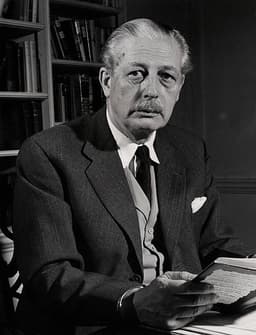
Harold Macmillan
Politician · Modern
58.4Total

Xiomara Castro
Politician · Modern
46.3Total
Basic Information
Born
1894
1959
Died
1986
—
Era
Modern
Modern
Nationality
United Kingdom
Honduras
Occupation
Politician
Politician
Civilization
Western
Western
Score Comparison
Military (10%)
50.0
49.7
Political (20%)
72.0
42.3
Influence (20%)
60.0
51.0
Legacy (20%)
50.0
39.2
Leadership (15%)
72.0
55.3
Strategy (15%)
43.1
41.4
TOTAL
58.4
46.3
Harold Macmillan — Complete Timeline
1957 AD
Elected Prime MinisterPolitical Action
Macmillan succeeded Anthony Eden as Prime Minister after the Suez Crisis. He led the Conservative Party to a landslide victory in the 1959 general election, consolidating his power.
Prime MinisterConservative Party
Impact: national
Delivered 'You've Never Had It So Good' SpeechCultural◆ Major
Macmillan gave a speech in Bedford stating that Britons had 'never had it so good,' referring to post-war prosperity. The phrase became emblematic of his premiership and the era of rising living standards.
SpeechEconomic Prosperity
Impact: nationalconstructive
Signed the Treaty of RomePolitical Action◆ Major
Macmillan's government signed the Treaty of Rome, establishing the European Economic Community (EEC). However, the UK did not join at this time, as Macmillan prioritized the European Free Trade Association (EFTA).
European IntegrationEEC
Impact: global
1960 AD
Wind of Change SpeechCultural◆ Major
Macmillan delivered the 'Wind of Change' speech to the South African Parliament, acknowledging the rise of African nationalism and the inevitability of decolonization. This signaled Britain's shift away from empire.
DecolonizationAfrica
Impact: global
1963 AD
Profumo AffairPolitical Action◆ Major
The Profumo affair, a sex scandal involving War Minister John Profumo, damaged Macmillan's government. Macmillan's handling of the crisis was criticized, contributing to his resignation later that year.
ScandalGovernment
Impact: nationaldestructive
Resigned as Prime MinisterPolitical Action◆ Major
Macmillan resigned as Prime Minister in October 1963, citing ill health. He was succeeded by Alec Douglas-Home. His resignation marked the end of a premiership defined by prosperity and decolonization.
ResignationConservative Party
Impact: national
Xiomara Castro — Complete Timeline
2021 AD
Elected President of HondurasPolitical Action◆ Major
Xiomara Castro won the Honduran presidential election as the candidate of the Liberty and Refoundation (Libre) party, defeating the National Party candidate. She became the first female president of Honduras, ending 12 years of National Party rule.
ElectionFirst Female PresidentHonduras
Impact: nationalconstructive
2022 AD
Declared a State of Emergency to Combat GangsPolitical Action◆ Major
Castro's government declared a state of emergency and suspended constitutional rights in response to rising gang violence. The measure allowed for mass arrests without warrants and was criticized by human rights groups but supported by many Hondurans.
Gang ViolenceState of EmergencyHuman Rights
Impact: nationaldestructive
2023 AD
Reestablished Diplomatic Relations with ChinaPolitical Action◆ Major
Castro's government severed diplomatic ties with Taiwan and established formal relations with the People's Republic of China. This shift aligned Honduras with the One-China policy and opened new economic agreements with China.
Foreign PolicyChinaTaiwan
Impact: regional
Expert Analysis
Origins
Harold Macmillan was born in 1894 in London to a wealthy publishing family. He was educated at Eton and Balliol College, Oxford, where he studied classics. After serving in World War I, he entered politics as a Conservative MP in 1924. His privileged background and elite education shaped his pragmatic, aristocratic style.
Xiomara Castro was born in 1959 in Tegucigalpa, Honduras, to a middle-class family. She studied business administration but left university to marry Manuel Zelaya. As first lady from 2006 to 2009, she became politically active after her husband's ouster in a coup. Her rise from first lady to president marks a dramatic shift from traditional gender roles in Honduran politics.
Rise to Power
Macmillan rose to prominence as a loyal party figure. He served in key cabinet roles under Churchill and Eden, including Foreign Secretary and Chancellor of the Exchequer. In 1957, after Eden's resignation following the Suez Crisis, Macmillan became Prime Minister. He quickly consolidated power by winning the 1959 general election with a landslide majority, a feat he achieved by capitalizing on economic prosperity.
Castro emerged as a political force after the 2009 coup that removed her husband. She founded the Liberty and Refoundation (Libre) party and ran for president in 2013, losing narrowly. In 2021, she won the presidency with 51% of the vote, becoming Honduras's first female president. Her campaign focused on anti-corruption, social welfare, and opposition to the conservative National Party.
Leadership & Governance
Macmillan governed as a moderate Conservative, promoting economic growth and consumerism. His famous 'You've Never Had It So Good' speech in 1957 encapsulated the post-war boom. He pursued decolonization, notably with the 'Wind of Change' speech in 1960, acknowledging African independence movements. However, his government's application to join the European Economic Community was vetoed by France in 1963. Macmillan scored 72.0 in political acumen, reflecting his ability to manage party factions and public opinion.
Castro leads as a leftist reformer. She declared a state of emergency in 2022 to combat gang violence, suspending constitutional rights and deploying military police. She reestablished diplomatic relations with China, breaking with Taiwan, a move that scored diplomatic points but drew criticism. Her government has struggled with economic crises and corruption allegations. Castro's leadership score is 55.3, indicating mixed effectiveness in a volatile political environment.
Triumph & Tragedy
Macmillan's greatest triumph was managing the transition from empire to Commonwealth. He oversaw the independence of many African nations, including Ghana and Nigeria, without major conflict. His 1959 election victory was a personal triumph. His greatest failure was the Profumo Affair in 1963, a sex scandal that eroded public trust. Macmillan's handling of the affair was criticized, and he resigned later that year citing health reasons. His legacy score of 50.0 partly reflects this tarnished end.
Castro's triumph is breaking gender barriers and returning the presidency to the left after 12 years. She successfully reestablished ties with China, securing aid and investment. Her tragedy is the escalating violence and economic hardship during her tenure. The state of emergency has been criticized for human rights abuses without significantly reducing crime. Her political score of 42.3 reflects these challenges.
Character & Destiny
Macmillan was known for his unflappable, aristocratic demeanor, often called 'Supermac' by the press. He was a pragmatist who valued consensus and gradual change. His character allowed him to navigate the post-war consensus but also made him appear out of touch during the Profumo crisis. His strategy score of 43.1 suggests a cautious, non-innovative approach.
Castro is determined and resilient, having survived political persecution and a coup. She is more ideological than Macmillan, pushing for socialist reforms. Her character has inspired women in Honduras but also polarized the nation. Her strategy score of 41.4 reflects a reactive rather than proactive governance style.
Legacy
Macmillan's legacy is mixed. He is remembered for 'You've Never Had It So Good' and the Wind of Change, but also for the Profumo affair. His influence score of 60.0 reflects his role in decolonization and the EEC application. He is seen as a transitional figure between empire and modern Britain.
Castro's legacy is still forming. She is a symbol of female political empowerment in Central America. Her realignment with China may have long-term economic impacts. However, her presidency so far has not resolved Honduras's deep-seated problems. Her legacy score of 39.2 indicates limited enduring impact.
Conclusion
Harold Macmillan had greater impact due to his role in decolonization and shaping post-war Britain. Despite the Profumo scandal, his political acumen (72.0) and influence (60.0) surpass Castro's. Castro's leadership is historic but constrained by Honduras's instability and her lower scores (total 46.3 vs 58.4). Macmillan's actions affected millions across continents, while Castro's impact remains national and uncertain. Thus, Macmillan is the more significant historical figure.
Rankings
🥇
Harold MacmillanLeader
Mil: 50.0Pol: 72.0Inf: 60.0
58.4
🥈
Xiomara Castro
Mil: 49.7Pol: 42.3Inf: 51.0
46.3
+12.1 behind
How This Comparison Works
Algorithm
Each figure is scored on 6 dimensions (0—100 scale) based on structured historical data: Military (10%), Political (20%), Influence (20%), Legacy (20%), Leadership (15%), Strategy (15%). The weighted total produces the final ranking.
Data Sources
Scores are computed from structured sub-indicators in the database. Scale factors adjust for era (Ancient ×0.85, Modern ×1.0) and civilization size (Eastern ×1.05, Other ×0.80) to account for differences in population and military scale.
Maximum 3 Figures
Comparisons are limited to 2—3 figures to ensure readability and statistical meaningfulness.
Error Margins
±5 points per dimension — Sub-scores are derived from historical records with inherent uncertainty. Two figures within 5 points on a dimension should be considered roughly equivalent in that area.
Total Score Accuracy
±3 points overall — The weighted combination of 6 dimensions produces a total score with approximately ±3 points of uncertainty. Differences of less than 3 points are not statistically significant— the figures are effectively tied.
Known Limitations
- Historical records are incomplete and uneven across civilizations
- Figures from oral-tradition societies may be underrepresented
- Occupation labels can misclassify multi-role figures
- Scores measure capability and impact, not moral character
- Quantitative scoring is a comparison tool, not absolute truth
Capability Radar
Military (10%) — Battles & Warfare
Battles
28
29
Win Rate
31
33
Expansion
36
34
Political (20%) — Governance & Reform
Reform
55
40
Diplomacy
70
35
Economy
65
25
Influence (20%) — Cultural & Global Reach
Cultural
40
25
Global
50
20
Legacy (20%) — Historical Impact
Historical
50
20
Longevity
40
15
Leadership (15%) — Power & Stability
Tenure
60
30
Stability
60
20
Strategy (15%) — Tactics & Innovation
Strategy
40
37
Tactics
40
40
Reform
45
43
Similar Comparisons
Comments & Discussion
No comments yet. Be the first to share your thoughts!