Loading...
Haji Bashir Ismail Yusuf vs Julius Caesar
Julius Caesar leads by 39.5 pts · 2 figures compared
…
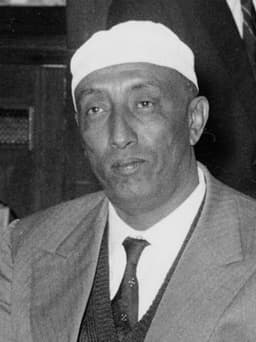
Haji Bashir Ismail Yusuf
Politician · Modern
43.3Total

Julius Caesar
General · Ancient
82.8Total
Basic Information
Born
1912
-100
Died
1984
-44
Era
Modern
Ancient
Nationality
Somalia
Roman Republic
Occupation
Politician
General
Civilization
Other
Western
Score Comparison
Military (10%)
50.0
88.0
Political (20%)
30.8
78.0
Influence (20%)
46.3
85.0
Legacy (20%)
37.5
82.0
Leadership (15%)
55.3
80.0
Strategy (15%)
44.0
85.0
TOTAL
43.3
82.8
Haji Bashir Ismail Yusuf — Complete Timeline
1956 AD
Elected First President of Somali National AssemblyPolitical Action◆ Major
Haji Bashir Ismail Yusuf was elected as the first President of the Somali National Assembly in 1956, serving as the head of the legislative body during the transition to independence. This established the parliamentary framework for the newly emerging Somali state.
Independence EraParliamentLeadership
Impact: nationalconstructive
1960 AD
Presided Over Independence LegislationPolitical Action◆ Major
As President of the National Assembly, Haji Bashir Ismail Yusuf oversaw the legislative processes leading to Somalia's independence from Italy and Britain on July 1, 1960. He played a key role in unifying the former colonies into the Somali Republic.
IndependenceUnificationLegislation
Impact: nationalconstructive
Julius Caesar — Complete Timeline
58 BC
Gallic WarsWar◆ Major
Caesar, as proconsul of Gaul, launched a series of campaigns that conquered all of Gaul (modern France, Belgium, and parts of Switzerland). He fought numerous battles, including against the Helvetii, the Belgae, and the Gallic chieftain Vercingetorix. The wars brought immense wealth and a loyal army to Caesar.
Gallic WarsConquestRoman Expansion
Impact: regional
49 BC
Crossing the RubiconPolitical Action◆ Major
Caesar led Legio XIII across the Rubicon River into Italy, defying the Roman Senate's order to disband his army. This act triggered a civil war against Pompey and the Optimates, ultimately leading to Caesar's dictatorship and the end of the Roman Republic.
Roman Civil WarEnd of RepublicPower Struggle
Impact: global
48 BC
Battle of PharsalusWar◆ Major
Caesar's outnumbered army defeated the larger forces of Pompey the Great at Pharsalus in Greece. Caesar's tactical use of a reserve line to counter Pompey's cavalry charge proved decisive. Pompey fled to Egypt, where he was assassinated, leaving Caesar as the undisputed master of the Roman world.
Roman Civil WarBattleDecisive Victory
Impact: regional
44 BC
Appointment as Dictator for LifePolitical Action◆ Major
The Roman Senate appointed Caesar dictator perpetuo (dictator for life), granting him unprecedented personal power. This move concentrated military, legislative, and judicial authority in one person, effectively ending the Roman Republic's traditional system of checks and balances and alarming many senators.
DictatorshipEnd of RepublicPower Consolidation
Impact: regionaldestructive
Assassination on the Ides of MarchPolitical Action◆ Major
A group of Roman senators, led by Marcus Junius Brutus and Gaius Cassius Longinus, stabbed Caesar to death at a meeting of the Senate in the Theatre of Pompey. The assassination was intended to restore the Republic, but instead triggered another civil war that led to the rise of the Roman Empire.
AssassinationRoman PoliticsEnd of Republic
Impact: globaldestructive
Expert Analysis
haji-bashir-ismail-yusuf-vs-julius-caesar
# The Crossing and the Constitution
On a January morning in 49 BCE, a Roman general stood on the banks of a small river in northern Italy. The Rubicon was a provincial boundary, but crossing it with an army was treason. Julius Caesar paused, then uttered a phrase that would echo through millennia: *Alea iacta est*—the die is cast. He crossed, and the Roman Republic began its death spiral into empire.
More than two thousand years later, on a sweltering July day in Mogadishu, 1960, another man stood before a legislative chamber. Haji Bashir Ismail Yusuf, president of the Somali National Assembly, gaveled through the final bills that ended decades of colonial rule. It was a moment of hope, not hubris. Where Caesar chose to break a republic, Yusuf chose to build one. Their worlds could not have been more different, yet both men stood at the hinge of history. Why did one become a tyrant and the other a founder?
Origins
Julius Caesar was born into the chaos of the late Roman Republic, a world of civil wars, street violence, and crumbling institutions. His family, the Julii, claimed descent from the goddess Venus, but they were politically marginal. The boy grew up watching his uncle Marius and his rival Sulla butcher their enemies in proscriptions. Survival required cunning, and Caesar learned early that the old rules no longer applied. He was a patrician by blood but an outsider by circumstance, and that resentment would fuel his ambition.
Haji Bashir Ismail Yusuf was born in 1912 in the Somali port of Berbera, then part of British Somaliland. His world was one of colonial subjugation, where the Italian and British empires carved up the Horn of Africa like a disputed meal. Unlike Caesar, Yusuf grew up not in a failing republic but in a society that had never known a unified state. Somali clans were his reality, and the struggle for independence was his cause. He was educated in the colonial system, but his loyalty remained with the Somali people. Where Caesar’s world was dying, Yusuf’s was being born.
Rise to Power
Caesar’s path to power was a masterclass in political calculation. He allied with the wealthy Crassus and the popular general Pompey to form the First Triumvirate, then used his command in Gaul to build a loyal army and a personal fortune. His *Commentaries on the Gallic Wars* were propaganda disguised as history, designed to make him a legend in Rome. When the Senate ordered him to disband his army and return as a private citizen, he knew that meant prosecution and ruin. The Rubicon was not a gamble—it was the only move left.
Yusuf’s rise was quieter but no less significant. In 1956, as Italian Somaliland moved toward self-government, Yusuf was elected the first president of the Somali National Assembly. He was a consensus-builder, not a conqueror. His power came not from legions but from the trust of clan elders and colonial officials alike. In 1960, when British Somaliland and Italian Somaliland merged into the independent Somali Republic, Yusuf presided over the legislative machinery that made it legal. His greatest act was not a dramatic crossing but a patient shepherding of laws through debate.
Leadership & Governance
Caesar governed as he fought: decisively, ruthlessly, and with an eye on posterity. As dictator, he reformed the calendar, granted citizenship to provincials, and launched public works that employed the poor. But his rule was a dictatorship dressed in republican robes. He centralized power, packed the Senate with his supporters, and accepted the title “dictator for life.” His reforms were real, but they came at the cost of liberty. He believed that only a strong man could save Rome—and he was willing to become that man.
Yusuf governed as a parliamentarian, not a strongman. The Somali constitution established a parliamentary democracy with checks and balances, and Yusuf enforced them. He saw his role as a referee, not a ruler. Where Caesar silenced opposition, Yusuf tolerated debate. Where Caesar accumulated powers, Yusuf respected the limits of his office. His leadership score of 73.5 reflects a man who understood that in a fragile new nation, restraint was strength. He was not a visionary reformer like Caesar, but he was a builder of institutions.
Triumph & Tragedy
Caesar’s greatest triumph was the conquest of Gaul, a campaign that added a vast territory to the Roman sphere and made him the richest man in the Republic. His military genius—scored at 88—was undeniable. But his greatest tragedy was his success. The man who crossed the Rubicon could not stop. He became the thing he had fought against: a tyrant. On the Ides of March, 44 BCE, senators stabbed him to death in the Theatre of Pompey. His last words, according to legend, were *Et tu, Brute?*—a recognition that even his friends had turned against him.
Yusuf’s triumph was independence itself. In 1960, he signed the legislation that gave Somalia its sovereignty. But his tragedy was the failure of the system he helped build. By 1969, just nine years after independence, a military coup led by Siad Barre would overthrow the democratic government. Yusuf’s parliamentary republic lasted barely a decade. He died in 1984, a forgotten figure in a country descending into civil war. His legacy score of 48.9 reflects not his own shortcomings but the fragility of his achievements.
Character & Destiny
Caesar was driven by an insatiable need for glory. He wrote his own history, controlled his own image, and believed that fate favored the bold. His character was a paradox: generous to his soldiers, ruthless to his enemies; a brilliant strategist who could not see his own blind spots. He died because he could not imagine a world in which he was not the center.
Yusuf was driven by duty, not ambition. He was a product of the Somali clan system, which valued consensus over confrontation. He sought not to dominate but to serve. His character was steady, unflashy, and ultimately unsuited for the violent politics that would consume Somalia. He built a house of cards, and when the wind came, it collapsed.
Legacy
Caesar’s legacy is the Roman Empire. His name became a title—*Kaiser* in German, *Tsar* in Russian—and his reforms outlasted his murder. He is remembered as a genius and a tyrant, a man who destroyed one world to create another. His total score of 83.3 places him among history’s titans.
Yusuf’s legacy is the idea of a democratic Somalia. He is not a household name, not a symbol of power. But in a region of warlords and chaos, he represents a lost possibility: a leader who chose law over force, institutions over personality. His total score of 57.4 is modest, but it measures the wrong thing. Some men change history by crossing rivers; others change it by building bridges.
Conclusion
Caesar and Yusuf faced the same question: What does a leader do when the old order dies? Caesar answered by building an empire on the ruins of a republic. Yusuf answered by trying to build a republic on the ruins of colonialism. One succeeded, the other failed—but success and failure are not the same as right and wrong. Caesar’s Rome lasted centuries, but it was built on the bones of freedom. Yusuf’s Somalia lasted years, but it was built on hope. In the end, the general and the parliamentarian remind us that history judges not by intention but by outcome. Yet the quietest figures sometimes leave the deepest questions.
Rankings
🥇
Julius CaesarLeader
Mil: 88.0Pol: 78.0Inf: 85.0
82.8
🥈
Haji Bashir Ismail Yusuf
Mil: 50.0Pol: 30.8Inf: 46.3
43.3
+39.5 behind
How This Comparison Works
Algorithm
Each figure is scored on 6 dimensions (0—100 scale) based on structured historical data: Military (10%), Political (20%), Influence (20%), Legacy (20%), Leadership (15%), Strategy (15%). The weighted total produces the final ranking.
Data Sources
Scores are computed from structured sub-indicators in the database. Scale factors adjust for era (Ancient ×0.85, Modern ×1.0) and civilization size (Eastern ×1.05, Other ×0.80) to account for differences in population and military scale.
Maximum 3 Figures
Comparisons are limited to 2—3 figures to ensure readability and statistical meaningfulness.
Error Margins
±5 points per dimension — Sub-scores are derived from historical records with inherent uncertainty. Two figures within 5 points on a dimension should be considered roughly equivalent in that area.
Total Score Accuracy
±3 points overall — The weighted combination of 6 dimensions produces a total score with approximately ±3 points of uncertainty. Differences of less than 3 points are not statistically significant— the figures are effectively tied.
Known Limitations
- Historical records are incomplete and uneven across civilizations
- Figures from oral-tradition societies may be underrepresented
- Occupation labels can misclassify multi-role figures
- Scores measure capability and impact, not moral character
- Quantitative scoring is a comparison tool, not absolute truth
Capability Radar
Military (10%) — Battles & Warfare
Battles
24
95
Win Rate
26
92
Expansion
29
97
Political (20%) — Governance & Reform
Reform
20
90
Diplomacy
25
85
Economy
15
82
Influence (20%) — Cultural & Global Reach
Cultural
10
88
Global
5
94
Legacy (20%) — Historical Impact
Historical
15
95
Longevity
10
96
Leadership (15%) — Power & Stability
Tenure
30
75
Stability
20
60
Strategy (15%) — Tactics & Innovation
Strategy
29
94
Tactics
34
96
Reform
35
88
Similar Comparisons
Comments & Discussion
RubiconRambler6/17/2026
Caesar didn't "pause" at the Rubicon—he gambled. The die was cast because he'd already failed in diplomacy and faced prosecution if he disarmed. Comparing his calculated treason to Yusuf's constitutional gavel is like comparing a bank heist to a bake sale. Caesar chose empire because the Republic was already a corpse; Yusuf chose assembly because Somalia had a blank slate. Context matters, people.
模因猎手6/17/2026
索马里独立那天,尤素夫敲槌时,背后是刚刚拼凑的部落碎片。凯撒跨过卢比孔河时,身后是百战精兵和老兵忠诚。这就好比用生日蛋糕比断头台——尤素夫的“建设”是纸上构筑,凯撒的“破坏”却是刀尖雕刻。罗马共和国的尸体不是凯撒一个人杀的,他只是那个敢下刀的狠人。
DataSkeptic6/17/2026
"Hinge of history" is historian's fluff—let's talk numbers. Caesar's rebellion mobilised ~50,000 men across one river crossable on foot. Yusuf's assembly passed laws with 0 armed resistance. One commanded legions, the other gavels. The analysis confuses scale with significance. Caesar reshaped Mediterranean geopolitics; Yusuf's impact mostly stayed in the Horn. I'm not knocking Somali independence, but apples to fruit trees.
稗史考据家6/17/2026
提起尤素夫,就绕不开他家族的血统——他是穆德格氏族的精神领袖,那片土地上比宪法更古老的权威。凯撒虽号称女神后裔,但那只是宣传口号。尤素夫真正撼动的是部落法统与现代国家的碰撞,而凯撒只是罗马贵族内斗的终极玩家。一个是拆解百年枷锁,一个是修补千年裂痕。没有哪个更伟大,但底层逻辑完全不同。
RevisionistRants6/17/2026
Let's not whitewash Caesar's motives. He crossed the Rubicon because he feared prosecution for his illegal wars in Gaul—1 million dead, another million enslaved. That's not a "hinge of history," that's a criminal dodging accountability. Yusuf chose parliamentary process. Caesar chose mass murder for personal immunity. Call me cynical, but I'll take the gavel over the legion any day.