Loading...
Gyeongjong of Goryeo vs Yuwen Yong
Yuwen Yong leads by 20.1 pts · 2 figures compared
…
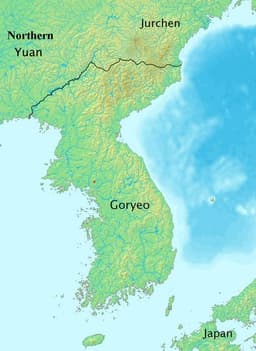
Gyeongjong of Goryeo
Emperor · Medieval
47.1Total
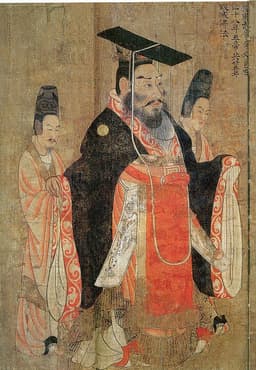
Yuwen Yong
Emperor · Medieval
67.2Total
Basic Information
Born
955
543
Died
981
578
Era
Medieval
Medieval
Nationality
Korea
China
Occupation
Emperor
Emperor
Civilization
Eastern
Eastern
Score Comparison
Military (10%)
20.0
78.0
Political (20%)
53.8
78.0
Influence (20%)
53.3
58.0
Legacy (20%)
47.5
54.0
Leadership (15%)
48.8
85.0
Strategy (15%)
45.0
69.1
TOTAL
47.1
67.2
Gyeongjong of Goryeo — Complete Timeline
976 AD
Institution of the Jeonsigwa Land SystemReform◆ Major
King Gyeongjong established the jeonsigwa, a land distribution system that allocated state-owned farmland to government officials based on their rank. This reform aimed to secure royal revenue and control over land, while providing a stable income for the bureaucracy.
Impact: nationalconstructive
Yuwen Yong — Complete Timeline
574 AD
Suppression of Buddhism in Northern ZhouReform◆ Major
Emperor Wu of Northern Zhou (Yuwen Yong) ordered the suppression of Buddhism, confiscating monastic lands, forcing monks and nuns to return to lay life, and destroying temples. He aimed to increase state revenue and military manpower, strengthening the state.
Northern ZhouBuddhist PersecutionReform
Impact: nationaldestructive
577 AD
Conquest of Northern QiWar
Emperor Wu led a successful campaign against the rival Northern Qi dynasty, conquering its territory and unifying northern China under Northern Zhou. This victory ended the division of the north and set the stage for the Sui dynasty's unification of all China.
Northern ZhouUnificationNorthern Qi
Impact: regionalconstructive
578 AD
Death during campaign against the TurksWar◆ Major
Emperor Wu died of illness while leading a campaign against the G
Northern ZhouMilitary CampaignDeath
Impact: regionaltragic
Expert Analysis
Gyeongjong of Goryeo vs Yuwen Yong
# The Emperor and the Unifier: Two Paths to Power in Medieval East Asia
In the autumn of 976, as Gyeongjong of Goryeo signed the decree that would reshape his kingdom’s economy, he could not have known that two years earlier and a thousand miles to the west, another emperor had already attempted something far more radical. Yuwen Yong, the Emperor Wu of Northern Zhou, had stripped Buddhist monasteries of their lands and forced thousands of monks back into secular life. Both men sought to centralize power through land reform. One would die in bed, his reforms enduring for centuries. The other would die on horseback, his empire crumbling within three years of his passing. What separated them was not ambition, but the worlds they inherited—and the choices those worlds forced upon them.
Origins
Gyeongjong was born into a dynasty still finding its footing. The Goryeo kingdom, founded only in 918, had spent decades consolidating the Korean peninsula after the fall of Unified Silla. His father, King Gwangjong, had already set a precedent for strong central rule, purging aristocratic rivals and freeing slaves to build a loyal bureaucracy. Gyeongjong grew up in a court where the king’s authority was real but contested, where landed aristocrats—the *hojok*—held local power that threatened the throne. His education would have emphasized Confucian statecraft: the art of balancing factions, rewarding loyalty, and keeping the treasury solvent.
Yuwen Yong, by contrast, was born into a world of war. His Xianbei-ruled Northern Zhou was one of three Chinese kingdoms locked in a struggle for supremacy. His father, Yuwen Tai, had built a formidable military machine based on the *fubing* militia system, but died when Yuwen Yong was just fourteen. For the next twelve years, the young emperor watched as his cousin Yuwen Hu—the regent—ruled in his name, even poisoning an elder brother who resisted. Yuwen Yong learned patience in the shadows, studying military strategy and waiting for the moment to strike. When he finally killed Yuwen Hu in a palace coup in 572, he was twenty-nine years old—older than Gyeongjong would ever be, and hardened by a decade of feigned weakness.
Rise to Power
Gyeongjong ascended the throne in 975 with relatively little drama. His father had died of illness, and the succession was smooth. He was twenty years old, educated, and surrounded by advisers who had served his father. The challenge was not seizing power, but wielding it effectively. The *hojok* were restless; the treasury was strained from Gwangjong’s expensive reforms. Gyeongjong needed a policy that would reward loyal officials without alienating the aristocracy entirely.
Yuwen Yong’s rise was anything but smooth. His coup against Yuwen Hu was a masterpiece of deception—he spent years appearing weak and indecisive, lulling the regent into overconfidence. When he struck, it was swift and final. Unlike Gyeongjong, who inherited a functioning administration, Yuwen Yong had to rebuild one from the wreckage of a regency that had lasted over a decade. He immediately began purging Yuwen Hu’s faction, promoting military officers who owed him personal loyalty, and preparing for the war that would define his reign.
Leadership & Governance
Here the two emperors diverged most sharply. Gyeongjong’s signature achievement, the *jeonsigwa* land system of 976, was essentially a bureaucratic reform. It classified all state-owned farmland and distributed it according to official rank, from the highest minister down to the lowest functionary. The system was elegant in its simplicity: it tied officials’ income to their position, not their family connections, and ensured that land reverted to the state upon death or dismissal. This stabilized royal finances and reduced the power of local magnates. But Gyeongjong did not enforce it with violence. He negotiated, compromised, and allowed exceptions. The *jeonsigwa* worked because it was perceived as fair, not because it was feared.
Yuwen Yong’s suppression of Buddhism in 574 was the opposite: a hammer blow against an entrenched institution. Northern Zhou had thousands of monasteries controlling vast tracts of tax-exempt land, housing tens of thousands of monks who neither farmed nor fought. Yuwen Yong saw this as a drain on military resources. His decree confiscated all monastic lands, forced monks and nuns to marry and register as taxpayers, and melted down Buddhist statues for coinage. It was brutally efficient—within months, the state had gained massive revenue and manpower. But it created bitter enemies among the devout, and the suppression lasted only as long as his reign.
Militarily, Yuwen Yong was far superior. His conquest of Northern Qi in 577 was a campaign of stunning speed and decisiveness. He personally led his armies, outmaneuvered enemy generals, and absorbed the defeated kingdom’s troops into his own forces. By 578, he controlled all of northern China and was preparing to invade the south. Gyeongjong, by contrast, fought no major wars. His strategy score of 30.0 compared to Yuwen Yong’s 81.8 reflects this gap—but it also reflects different priorities. Gyeongjong was building institutions for the long term. Yuwen Yong was building an empire for the moment.
Triumph & Tragedy
Gyeongjong’s greatest moment was the promulgation of the *jeonsigwa* in 976. It was a triumph of administrative statecraft, and it would outlast him by centuries—the basic framework of land allocation by rank remained in use until the late Goryeo period. His tragedy was his early death at age twenty-six in 981. He died without seeing the full fruits of his reforms, leaving the throne to his young son, who would face the same aristocratic pressures his father had tried to contain.
Yuwen Yong’s triumph was the conquest of Northern Qi in 577, which unified the north for the first time in decades. He had achieved what his father had only dreamed of. His tragedy came the very next year. In 578, while leading a campaign against the Göktürks, he fell ill and died at age thirty-five. His son, Emperor Xuan, was a debauched and incompetent ruler who reversed many of his father’s policies—including the Buddhist suppression—and alienated the military. Within three years, Yuwen Yong’s dynasty was overthrown by his own general, Yang Jian, who founded the Sui dynasty and completed the unification of China.
Character & Destiny
Gyeongjong was a builder. He thought in systems and structures, in the slow accumulation of bureaucratic power. His personality—cautious, diplomatic, methodical—suited a kingdom that needed stability, not conquest. He understood that the *hojok* could not be crushed, only managed. His reforms bought time for the Goryeo dynasty to mature.
Yuwen Yong was a warrior-emperor in the mold of Caesar or Genghis Khan. He thought in campaigns and conquests, in the decisive blow that ends all argument. His personality—ruthless, patient, strategic—suited a chaotic era where only the strong survived. But his methods created enemies faster than they created institutions. When he died, there was no bureaucratic structure to hold his empire together. It collapsed because he had built it around himself.
Legacy
Today, Gyeongjong is remembered as a reformer who gave Goryeo a stable fiscal foundation. His total score of 60.6 reflects a solid but unspectacular reign. He is not a household name, even in Korea. But the *jeonsigwa* system he created influenced Korean land policy for centuries, and his cautious approach to reform set a precedent for later Goryeo kings.
Yuwen Yong’s legacy is more dramatic but more fragile. His total score of 74.0 reflects his military achievements and his bold—if controversial—religious policies. He is remembered as a unifier, a precursor to the Sui and Tang dynasties that would follow. But his empire died with him. His suppression of Buddhism was reversed within years. His conquests were inherited by a usurper. He is a figure of what might have been—a northern Chinese emperor who could have reunited all of China, had he lived.
Conclusion
Standing at the edge of their respective histories, Gyeongjong and Yuwen Yong embody a fundamental tension in medieval statecraft: the choice between building institutions and winning wars. Gyeongjong built a machine that could run without him. Yuwen Yong built a monument that required his constant presence. One died young, but his work endured. The other died young, and his work crumbled. In the end, the emperor who never led an army into battle left a deeper mark on his kingdom than the conqueror who unified the north. It is a reminder that in the long arc of history, the pen may not always be mightier than the sword—but the land deed often outlasts both.
Rankings
🥇
Yuwen YongLeader
Mil: 78.0Pol: 78.0Inf: 58.0
67.2
🥈
Gyeongjong of Goryeo
Mil: 20.0Pol: 53.8Inf: 53.3
47.1
+20.1 behind
How This Comparison Works
Algorithm
Each figure is scored on 6 dimensions (0—100 scale) based on structured historical data: Military (10%), Political (20%), Influence (20%), Legacy (20%), Leadership (15%), Strategy (15%). The weighted total produces the final ranking.
Data Sources
Scores are computed from structured sub-indicators in the database. Scale factors adjust for era (Ancient ×0.85, Modern ×1.0) and civilization size (Eastern ×1.05, Other ×0.80) to account for differences in population and military scale.
Maximum 3 Figures
Comparisons are limited to 2—3 figures to ensure readability and statistical meaningfulness.
Error Margins
±5 points per dimension — Sub-scores are derived from historical records with inherent uncertainty. Two figures within 5 points on a dimension should be considered roughly equivalent in that area.
Total Score Accuracy
±3 points overall — The weighted combination of 6 dimensions produces a total score with approximately ±3 points of uncertainty. Differences of less than 3 points are not statistically significant— the figures are effectively tied.
Known Limitations
- Historical records are incomplete and uneven across civilizations
- Figures from oral-tradition societies may be underrepresented
- Occupation labels can misclassify multi-role figures
- Scores measure capability and impact, not moral character
- Quantitative scoring is a comparison tool, not absolute truth
Capability Radar
Military (10%) — Battles & Warfare
Battles
5
75
Win Rate
5
80
Expansion
5
80
Political (20%) — Governance & Reform
Reform
70
85
Diplomacy
40
70
Economy
65
75
Influence (20%) — Cultural & Global Reach
Cultural
30
40
Global
20
40
Legacy (20%) — Historical Impact
Historical
45
65
Longevity
40
50
Leadership (15%) — Power & Stability
Tenure
55
60
Stability
50
70
Strategy (15%) — Tactics & Innovation
Strategy
5
75
Tactics
5
70
Reform
5
85
Similar Comparisons
Comments & Discussion
北周宇文护6/16/2026
作为军事史研究者,我要说这比较太天真。宇文邕是砍下北齐高纬脑袋的狠人,而高丽景宗?他能打过契丹还是女真?数据摆在那:北周吞并北齐时兵力达20万,高丽撑死5万。草原上的狼和家犬能比?宇文邕死得早不是失败,是老天不想让隋文帝抢功。别拿盆景和松树比高低!