Loading...
Gyeongjong of Goryeo vs Parakramabahu I
Parakramabahu I leads by 19.0 pts · 2 figures compared
…
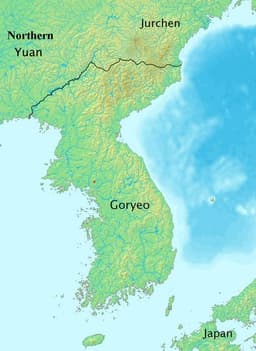
Gyeongjong of Goryeo
Emperor · Medieval
47.1Total
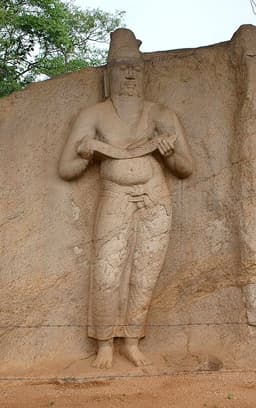
Parakramabahu I
Emperor · Medieval
66.1Total
Basic Information
Born
955
1123
Died
981
1186
Era
Medieval
Medieval
Nationality
Korea
Sri Lanka
Occupation
Emperor
Emperor
Civilization
Eastern
Indian
Score Comparison
Military (10%)
20.0
82.0
Political (20%)
53.8
72.0
Influence (20%)
53.3
61.0
Legacy (20%)
47.5
52.0
Leadership (15%)
48.8
82.0
Strategy (15%)
45.0
65.4
TOTAL
47.1
66.1
Gyeongjong of Goryeo — Complete Timeline
976 AD
Institution of the Jeonsigwa Land SystemReform◆ Major
King Gyeongjong established the jeonsigwa, a land distribution system that allocated state-owned farmland to government officials based on their rank. This reform aimed to secure royal revenue and control over land, while providing a stable income for the bureaucracy.
Impact: nationalconstructive
Parakramabahu I — Complete Timeline
1153 AD
Unification of Sri LankaWar
Parakramabahu I unified the entire island of Sri Lanka under his rule after a series of military campaigns. He defeated the rulers of Ruhuna and other regional kingdoms, ending a period of fragmentation.
Impact: national
1160 AD
Construction of Parakrama SamudraOther◆ Major
Parakramabahu I constructed the Parakrama Samudra, a massive man-made sea of interconnected tanks and canals near Polonnaruwa. This irrigation system, covering over 5,000 acres, was a major engineering achievement.
Impact: regionalconstructive
1165 AD
Invasion of BurmaWar◆ Major
Parakramabahu I launched a naval invasion of Burma (Pagan Kingdom) in retaliation for a trade dispute. The Sinhalese fleet captured the port of Kusumiya and sacked the city, demonstrating Sri Lanka's naval power.
Impact: regional
Reform of the Buddhist SanghaReform◆ Major
Parakramabahu I convened a council to purify the Buddhist Sangha. He expelled corrupt monks and re-established discipline, strengthening Theravada Buddhism in Sri Lanka.
Impact: nationalconstructive
1170 AD
Construction of Polonnaruwa VatadageCultural◆ Major
Parakramabahu I built the Polonnaruwa Vatadage, a circular relic house for the Tooth Relic of the Buddha. This structure is considered a masterpiece of Sinhalese architecture.
Impact: nationalconstructive
Expert Analysis
Gyeongjong of Goryeo vs Parakramabahu I
### The King and the Conqueror: Two Paths to Power in Medieval Asia
In 976, on the Korean peninsula, a young king named Gyeongjong sat in his palace in Kaesong, signing a decree that would reshape his kingdom’s economy. Half a world away, in the tropical heat of Sri Lanka, another king, Parakramabahu I, was just beginning his ascent. Both men ruled in the same century, both inherited fractured realms, and both are remembered as great builders. But their methods, their ambitions, and their ultimate fates could not have been more different. One was a reformer who stabilized a dynasty; the other was a conqueror who built an empire. What drove these two medieval monarchs down such divergent paths?
### Origins
Gyeongjong of Goryeo was born into a dynasty still consolidating its power. His father, King Gwangjong, had purged the aristocracy and established a centralized monarchy, but the cost was high—the court was riven with suspicion, and the treasury was strained. Gyeongjong, born in 955, grew up in the shadow of his father’s iron fist. He inherited not a stable empire but a tense, exhausted kingdom. His education was that of a bureaucrat-king: trained in Confucian statecraft, he understood that survival depended not on glory but on systems.
Parakramabahu I, born in 1123, came of age in a different world. Sri Lanka was a land of warring principalities, with the great Sinhalese kingdom of Polonnaruwa fragmented into rival factions. He was a prince of the royal line, but his path to power was not assured. From his youth, he displayed a restless energy—he studied military tactics, oversaw irrigation projects, and learned the art of diplomacy. Where Gyeongjong was shaped by the need to preserve, Parakramabahu was shaped by the drive to unify.
### Rise to Power
Gyeongjong’s rise was quiet, almost inevitable. He became king in 975 after his father’s death, inheriting a throne that was already his by blood. There was no dramatic coup, no epic campaign. His power came from the pen, not the sword. Within a year, he had designed and implemented the *jeonsigwa* land system—a reform that allocated state-owned farmland according to official rank. It was a masterstroke of administrative genius, stabilizing the kingdom’s finances by tying land ownership to service to the crown. It was not a conquest; it was a ledger.
Parakramabahu’s rise was anything but quiet. He spent years maneuvering through the chaos of Sri Lanka’s civil wars. In 1153, after a series of bloody campaigns, he finally defeated his rivals and unified the entire island under his rule. He did not inherit unity—he forged it. Where Gyeongjong used a decree, Parakramabahu used an army. His accession was a turning point, marked by the smoke of battle and the submission of enemies.
### Leadership & Governance
As rulers, the two kings embodied two distinct philosophies. Gyeongjong governed through structure. The *jeonsigwa* system was his legacy: it created a stable revenue stream, reduced the power of the old landed aristocracy, and strengthened the central bureaucracy. He was a king who governed from the throne room, not the battlefield. His military score is a modest 55.1, and his strategy a low 30.0—he was no general. His genius lay in administration.
Parakramabahu was the opposite. His leadership was martial and monumental. He expanded the island’s irrigation networks, building the Parakrama Samudra—a vast man-made sea of interconnected tanks and canals that still waters Sri Lankan fields today. He reformed the Buddhist Sangha, purging corrupt monks and restoring discipline. But he also launched a naval invasion of Burma in 1165, retaliating for a trade dispute with a fleet that struck deep into the Pagan Kingdom. His strategy score of 72.0 reflects a mind that saw war as a tool of statecraft. He built temples, but he also built ships.
### Triumph & Tragedy
Gyeongjong’s triumph was the *jeonsigwa*. It gave his kingdom a fiscal backbone that would last for generations. But his tragedy was perhaps that he did not live to see its full fruits. He died in 981, after only six years on the throne—young, at 26, possibly from illness. His reign was a brief, bright flash of reform, but it left no room for conquest or expansion.
Parakramabahu’s triumph was his unification of Sri Lanka, a feat that made his reign the golden age of medieval Sinhalese civilization. The Polonnaruwa Vatadage, a circular relic house for the Buddha’s Tooth, stands as a stone testament to his ambition. But his tragedy was overreach. The invasion of Burma, while bold, drained resources and sowed resentment. He died in 1186, leaving a kingdom that was powerful but brittle—the cracks would widen after his death.
### Character & Destiny
Gyeongjong was a reformer’s soul in a warrior’s age. His personality favored order over glory, stability over expansion. He knew that his father’s harsh rule had created enemies, and he chose to build consensus through land grants rather than through force. His destiny was to be a caretaker—a king who made his kingdom work, not one who made it larger.
Parakramabahu was a conqueror’s soul in a builder’s age. He could not rest with what he had. He unified the island, then looked across the sea. His personality was restless, ambitious, and proud. He built irrigation systems not just to feed his people, but to fund his armies. His destiny was to be remembered—but also to be the last great king of his line.
### Legacy
Gyeongjong is remembered in Korea as a quiet architect of stability. The *jeonsigwa* system influenced land policy for centuries. His legacy score of 64.4 reflects a king who mattered more for what he created than for what he conquered. He is a footnote to some, but a foundation to scholars.
Parakramabahu is a colossus in Sri Lankan memory. His name is carved into the landscape—the Parakrama Samudra, the Vatadage, the chronicles of the *Mahavamsa*. His legacy score of 68.6 is higher, and his influence score of 73.5 speaks to a king who shaped a nation’s identity. He is the hero of epic tales, the king who made Sri Lanka great.
### Conclusion
Two kings, two kingdoms, one century. Gyeongjong chose the ledger; Parakramabahu chose the sword. One secured a dynasty; the other built an empire. The difference was not in their times, but in their temperaments. Gyeongjong looked at a fractured court and saw a need for order. Parakramabahu looked at a fractured island and saw a need for unity. Both succeeded—but success, like power, takes many forms. In the end, the question is not who was greater, but what kind of greatness endures. Parakramabahu built monuments that still stand; Gyeongjong built systems that still shape governance. Both, in their own way, conquered time.
Rankings
🥇
Parakramabahu ILeader
Mil: 82.0Pol: 72.0Inf: 61.0
66.1
🥈
Gyeongjong of Goryeo
Mil: 20.0Pol: 53.8Inf: 53.3
47.1
+19.0 behind
How This Comparison Works
Algorithm
Each figure is scored on 6 dimensions (0—100 scale) based on structured historical data: Military (10%), Political (20%), Influence (20%), Legacy (20%), Leadership (15%), Strategy (15%). The weighted total produces the final ranking.
Data Sources
Scores are computed from structured sub-indicators in the database. Scale factors adjust for era (Ancient ×0.85, Modern ×1.0) and civilization size (Eastern ×1.05, Other ×0.80) to account for differences in population and military scale.
Maximum 3 Figures
Comparisons are limited to 2—3 figures to ensure readability and statistical meaningfulness.
Error Margins
±5 points per dimension — Sub-scores are derived from historical records with inherent uncertainty. Two figures within 5 points on a dimension should be considered roughly equivalent in that area.
Total Score Accuracy
±3 points overall — The weighted combination of 6 dimensions produces a total score with approximately ±3 points of uncertainty. Differences of less than 3 points are not statistically significant— the figures are effectively tied.
Known Limitations
- Historical records are incomplete and uneven across civilizations
- Figures from oral-tradition societies may be underrepresented
- Occupation labels can misclassify multi-role figures
- Scores measure capability and impact, not moral character
- Quantitative scoring is a comparison tool, not absolute truth
Capability Radar
Military (10%) — Battles & Warfare
Battles
5
75
Win Rate
5
80
Expansion
5
70
Political (20%) — Governance & Reform
Reform
70
80
Diplomacy
40
70
Economy
65
75
Influence (20%) — Cultural & Global Reach
Cultural
30
65
Global
20
40
Legacy (20%) — Historical Impact
Historical
45
70
Longevity
40
60
Leadership (15%) — Power & Stability
Tenure
55
85
Stability
50
80
Strategy (15%) — Tactics & Innovation
Strategy
5
75
Tactics
5
70
Reform
5
65
Similar Comparisons
Comments & Discussion
铁血史官6/16/2026
你们这些粉饰太平的人总爱说景宗是"改革家",可他最大的成就就是没被他爸杀掉的贵族们推翻。反观波洛罗摩婆诃一世,他把分裂的斯里兰卡统一了,打到缅甸让敌人献出白象,还建了能蓄水灌溉整个北部的巨型水库。景宗不过是高丽王朝过渡期的一个傀儡,连庙号都是大臣们随便给的。一个守成之君,一个开拓之主,高下立判。
The Battle Axe Broker6/16/2026
Gyeongjong wasn't a king; he was an accountant in a crown. His "reforms" were a bureaucratic bribe to the very aristocracy his father Gwangjong spent decades slaughtering. The *Jeonsigwa* land system just codified the nobility's power in exchange for short-term peace. Parakramabahu at least *built* something—massive irrigation works, conquests in Burma, a navy. One man stabilized a hostage situation; the other built an empire. History's verdict is clear.
水镜先生6/16/2026
把高丽景宗和波洛罗摩婆诃一世放一起比,简直是侮辱了后者。景宗就是个被迫坐在龙椅上的病秧子,他推行科举?那是他爹光宗玩剩下的。他真正做的是向豪族妥协,把国家权力一块块割让出去。而斯里兰卡那位,亲自率军跨海征讨缅甸,修建了帕拉克拉马水库——到今天还在用。一个靠退让保命,一个靠征服留名,有什么可比的?
Static Charge6/16/2026
Let's talk hard data: Gyeongjong's reign lasted four years and is primarily remembered for a land tax document. Four years. Parakramabahu ruled for thirty-three and left behind an irrigation network that supported millions. The comparison isn't even close on output metrics. Gyeongjong's "reforms" were just tweaking his father's system; Parakramabahu commissioned the *Mahavamsa* chronicle and built the Polonnaruwa Vatadage. One is a footnote in regional history, the other is a civilization-shapin
Loose Canon6/16/2026
Am I the only one who sees the irony? Gyeongjong's *Jeonsigwa* was essentially a medieval Korean property assessment scheme—bureaucratic drudgery. Parakramabahu literally conquered parts of Southeast Asia. Yet modern historians romanticize Gyeongjong as the "stabilizer." Stabilization of what? A court so paranoid his father executed his own in-laws? Meanwhile, Parakramabahu's irrigation works still function. One gave his nobles paper deeds; the other gave his people water. I know which legacy I'