Loading...
Charles de Gaulle vs Parakramabahu I
Charles de Gaulle leads by 2.1 pts · 2 figures compared
…
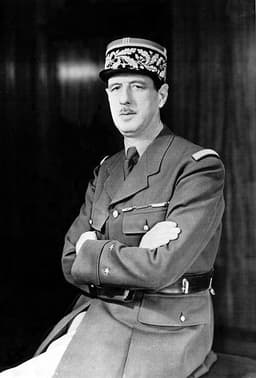
Charles de Gaulle
Politician · Modern
68.2Total
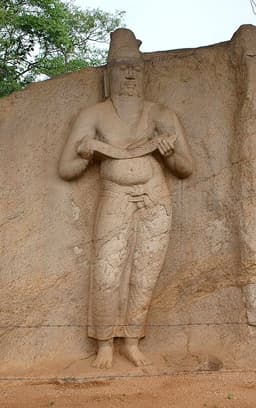
Parakramabahu I
Emperor · Medieval
66.1Total
Basic Information
Born
1890
1123
Died
1970
1186
Era
Modern
Medieval
Nationality
France
Sri Lanka
Occupation
Politician
Emperor
Civilization
Western
Indian
Score Comparison
Military (10%)
55.0
82.0
Political (20%)
75.0
72.0
Influence (20%)
65.0
61.0
Legacy (20%)
68.0
52.0
Leadership (15%)
78.0
82.0
Strategy (15%)
65.0
65.4
TOTAL
68.2
66.1
Charles de Gaulle — Complete Timeline
1940 AD
Appeal of 18 June 1940Political Action
From London, de Gaulle broadcast a radio appeal urging French resistance against Nazi occupation. He called on French soldiers and citizens to continue the fight, founding the Free French Forces and becoming the symbol of French defiance.
World War IIResistanceLeadership
Impact: nationalconstructive
1958 AD
Founding of the Fifth RepublicPolitical Action
De Gaulle returned to power during the Algerian crisis and oversaw the drafting of a new constitution. The Fifth Republic established a strong executive presidency, replacing the unstable parliamentary system of the Fourth Republic.
ConstitutionGovernment ReformPolitical System
Impact: nationalconstructive
1962 AD
End of the Algerian WarPolitical Action◆ Major
De Gaulle negotiated the
DecolonizationPeace TreatyAlgeria
Impact: regionalconstructive
1968 AD
May 1968 CrisisPolitical Action◆ Major
Mass student protests and general strikes paralyzed France, challenging de Gaulle's government. De Gaulle briefly fled to Germany, then returned to dissolve the National Assembly and call elections, which his party won, but his authority was weakened.
ProtestPolitical CrisisSocial Unrest
Impact: nationaldestructive
1969 AD
Resignation as PresidentPolitical Action
De Gaulle resigned after losing a referendum on regional reform and Senate restructuring. The defeat marked the end of his political career, as he withdrew from public life and died the following year.
ResignationPolitical DefeatReferendum
Impact: nationaltragic
Parakramabahu I — Complete Timeline
1153 AD
Unification of Sri LankaWar
Parakramabahu I unified the entire island of Sri Lanka under his rule after a series of military campaigns. He defeated the rulers of Ruhuna and other regional kingdoms, ending a period of fragmentation.
Impact: national
1160 AD
Construction of Parakrama SamudraOther◆ Major
Parakramabahu I constructed the Parakrama Samudra, a massive man-made sea of interconnected tanks and canals near Polonnaruwa. This irrigation system, covering over 5,000 acres, was a major engineering achievement.
Impact: regionalconstructive
1165 AD
Invasion of BurmaWar◆ Major
Parakramabahu I launched a naval invasion of Burma (Pagan Kingdom) in retaliation for a trade dispute. The Sinhalese fleet captured the port of Kusumiya and sacked the city, demonstrating Sri Lanka's naval power.
Impact: regional
Reform of the Buddhist SanghaReform◆ Major
Parakramabahu I convened a council to purify the Buddhist Sangha. He expelled corrupt monks and re-established discipline, strengthening Theravada Buddhism in Sri Lanka.
Impact: nationalconstructive
1170 AD
Construction of Polonnaruwa VatadageCultural◆ Major
Parakramabahu I built the Polonnaruwa Vatadage, a circular relic house for the Tooth Relic of the Buddha. This structure is considered a masterpiece of Sinhalese architecture.
Impact: nationalconstructive
Expert Analysis
Charles de Gaulle vs Parakramabahu I
### The General and the King: Two Paths to National Resurrection
On a damp June evening in 1940, a towering French general stood before a microphone in a London studio, his voice crackling across the English Channel to a defeated nation. Half a world away and eight centuries earlier, a young Sinhalese prince climbed the ramparts of a besieged fortress in Polonnaruwa, rallying his troops for a campaign that would stitch a fractured island back together. Charles de Gaulle and Parakramabahu I never met, never exchanged a word, yet both faced the same fundamental challenge: how to resurrect a civilization from the brink of collapse. One did so through words and constitutions, the other through swords and irrigation canals. Their stories reveal how the same historical impulse—national renewal—can take radically different forms depending on the age, the culture, and the man.
### Origins
Charles de Gaulle was born into a devoutly Catholic, nationalist family in Lille in 1890. His father taught history and philosophy, and young Charles grew up reading the epic poetry of ancient Greece alongside the military treatises of Napoleon. The Franco-Prussian War of 1870, which ended in French humiliation, was a living wound in his household. De Gaulle absorbed a fierce conviction: France had a unique destiny, and its greatness could only be restored through strength, will, and a touch of aristocratic disdain for the ordinary.
Parakramabahu I, born in 1123, came of age in a very different world—the lush, monsoon-soaked kingdom of Polonnaruwa in medieval Sri Lanka. His grandfather had been a great king, but by the time Parakramabahu reached manhood, the island was fragmented into warring principalities. The Buddhist sangha, the monastic order that held the nation’s spiritual core, had grown corrupt and lax. Parakramabahu’s early years were spent in the shadow of a broken inheritance, learning that power must be seized before it can be wielded. Where de Gaulle absorbed the lessons of Clausewitz and the French Revolution, Parakramabahu studied the *Mahavamsa*, the great chronicle of Sinhalese kings, and the practical arts of water engineering that had made ancient Sri Lanka a rice-basket of Asia.
### Rise to Power
De Gaulle entered history through a radio broadcast. In 1940, as France surrendered to Nazi Germany, he was a little-known brigadier general who had briefly served as undersecretary of defense. His “Appeal of 18 June” was a desperate gamble: from London, he called on all French soldiers, sailors, and patriots to resist the occupation. At first, almost no one listened. Only a few thousand men rallied to his banner. But de Gaulle understood something his contemporaries did not: legitimacy in the modern age flows not from armies or territories, but from the claim to speak for a nation’s soul. He founded the Free French Forces and spent the next four years as a voice in exile, gradually assembling the political and military infrastructure that would allow him to return as France’s savior.
Parakramabahu’s rise was far more brutal. Around 1153, he launched a series of military campaigns to unify Sri Lanka under his rule. His enemies were not foreign occupiers but rival Sinhalese princes who had carved the island into petty kingdoms. He defeated them one by one, using a combination of siege warfare, naval raids, and strategic marriages. Where de Gaulle’s battlefield was the radio wave and the diplomatic telegram, Parakramabahu’s was the muddy riverbank and the breached city wall. The turning point came when he captured the city of Polonnaruwa and had himself crowned king. Unlike de Gaulle, who had to wait for the Allies to liberate France, Parakramabahu seized his throne with his own hands.
### Leadership & Governance
As president of the Fifth Republic, founded in 1958, de Gaulle governed through a constitution he had helped design—a system that concentrated power in the executive, allowing him to act decisively. His leadership style was aloof, almost monarchical. He believed that a leader must maintain distance to preserve authority. When the Algerian War threatened to tear France apart, he did not consult the public or parliament; he negotiated the Évian Accords in secret, ending the conflict in 1962 and granting Algeria independence. The decision enraged the French army and the pied-noir colonists, but de Gaulle stood firm. He understood that France’s long-term interests required cutting loose a colony that had become a hemorrhage.
Parakramabahu governed through a fusion of military might and public works. His most astonishing achievement was the Parakrama Samudra, a “sea of Parakrama”—a vast man-made reservoir system of interconnected tanks and canals built around 1160. It irrigated thousands of acres of rice paddies, turning drought-prone land into a granary. He also convened a Buddhist council in 1165 to purify the sangha, expelling corrupt monks and re-establishing monastic discipline. Where de Gaulle used the law to reshape the state, Parakramabahu used water and religion to reshape society. Both understood that governance is not merely about holding power, but about leaving a physical or institutional mark that outlasts the ruler.
### Triumph & Tragedy
De Gaulle’s greatest triumph was also his most painful. In 1968, student protests and a general strike paralyzed France. The crisis exposed the gap between de Gaulle’s vision of a strong, centralized state and the aspirations of a new generation. He briefly fled to Germany to consult with French generals, a moment of panic that shattered his aura of invincibility. He returned, called elections, and won—but the victory was hollow. The May 1968 Crisis revealed that his France no longer existed. He resigned the following year after losing a referendum on regional reform, a quiet end to a titanic career.
Parakramabahu’s tragedy was different. In 1165, he launched a naval invasion of Burma (the Pagan Kingdom) over a trade dispute. The campaign was a spectacular success—the Sinhalese fleet raided the Burmese coast and returned with plunder. But it was a war of choice, not necessity, and it drained resources that might have been used for irrigation or temple-building. His later years were marked by overreach. The same ambition that unified Sri Lanka also tempted him to extend his reach beyond the island’s shores, a pattern that would eventually strain the kingdom’s economy and sow the seeds of decline after his death in 1186.
### Character & Destiny
De Gaulle was a man of immense pride and stubbornness. He once said, “France cannot be France without greatness.” This belief drove everything he did—from his refusal to accept defeat in 1940 to his insistence on an independent nuclear deterrent in the 1960s. But it also blinded him. He could not see that the France of 1968 was no longer the France of 1940. His character was a double-edged sword: it gave him the courage to resist, but also the rigidity to fall.
Parakramabahu was driven by a different motto, one inscribed in the chronicles: “Not even a drop of water that falls as rain should be allowed to flow into the ocean without being made useful to man.” His character was that of a builder and a warrior, a man who saw the land as a canvas for his will. Yet his destiny was constrained by the limits of pre-modern technology and logistics. He could build reservoirs, but he could not build institutions that would survive his death. His kingdom flourished under his hand, but withered without him.
### Legacy
Today, de Gaulle is remembered as the founder of modern France. The Fifth Republic endures, and his name adorns airports, aircraft carriers, and public squares. His legacy is institutional: he gave France a political system that balanced stability with democracy. Parakramabahu is remembered in Sri Lanka as a national hero, the greatest king of the medieval period. The Parakrama Samudra still irrigates farmland, and the Polonnaruwa Vatadage, built around 1170, still draws pilgrims. His legacy is physical and spiritual: he left behind stone and water.
### Conclusion
Standing at the end of their lives, both men might have recognized something in each other. De Gaulle, the aristocratic general who saved France with words; Parakramabahu, the warrior-king who unified Sri Lanka with swords and canals. One built a constitution that outlasted him; the other built a reservoir that still holds water. The difference between them is not one of greatness, but of medium. De Gaulle worked in the realm of politics, Parakramabahu in the realm of earth and stone. And yet both understood the same truth: that a nation’s survival depends not on its borders or its armies, but on the will of a single man who refuses to let it die.
Rankings
🥇
Charles de GaulleLeader
Mil: 55.0Pol: 75.0Inf: 65.0
68.2
🥈
Parakramabahu I
Mil: 82.0Pol: 72.0Inf: 61.0
66.1
+2.1 behind
How This Comparison Works
Algorithm
Each figure is scored on 6 dimensions (0—100 scale) based on structured historical data: Military (10%), Political (20%), Influence (20%), Legacy (20%), Leadership (15%), Strategy (15%). The weighted total produces the final ranking.
Data Sources
Scores are computed from structured sub-indicators in the database. Scale factors adjust for era (Ancient ×0.85, Modern ×1.0) and civilization size (Eastern ×1.05, Other ×0.80) to account for differences in population and military scale.
Maximum 3 Figures
Comparisons are limited to 2—3 figures to ensure readability and statistical meaningfulness.
Error Margins
±5 points per dimension — Sub-scores are derived from historical records with inherent uncertainty. Two figures within 5 points on a dimension should be considered roughly equivalent in that area.
Total Score Accuracy
±3 points overall — The weighted combination of 6 dimensions produces a total score with approximately ±3 points of uncertainty. Differences of less than 3 points are not statistically significant— the figures are effectively tied.
Known Limitations
- Historical records are incomplete and uneven across civilizations
- Figures from oral-tradition societies may be underrepresented
- Occupation labels can misclassify multi-role figures
- Scores measure capability and impact, not moral character
- Quantitative scoring is a comparison tool, not absolute truth
Capability Radar
Military (10%) — Battles & Warfare
Battles
60
75
Win Rate
55
80
Expansion
20
70
Political (20%) — Governance & Reform
Reform
95
80
Diplomacy
90
70
Economy
70
75
Influence (20%) — Cultural & Global Reach
Cultural
70
65
Global
80
40
Legacy (20%) — Historical Impact
Historical
85
70
Longevity
75
60
Leadership (15%) — Power & Stability
Tenure
85
85
Stability
75
80
Strategy (15%) — Tactics & Innovation
Strategy
85
75
Tactics
70
70
Reform
80
65
Similar Comparisons
Comments & Discussion
DEADGAULLE_TANKIE6/16/2026
This comparison fundamentally misunderstands de Gaulle. He was not a "national resurrection" figure in the same sense. He was a right-wing military autocrat who hated both democracy and the popular front, yet used the "Free France" myth to retroactively claim legitimacy. His Gaullist constitution made the president a near-monarch. Parakramabahu built irrigation and unified a kingdom. De Gaulle built propaganda and crushed the Algerian independence movement. One is a nation-builder, the other an
水利总督6/16/2026
拿帕拉克拉马巴胡跟戴高乐比,简直是把水库管理员和独裁者混为一谈。帕王花了12年修了163座水库、4000条运河,养活了几十万人口,连干旱年份都能做到"雨水不会滴到地上浪费"。而戴高乐搞了个第五共和国宪法,总统权力大到能解散国会——这叫治国?这叫个人崇拜。你们历史学家太爱美化了。一个靠水利工程实打实提升国力,一个靠政治手腕巩固权位,高下立判。
NOSTALGIA_HITLERIST6/16/2026
Finally someone ranks Parakramabahu correctly. He's the forgotten Alexander of the East, conquering not just Lanka but sending fleets to Burma and demanding tribute from the Cholas. De Gaulle, by contrast, spent the war in exile writing memos and bickering with Churchill. Then he let Algeria go. The Lion of Polonnaruwa would have laughed at a general who surrenders his empire piecemeal. Give me a king who says "not a drop of rain shall fall useless" over a general who said "je vous ai compris" t
古板逻辑6/16/2026
你们这些英雄叙事永远忽略一个事实:帕拉克拉马巴胡的"黄金时代"建立在极端中央集权和农奴制基础上。铭文记载他征用数十万劳工修水库,死亡率极高。而戴高乐至少搞了现代化的公务员制度和议会。说帕王"统一"王国,其实是血腥清洗地方豪强,屠杀了至少三个独立政权。戴高乐虽然在阿尔及利亚问题上摇摆,但他最终推动了非殖民化。中世纪暴君比现代政治家?别闹了。
MEME_OVERLORD6/16/2026
Hot take: Parakramabahu was basically ancient Sri Lankan Peter the Great - ambitious canals, forced modernization, brutal expansion. De Gaulle was Louis XIV with a radio voice. Both were overrated control freaks who got deified because they won the propaganda war. Give me a pragmatic ruler like Augustus or Deng Xiaoping any day. Parakramabahu's "rain" quote sounds cool but irrigation didn't stop the kingdom from collapsing 200 years later. De Gaulle's constitution? Still standing though with cra