Loading...
Guy Verhofstadt vs Mokgweetsi Masisi
Guy Verhofstadt leads by 5.4 pts · 2 figures compared
…
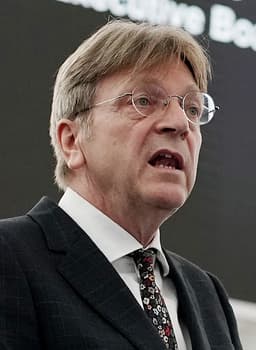
Guy Verhofstadt
Politician · Modern
54.8Total

Mokgweetsi Masisi
Politician · Modern
49.4Total
Basic Information
Born
1953
1961
Died
—
—
Era
Modern
Modern
Nationality
Belgium
Botswana
Occupation
Politician
Politician
Civilization
Western
Other
Score Comparison
Military (10%)
49.4
20.6
Political (20%)
60.0
62.7
Influence (20%)
59.0
53.3
Legacy (20%)
48.3
40.8
Leadership (15%)
66.0
72.0
Strategy (15%)
41.0
36.0
TOTAL
54.8
49.4
Guy Verhofstadt — Complete Timeline
1999 AD
Prime Minister of Belgium (first term)Political Action◆ Major
Guy Verhofstadt became Prime Minister of Belgium, leading a coalition government of liberals, socialists, and greens. His tenure focused on economic liberalization, social reforms, and European integration.
Prime MinisterBelgian Politics
Impact: national
2001 AD
Belgian presidency of the European UnionPolitical Action◆ Major
As Prime Minister, Guy Verhofstadt led Belgium's presidency of the European Union. The presidency focused on the Laeken Declaration, which launched the European Convention that drafted the EU Constitution. Verhofstadt was a vocal advocate for a federal Europe.
European UnionPresidencyFederalism
Impact: regionalconstructive
2003 AD
Legalization of same-sex marriageReform◆ Major
Under Prime Minister Guy Verhofstadt, Belgium became the second country in the world to legalize same-sex marriage. The law granted same-sex couples the same rights as heterosexual couples, including adoption rights later extended.
LGBTQ RightsSocial ReformMarriage Equality
Impact: nationalprogressive
2009 AD
Member of the European ParliamentPolitical Action
After leaving the Belgian premiership, Guy Verhofstadt became a Member of the European Parliament. He led the Alliance of Liberals and Democrats for Europe (ALDE) group and became a prominent voice for European federalism and reform.
European ParliamentFederalism
Impact: regionalconstructive
Mokgweetsi Masisi — Complete Timeline
2014 AD
Elected Vice President of BotswanaPolitical Action◆ Major
Masisi was elected Vice President by the National Assembly in November 2014, serving under President Ian Khama. He was responsible for education and social services.
Vice PresidencyPolitical Rise
Impact: national
2018 AD
Became President of BotswanaPolitical Action
Masisi became President of Botswana on April 1, 2018, succeeding Ian Khama. He inherited a stable economy but faced challenges of unemployment and inequality.
PresidencyPower Transition
Impact: national
2019 AD
Reversed ban on elephant huntingPolitical Action◆ Major
Masisi's government lifted the 2014 ban on elephant hunting, citing human-wildlife conflict and economic benefits. The decision was criticized by conservation groups but supported by local communities.
Environmental PolicyElephant Hunting
Impact: national
Re-elected President (2019)Political Action◆ Major
Masisi was re-elected in the 2019 general election, winning 52.7% of the vote. The election was deemed free and fair by observers, though the opposition alleged irregularities.
Re-electionDemocratic Process
Impact: national
2020 AD
Launched the Botswana Economic Recovery PlanReform◆ Major
Masisi launched a P10 billion economic recovery plan in response to the COVID-19 pandemic. The plan aimed to support businesses, protect jobs, and stimulate economic growth.
Economic PolicyCOVID-19 Response
Impact: nationalconstructive
Expert Analysis
Origins
Guy Verhofstadt was born on April 11, 1953, in Dendermonde, Belgium, into a Flemish liberal family. His father, a lawyer and resistance member, instilled in him a belief in individual freedoms. Verhofstadt studied law at Ghent University and became politically active in the liberal Party of Freedom and Progress (PVV). He was elected to the Belgian Chamber of Representatives in 1985 at age 32.
Mokgweetsi Masisi was born on July 21, 1962, in Moshupa, Botswana. His father, Edison Masisi, was a politician and teacher. Masisi studied English and History at the University of Botswana, then earned a master's in education from Florida State University. He worked as a teacher and later as a UNICEF project officer before entering politics in the Botswana Democratic Party (BDP).
Rise to Power
Verhofstadt's rise accelerated when he became chairman of the PVV in 1992, advocating for liberal reforms and European integration. In 1995, he was elected to the Belgian Senate. His breakthrough came in 1999 when he led the Flemish Liberals and Democrats (VLD) to victory, forming a coalition government and becoming Prime Minister of Belgium on July 12, 1999, at age 46.
Masisi rose through the BDP ranks, serving as Minister of Education and Skills Development from 2014 to 2018. He was elected Vice President in November 2014 under President Ian Khama, whom he succeeded on April 1, 2018, becoming the fifth President of Botswana. His ascent was marked by a smooth transition within a one-party-dominant system.
Leadership & Governance
Verhofstadt's leadership was defined by his federalist vision for Europe and domestic liberal reforms. He legalized same-sex marriage in 2003 (Belgium becoming the second country to do so), introduced euthanasia legislation, and pursued economic liberalization. His governance style was confrontational yet effective, scoring 66.0 in leadership. He also led Belgium's EU presidency in 2001, producing the Laeken Declaration that launched the European Convention on the Future of Europe.
Masisi's leadership (score 72.0) is pragmatic and consultative. Domestically, he focused on economic diversification, launching a P10 billion recovery plan in 2020 to combat COVID-19 impacts. He reversed the 2014 ban on elephant hunting in 2019, citing human-wildlife conflict and economic benefits, a decision that drew international criticism. His governance maintains Botswana's democratic traditions but faces challenges of high unemployment (scoring 62.7 in political, slightly above Verhofstadt's 60.0).
Triumph & Tragedy
Verhofstadt's greatest triumph was advancing European integration through the Laeken Declaration and serving as a prominent MEP advocating for federalism. His greatest failure was the inability to prevent the 2014 European Parliament election gains by eurosceptic parties, reflecting a disconnect between elite federalism and public sentiment. His military score of 49.4 reflects limited engagement in defense issues.
Masisi's triumph includes a peaceful transfer of power and re-election in 2019 with 52.7% of the vote, despite opposition complaints. His economic recovery plan mitigated some pandemic damage. His tragedy is the controversy over elephant hunting, which damaged Botswana's conservation image, and persistent unemployment (around 20% in 2020). His military score is low (20.6) as Botswana's defense is minimal.
Character & Destiny
Verhofstadt is known for his intellectualism, sharp rhetoric, and unwavering belief in European federalism. His character drove him to become a leading voice in the European Parliament, but also made him a polarizing figure. His destiny was to be a champion of a cause (EU integration) that remains incomplete, limiting his legacy score to 48.3.
Masisi is more reserved and consensus-driven, typical of Botswana's political culture. His character emphasizes stability and incremental change. His destiny is tied to Botswana's continued democratic stability and economic challenges; his legacy score of 40.8 reflects his early stage in office.
Legacy
Verhofstadt's legacy is the advancement of LGBT rights in Belgium and his role in shaping the EU's constitutional process. The Laeken Declaration set the stage for the failed European Constitution, but his ideas influenced later treaties. As an MEP, he remains a symbol of European federalism. His total score of 54.8 reflects moderate impact across domains.
Masisi's legacy is still forming. He will be remembered for navigating Botswana through the pandemic and the elephant hunting reversal. His leadership score of 72.0 is high, but his overall impact (total 49.4) is lower due to limited time in office and a smaller global stage.
Conclusion
Guy Verhofstadt had a greater impact on global history than Mokgweetsi Masisi. Verhofstadt's total score of 54.8 surpasses Masisi's 49.4 by 5.4 points. While Masisi's leadership score is higher (72.0 vs 66.0), Verhofstadt's influence (59.0 vs 53.3) and political impact (60.0 vs 62.7) are comparable, but his legacy (48.3 vs 40.8) and military (49.4 vs 20.6) give him the edge. Verhofstadt's role in European integration and landmark social reforms shaped a continent, whereas Masisi's impact is confined to Botswana's regional context. The data supports Verhofstadt as the more historically significant figure.
Rankings
🥇
Guy VerhofstadtLeader
Mil: 49.4Pol: 60.0Inf: 59.0
54.8
🥈
Mokgweetsi Masisi
Mil: 20.6Pol: 62.7Inf: 53.3
49.4
+5.4 behind
How This Comparison Works
Algorithm
Each figure is scored on 6 dimensions (0—100 scale) based on structured historical data: Military (10%), Political (20%), Influence (20%), Legacy (20%), Leadership (15%), Strategy (15%). The weighted total produces the final ranking.
Data Sources
Scores are computed from structured sub-indicators in the database. Scale factors adjust for era (Ancient ×0.85, Modern ×1.0) and civilization size (Eastern ×1.05, Other ×0.80) to account for differences in population and military scale.
Maximum 3 Figures
Comparisons are limited to 2—3 figures to ensure readability and statistical meaningfulness.
Error Margins
±5 points per dimension — Sub-scores are derived from historical records with inherent uncertainty. Two figures within 5 points on a dimension should be considered roughly equivalent in that area.
Total Score Accuracy
±3 points overall — The weighted combination of 6 dimensions produces a total score with approximately ±3 points of uncertainty. Differences of less than 3 points are not statistically significant— the figures are effectively tied.
Known Limitations
- Historical records are incomplete and uneven across civilizations
- Figures from oral-tradition societies may be underrepresented
- Occupation labels can misclassify multi-role figures
- Scores measure capability and impact, not moral character
- Quantitative scoring is a comparison tool, not absolute truth
Capability Radar
Military (10%) — Battles & Warfare
Battles
27
26
Win Rate
32
30
Expansion
37
33
Political (20%) — Governance & Reform
Reform
65
55
Diplomacy
70
60
Economy
60
55
Influence (20%) — Cultural & Global Reach
Cultural
40
30
Global
55
30
Legacy (20%) — Historical Impact
Historical
50
25
Longevity
40
20
Leadership (15%) — Power & Stability
Tenure
60
60
Stability
55
60
Strategy (15%) — Tactics & Innovation
Strategy
36
32
Tactics
39
37
Reform
44
39
Similar Comparisons
Comments & Discussion
No comments yet. Be the first to share your thoughts!