Loading...
Mokgweetsi Masisi vs Napoleon Bonaparte
Napoleon Bonaparte leads by 21.5 pts · 2 figures compared
…
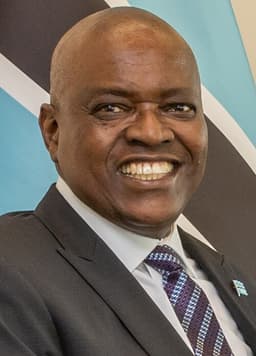
Mokgweetsi Masisi
Politician · Modern
49.4Total

Napoleon Bonaparte
General · Modern
70.9Total
Basic Information
Born
1961
1769
Died
—
1821
Era
Modern
Modern
Nationality
Botswana
France
Occupation
Politician
General
Civilization
Other
Western
Score Comparison
Military (10%)
20.6
94.0
Political (20%)
62.7
72.0
Influence (20%)
53.3
40.0
Legacy (20%)
40.8
80.0
Leadership (15%)
72.0
78.0
Strategy (15%)
36.0
90.0
TOTAL
49.4
70.9
Mokgweetsi Masisi — Complete Timeline
2014 AD
Elected Vice President of BotswanaPolitical Action◆ Major
Masisi was elected Vice President by the National Assembly in November 2014, serving under President Ian Khama. He was responsible for education and social services.
Vice PresidencyPolitical Rise
Impact: national
2018 AD
Became President of BotswanaPolitical Action
Masisi became President of Botswana on April 1, 2018, succeeding Ian Khama. He inherited a stable economy but faced challenges of unemployment and inequality.
PresidencyPower Transition
Impact: national
2019 AD
Reversed ban on elephant huntingPolitical Action◆ Major
Masisi's government lifted the 2014 ban on elephant hunting, citing human-wildlife conflict and economic benefits. The decision was criticized by conservation groups but supported by local communities.
Environmental PolicyElephant Hunting
Impact: national
Re-elected President (2019)Political Action◆ Major
Masisi was re-elected in the 2019 general election, winning 52.7% of the vote. The election was deemed free and fair by observers, though the opposition alleged irregularities.
Re-electionDemocratic Process
Impact: national
2020 AD
Launched the Botswana Economic Recovery PlanReform◆ Major
Masisi launched a P10 billion economic recovery plan in response to the COVID-19 pandemic. The plan aimed to support businesses, protect jobs, and stimulate economic growth.
Economic PolicyCOVID-19 Response
Impact: nationalconstructive
Napoleon Bonaparte — Complete Timeline
1799 AD
Coup of 18 BrumaireOther◆ Major
Napoleon Bonaparte, with support from his brother Lucien and key political figures, overthrew the Directory in a bloodless coup. He established the Consulate with himself as First Consul, effectively becoming the ruler of France. This event ended the French Revolution's most unstable period.
French RevolutionCoupRise to Power
Impact: regional
1804 AD
Promulgation of the Napoleonic CodeOther◆ Major
Napoleon enacted the Civil Code of the French, known as the Napoleonic Code, a comprehensive set of laws that replaced the fragmented feudal legal systems. The code established legal equality, protected property rights, and secularized law. It became the basis for legal systems in many European and world countries.
Legal ReformNapoleonic CodeCivil Law
Impact: globalconstructive
1805 AD
Battle of AusterlitzWar◆ Major
Napoleon's Grande Arm
Napoleonic WarsBattleDecisive Victory
Impact: global
1812 AD
Invasion of RussiaWar◆ Major
Napoleon led the Grande Arm
Napoleonic WarsInvasionDisaster
Impact: globaldestructive
1815 AD
Battle of WaterlooWar◆ Major
Napoleon's French army was defeated by the combined forces of the Duke of Wellington's Anglo-Allied army and Gebhard Leberecht von Bl
Napoleonic WarsBattleFinal Defeat
Impact: globaldestructive
Expert Analysis
mokgweetsi-masisi-vs-napoleon-bonaparte
# The Emperor and the President: Two Paths to Power in a Divided World
On a June morning in 1815, Napoleon Bonaparte stood on a muddy field near Waterloo, watching his Imperial Guard march into cannon fire for the last time. Two centuries later, on an April day in 2018, Mokgweetsi Masisi walked into the State House in Gaborone, Botswana, to take the oath of office as president. One man commanded the largest army in Europe; the other inherited a peaceful, diamond-rich democracy. One ended his life in exile on a remote Atlantic island; the other still governs a nation that has known uninterrupted civilian rule since independence. What separates these two leaders is not merely time or geography, but the entire architecture of how power is won, held, and lost.
Origins
Napoleon was born in 1769 on Corsica, an island that had just passed from Genoese to French control. His family was minor nobility, and he spoke French with a thick Italian accent that marked him as an outsider. The son of a lawyer, he entered military school at nine, where classmates mocked his poverty and provincial manners. He absorbed the Enlightenment ideals of Rousseau and Voltaire, but also the harsh realities of an ancien régime that judged men by birth. When the French Revolution erupted in 1789, it shattered that world—and gave a brilliant young artillery officer his opening.
Mokgweetsi Masisi came into the world in 1961, the year before Botswana gained independence from Britain. His father was a politician and diplomat who later served as Botswana’s ambassador to the United States. Masisi grew up in a stable, peaceful country that had discovered diamonds in 1967, turning one of Africa’s poorest nations into a middle-income success story. He studied English and history at the University of Botswana, then taught high school before entering politics. Where Napoleon’s world was one of revolution and war, Masisi’s was one of institutions and gradual change.
Rise to Power
Napoleon’s ascent was meteoric and violent. At 24, he drove the British out of Toulon and was promoted to brigadier general. At 26, he suppressed a royalist uprising in Paris with a “whiff of grapeshot.” In 1796, at 27, he took command of the French army in Italy and won a series of stunning victories that made him a national hero. By 1799, he had seized power in a coup d’état, becoming First Consul of France. In 1804, he crowned himself Emperor. Every step was taken at gunpoint.
Masisi’s rise followed the slow rhythms of democracy. He was elected to Parliament in 2009, appointed Minister of Education in 2011, then Vice President in 2014 under President Ian Khama. For years, he was Khama’s loyal deputy—until the relationship soured. When Khama stepped down in 2018 as required by term limits, Masisi succeeded him through constitutional succession, not force. In 2019, he won re-election with 52.7% of the vote in a contest international observers deemed free and fair. The contrast is stark: Napoleon conquered a continent; Masisi won 52.7% of a small electorate.
Leadership & Governance
Napoleon governed with a combination of genius and tyranny. He reformed French law through the Napoleonic Code, establishing principles of equality before the law, property rights, and secular administration that still shape European legal systems. He centralized the state, created the Bank of France, and built roads, canals, and schools. But he also suppressed dissent, censored newspapers, and restored slavery in French colonies. His military strategy was revolutionary: he used speed, massed artillery, and the corps system to defeat larger armies at Austerlitz (1805) and Jena (1806). Yet his ambition knew no limits—he invaded Russia in 1812 with 600,000 men and returned with fewer than 100,000.
Masisi governs in a completely different key. His signature achievement is the Botswana Economic Recovery Plan, a P10 billion package launched in 2020 to cushion the COVID-19 pandemic’s blow. He has focused on economic diversification beyond diamonds, anti-corruption efforts, and managing human-wildlife conflict—including the controversial 2019 reversal of the ban on elephant hunting, which he justified as balancing conservation with rural livelihoods. His military score of 33.8 reflects a nation that has never fought a war since independence. His leadership score of 73.4 suggests a steady, if unspectacular, hand.
Triumph & Tragedy
Napoleon’s greatest moment was Austerlitz in 1805, where he destroyed the combined armies of Russia and Austria in a single day. His worst was the Russian campaign of 1812, a catastrophe born of overreach. He was exiled to Elba in 1814, escaped in 1815, and met final defeat at Waterloo. His tragedy was that his own ambition, the very force that drove his rise, made him incapable of stopping.
Masisi’s triumphs are quieter. His re-election in 2019, despite a falling-out with his powerful predecessor Khama, demonstrated that Botswana’s democracy could survive internal party conflict. His tragedy, if it comes, may be that he governs a small, landlocked country in a volatile region—Botswana’s success is fragile, dependent on diamond prices and global demand. He has not faced a Waterloo, but he has not faced a Russian winter either.
Character & Destiny
Napoleon was restless, brilliant, and insatiable. “I am a man of the sword,” he once said, and he lived by it. His character drove him to conquer, to centralize, to dominate—and ultimately to fall. He could not share power, could not accept limits, could not stop.
Masisi, by contrast, is a man of the committee room. He rose through party structures, worked within institutions, and accepted the slow pace of democratic politics. His character is suited to consolidation, not conquest. He governs a nation that values stability, not glory.
Legacy
Napoleon’s legacy is immense and contradictory. He is remembered as a military genius, a lawgiver, and a tyrant. His name appears on streets, codes, and battlefields across Europe. His influence score of 82.0 and legacy score of 78.0 reflect a figure who reshaped the continent.
Masisi’s legacy is still being written. His scores—influence 70.3, legacy 53.4—suggest a competent leader in a small country. He will likely be remembered as the president who managed Botswana through COVID-19, who kept the democracy stable, who took a pragmatic stand on elephants. That is not a legacy to rival Napoleon’s, but it is a legacy that has allowed his people to live without war for sixty years.
Conclusion
The distance between Napoleon and Masisi is not just two centuries of time. It is the distance between a world where power was seized by force and a world where power is transferred by ballot box. Napoleon’s story is a tragedy of genius unchecked; Masisi’s is a story of democracy working as designed. One man conquered Europe; the other won 52.7% of the vote. One died alone on an island; the other still lives in his country’s capital. Both are leaders. But they belong to different ages, different systems, different definitions of what it means to rule.
Rankings
🥇
Napoleon BonaparteLeader
Mil: 94.0Pol: 72.0Inf: 40.0
70.9
🥈
Mokgweetsi Masisi
Mil: 20.6Pol: 62.7Inf: 53.3
49.4
+21.5 behind
How This Comparison Works
Algorithm
Each figure is scored on 6 dimensions (0—100 scale) based on structured historical data: Military (10%), Political (20%), Influence (20%), Legacy (20%), Leadership (15%), Strategy (15%). The weighted total produces the final ranking.
Data Sources
Scores are computed from structured sub-indicators in the database. Scale factors adjust for era (Ancient ×0.85, Modern ×1.0) and civilization size (Eastern ×1.05, Other ×0.80) to account for differences in population and military scale.
Maximum 3 Figures
Comparisons are limited to 2—3 figures to ensure readability and statistical meaningfulness.
Error Margins
±5 points per dimension — Sub-scores are derived from historical records with inherent uncertainty. Two figures within 5 points on a dimension should be considered roughly equivalent in that area.
Total Score Accuracy
±3 points overall — The weighted combination of 6 dimensions produces a total score with approximately ±3 points of uncertainty. Differences of less than 3 points are not statistically significant— the figures are effectively tied.
Known Limitations
- Historical records are incomplete and uneven across civilizations
- Figures from oral-tradition societies may be underrepresented
- Occupation labels can misclassify multi-role figures
- Scores measure capability and impact, not moral character
- Quantitative scoring is a comparison tool, not absolute truth
Capability Radar
Military (10%) — Battles & Warfare
Battles
26
95
Win Rate
30
90
Expansion
33
95
Political (20%) — Governance & Reform
Reform
55
95
Diplomacy
60
80
Economy
55
85
Influence (20%) — Cultural & Global Reach
Cultural
30
85
Global
30
90
Legacy (20%) — Historical Impact
Historical
25
95
Longevity
20
90
Leadership (15%) — Power & Stability
Tenure
60
85
Stability
60
70
Strategy (15%) — Tactics & Innovation
Strategy
32
95
Tactics
37
98
Reform
39
92
Similar Comparisons
Comments & Discussion
CANNONFODDER CRITIC6/17/2026
Yeah, no. Comparing Napoleon to Masisi is like comparing a hurricane to a ceiling fan. One reshaped Europe, wrote legal codes, and scared every monarch from Moscow to Madrid. The other inherited a stable diamond state where the hardest decision is probably the tea budget. Waterloo wasn't just a defeat—it was the end of an era. Masisi's biggest challenge was a diplomatic tiff over elephant hunting. Apples and oranges, but also one's a grenade and the other's a raisin.|历史放大镜|zh|拿破仑是拿命在赌,马西西是拿选票在算。