Loading...
Golda Meir vs Julio Maria Sanguinetti
Golda Meir leads by 1.2 pts · 2 figures compared
…
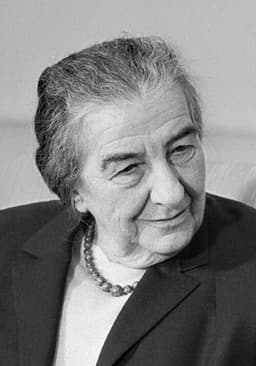
Golda Meir
Politician · Modern
55.8Total

Julio Maria Sanguinetti
Politician · Modern
54.6Total
Basic Information
Born
1898
1936
Died
1978
—
Era
Modern
Modern
Nationality
Israel
Uruguay
Occupation
Politician
Politician
Civilization
Middle Eastern
Western
Score Comparison
Military (10%)
45.0
50.0
Political (20%)
72.0
59.3
Influence (20%)
55.0
53.3
Legacy (20%)
54.0
45.8
Leadership (15%)
72.0
78.0
Strategy (15%)
25.0
42.4
TOTAL
55.8
54.6
Golda Meir — Complete Timeline
1969 AD
Appointment as Prime Minister of IsraelPolitical Action◆ Major
Golda Meir became Prime Minister of Israel after the death of Levi Eshkol. She was the first and only woman to hold the office, leading the country during a period of significant tension and conflict in the Middle East.
Prime MinisterFirst womanLeadership
Impact: national
1973 AD
Yom Kippur WarWar
Meir led Israel during the Yom Kippur War, when Egypt and Syria launched a surprise attack on the holiest day of the Jewish calendar. Israel initially suffered heavy losses but eventually repelled the attacks, though the war exposed intelligence failures.
WarSurprise attackIntelligence failure
Impact: regionaltragic
1974 AD
Resignation after the Agranat CommissionPolitical Action◆ Major
Following the Yom Kippur War, the Agranat Commission criticized the government's handling of the conflict. Meir resigned as Prime Minister in 1974, taking responsibility for the failures, though she remained a respected figure in Israeli politics.
ResignationAccountabilityWar aftermath
Impact: nationaltragic
Julio Maria Sanguinetti — Complete Timeline
1984 AD
Elected President of UruguayPolitical Action
Julio María Sanguinetti was elected president of Uruguay in the 1984 general election, the first democratic election after 11 years of military dictatorship. He took office in 1985, leading the transition to democracy.
DemocratizationElectionTransition
Impact: nationalconstructive
1986 AD
Signed the Ley de CaducidadPolitical Action◆ Major
Sanguinetti signed the Ley de Caducidad (Expiry Law) in December 1986, granting amnesty to military and police officers for human rights abuses committed during the dictatorship. The law was controversial and later challenged in a 1989 referendum.
AmnestyHuman RightsTransitional Justice
Impact: nationaldestructive
1991 AD
Promoted Mercosur FoundingPolitical Action◆ Major
As president, Sanguinetti was a key proponent of the Southern Common Market (Mercosur), signed in 1991 by Uruguay, Argentina, Brazil, and Paraguay. The trade bloc aimed to promote economic integration and reduce tariffs among member states.
Regional IntegrationTrade BlocMercosur
Impact: regionalconstructive
1994 AD
Re-elected PresidentPolitical Action◆ Major
Sanguinetti was re-elected president in the 1994 general election, serving a second term from 1995 to 2000. His second term focused on economic reforms and regional integration.
Re-electionSecond TermColorado Party
Impact: nationalconstructive
Expert Analysis
Origins
Golda Meir was born in 1898 in Kyiv, Russian Empire, to a poor Jewish family. She emigrated to the United States in 1906 and later to Palestine in 1921. Her early life was shaped by poverty and persecution, which fueled her commitment to Zionism. She worked as a teacher and became active in the labor movement, eventually rising through the ranks of the Mapai party. Her formative experiences included witnessing the hardships of Jewish communities and the struggle for a Jewish homeland.
Julio María Sanguinetti was born in 1936 in Montevideo, Uruguay, into a middle-class family of Italian descent. He studied law and social sciences at the University of the Republic, where he became involved in politics through the Colorado Party. His father was a politician, providing early exposure to governance. Sanguinetti's background was one of institutional stability, contrasting sharply with Meir's experience of displacement and nation-building.
Rise to Power
Meir's rise began with her role in the Histadrut trade union and her appointment as Israel's ambassador to the Soviet Union in 1948. She served as Minister of Labor (1949–1956) and Foreign Minister (1956–1966), earning a reputation for pragmatism and toughness. In 1969, after the death of Prime Minister Levi Eshkol, she became prime minister despite being a compromise candidate. Her ascension was a turning point for Israel, as she was the first and only woman to hold the office.
Sanguinetti's political career advanced within the Colorado Party, serving as Minister of Education and Culture (1969–1972) and later as Minister of Industry and Commerce. Following the 1973 military coup, he became a leading voice for democracy. In 1984, after 11 years of military dictatorship, he was elected president in Uruguay's first democratic election. His rise was marked by his role in negotiating the transition, including the 1984 Naval Club Pact, which set terms for the return to civilian rule.
Leadership & Governance
Meir's leadership during the Yom Kippur War (1973) defined her tenure. Initially, Israel suffered heavy losses due to intelligence failures, but Meir authorized decisive counterattacks, leading to a military victory. However, the war's costly outcome led to public outcry. She also focused on building alliances, particularly with the United States, and strengthening Israel's economy. Her governance style was hands-on and determined, but she was criticized for her handling of the war's intelligence lapses. She scored 72.0 in political leadership, reflecting her ability to navigate crises.
Sanguinetti's governance focused on restoring democratic institutions and economic stability. He signed the Ley de Caducidad (Expiry Law) in 1986, granting amnesty to military personnel for human rights abuses, a controversial move aimed at preventing a coup. He also promoted economic liberalization and regional integration, including the founding of Mercosur in 1991. His leadership score of 78.0 reflects his success in consolidating democracy, though critics argue the amnesty law hindered justice.
Triumph & Tragedy
Meir's greatest triumph was leading Israel through the Yom Kippur War, which ended with a military victory and eventual peace with Egypt. However, the war exposed intelligence failures, leading to her resignation in 1974 after the Agranat Commission's criticism. Her legacy as a female leader in a male-dominated era is celebrated, but her handling of the war remains a point of debate. She scored 55.8 overall, with military score of 45.0 reflecting the war's mixed outcomes.
Sanguinetti's triumph was restoring democracy and overseeing a peaceful transition. His second term (1995–2000) focused on economic reforms, reducing inflation, and strengthening Mercosur. However, his signing of the Ley de Caducidad is seen as a tragedy for human rights, as it prevented prosecution of atrocities. His overall score of 54.6 is slightly below Meir's, but his leadership in democracy-building is highly regarded.
Character & Destiny
Meir was known for her strong will, bluntness, and maternal image. She often made decisions based on intuition and experience, sometimes disregarding military advice. Her character shaped her fate: her refusal to preemptively strike during the Yom Kippur War was based on a desire to avoid appearing aggressive, but it led to initial defeats. Historians see her as a product of her time, embodying Israel's pioneering spirit and defiance.
Sanguinetti was a pragmatic, consensus-building politician. His legal background influenced his approach, favoring institutional solutions over confrontation. The Ley de Caducidad exemplified his belief that stability required compromise. His character led to a stable transition but left unresolved grievances. He is remembered as a skilled negotiator who prioritized democracy over justice.
Legacy
Meir's legacy is tied to her role as Israel's first female prime minister and her leadership during a pivotal war. She inspired women in politics globally, though her military and strategic scores (25.0) indicate limited long-term impact on defense policy. Israel's security stance evolved beyond her tenure. She remains a symbol of strength and resilience.
Sanguinetti's legacy is the restoration of Uruguayan democracy and regional integration through Mercosur. His amnesty law remains controversial, but his influence on democratic institutions endures. He scored 45.8 in legacy, reflecting a more localized but stable impact.
Conclusion
Golda Meir had a greater impact on global history due to Israel's central role in Middle Eastern geopolitics and her symbolic importance as a female leader. Her leadership during the Yom Kippur War shaped regional dynamics, despite the war's flaws. Sanguinetti's achievements in democratization are significant but confined to Uruguay. While Meir's scores (55.8 total) edge out Sanguinetti's (54.6), the gap reflects her broader influence. Meir's political score of 72.0 and leadership of 72.0 surpass Sanguinetti's 59.3 and 78.0 respectively, but her strategic score of 25.0 drags her down. Ultimately, Meir's role in a global conflict gives her a more enduring legacy.
Rankings
🥇
Golda MeirLeader
Mil: 45.0Pol: 72.0Inf: 55.0
55.8
🥈
Julio Maria Sanguinetti
Mil: 50.0Pol: 59.3Inf: 53.3
54.6
+1.2 behind
How This Comparison Works
Algorithm
Each figure is scored on 6 dimensions (0—100 scale) based on structured historical data: Military (10%), Political (20%), Influence (20%), Legacy (20%), Leadership (15%), Strategy (15%). The weighted total produces the final ranking.
Data Sources
Scores are computed from structured sub-indicators in the database. Scale factors adjust for era (Ancient ×0.85, Modern ×1.0) and civilization size (Eastern ×1.05, Other ×0.80) to account for differences in population and military scale.
Maximum 3 Figures
Comparisons are limited to 2—3 figures to ensure readability and statistical meaningfulness.
Error Margins
±5 points per dimension — Sub-scores are derived from historical records with inherent uncertainty. Two figures within 5 points on a dimension should be considered roughly equivalent in that area.
Total Score Accuracy
±3 points overall — The weighted combination of 6 dimensions produces a total score with approximately ±3 points of uncertainty. Differences of less than 3 points are not statistically significant— the figures are effectively tied.
Known Limitations
- Historical records are incomplete and uneven across civilizations
- Figures from oral-tradition societies may be underrepresented
- Occupation labels can misclassify multi-role figures
- Scores measure capability and impact, not moral character
- Quantitative scoring is a comparison tool, not absolute truth
Capability Radar
Military (10%) — Battles & Warfare
Battles
0
28
Win Rate
0
29
Expansion
15
33
Political (20%) — Governance & Reform
Reform
55
65
Diplomacy
70
60
Economy
60
55
Influence (20%) — Cultural & Global Reach
Cultural
55
30
Global
60
30
Legacy (20%) — Historical Impact
Historical
65
40
Longevity
50
35
Leadership (15%) — Power & Stability
Tenure
60
55
Stability
50
70
Strategy (15%) — Tactics & Innovation
Strategy
10
38
Tactics
0
42
Reform
20
43
Similar Comparisons
Comments & Discussion
No comments yet. Be the first to share your thoughts!