Loading...
Gnaeus Julius Agricola vs Sun Bin
Sun Bin leads by 0.3 pts · 2 figures compared
…
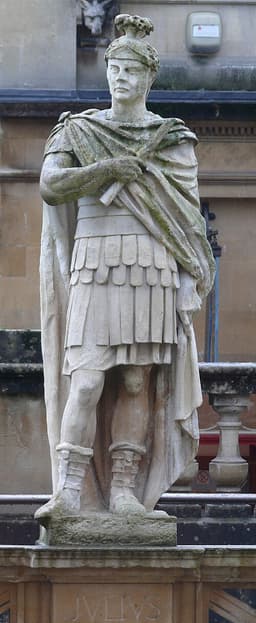
Gnaeus Julius Agricola
General · Ancient
52.5Total

Sun Bin
General · Ancient
52.8Total
Basic Information
Born
40
-380
Died
93
-316
Era
Ancient
Ancient
Nationality
Roman Empire
China
Occupation
General
General
Civilization
Western
Eastern
Score Comparison
Military (10%)
72.0
80.0
Political (20%)
35.1
25.0
Influence (20%)
54.1
58.3
Legacy (20%)
47.5
55.0
Leadership (15%)
61.1
30.0
Strategy (15%)
55.0
82.0
TOTAL
52.5
52.8
Gnaeus Julius Agricola — Complete Timeline
74 AD
Governorship of AquitaniaPolitical Action
Agricola was appointed governor of Aquitania, a Roman province in Gaul. He administered the province for three years, focusing on legal and financial reforms. This post prepared him for higher command and demonstrated his administrative skills.
Provincial AdministrationGaulCareer
Impact: regionalconstructive
78 AD
Conquest of the OrdovicesWar◆ Major
As governor of Britain, Agricola launched a campaign against the Ordovices tribe in northern Wales. He defeated them and then conquered the island of Anglesey, a stronghold of Druids and resistance, completing the Roman subjugation of Wales.
Roman BritainWalesMilitary Campaign
Impact: regional
83 AD
Battle of Mons GraupiusWar◆ Major
Agricola's army defeated a large Caledonian force led by Calgacus at Mons Graupius in northern Scotland. The Roman victory was decisive, but Agricola did not pursue the defeated tribes into the Highlands, leaving the conquest of Scotland incomplete.
BattleScotlandCaledonia
Impact: regional
Circumnavigation of BritainOther
Agricola ordered a Roman fleet to circumnavigate Britain, proving it was an island. The fleet sailed around the northern coast, encountering the Orkney Islands. This exploration provided valuable geographical knowledge and demonstrated Roman naval power.
ExplorationNavyGeography
Impact: regionalconstructive
Sun Bin — Complete Timeline
360 BC
Suffering of mutilation as punishmentOther◆ Major
Sun Bin was framed for treason by his former classmate Pang Juan and sentenced to mutilation (removal of kneecaps) and facial tattooing. This disability forced him to hide and later flee to Qi, where he became a strategist.
PunishmentDisabilityPersonal
Impact: nationaltragic
354 BC
Defeat of Wei at the Battle of GuilingWar◆ Major
Sun Bin, as strategist for the state of Qi, advised attacking Wei's capital while Wei's army was besieging Handan. The Qi army defeated Wei at Guiling, forcing Wei to withdraw. This victory established Sun Bin's reputation.
BattleWarring StatesQiWei
Impact: regional
342 BC
Defeat of Wei at the Battle of MalingWar
Sun Bin used a ruse of decreasing campfires to lure Wei general Pang Juan into an ambush at Maling. The Qi army annihilated the Wei forces. Pang Juan committed suicide. This battle crippled Wei's power.
BattleWarring StatesAmbushQi Victory
Impact: regional
340 BC
Composition of the Sun Bin's Art of WarCultural◆ Major
Sun Bin wrote a military treatise titled 'Sun Bin's Art of War' (Sun Bin Bing Fa). The text was lost for over 2,000 years until its rediscovery in a Han dynasty tomb in 1972. It contains strategic and tactical principles.
Military TreatiseWritingStrategy
Impact: globalconstructive
Expert Analysis
Origins
Gnaeus Julius Agricola was born in 40 AD in the Roman colony of Forum Julii (modern Fréjus, France) to a senatorial family. His father was a Roman senator, and his mother was a wealthy noblewoman. Agricola received a traditional Roman education in rhetoric and military arts. He began his military career as a tribune in Britain under Governor Suetonius Paulinus, gaining firsthand experience in the conquest of the island.
Sun Bin was born around 380 BC in the state of Qi during the Warring States period of China. He was a descendant of Sun Tzu, the author of 'The Art of War'. Little is known of his early life, but he studied military strategy under a master named Guiguzi alongside his classmate Pang Juan. Sun Bin's talents earned him recognition, but his brilliance also made him a target.
Rise to Power
Agricola rose through the ranks of Roman administration and military. After serving as tribune in Britain, he held a series of quaestorships and praetorships in Rome and other provinces. His big break came in 77 AD when Emperor Vespasian appointed him governor of Britain. In this role, Agricola expanded Roman control northward, conquering the Ordovices in Wales in 78 AD and then pushing into Caledonia (modern Scotland). His decisive victory at the Battle of Mons Graupius in 83 AD broke Caledonian resistance, though he was recalled shortly after.
Sun Bin's rise was more circuitous. He was invited to the state of Wei by his former classmate Pang Juan, who had become a general there. However, Pang Juan, jealous of Sun Bin's superior strategic mind, framed him for treason. Sun Bin was sentenced to mutilation—removal of his kneecaps (known as 'bin' punishment) and facial tattooing—which left him permanently disabled. He escaped to his native Qi with the help of Qi envoys, who recognized his genius. In Qi, he became a strategist for the general Tian Ji, and through his cunning plans, he helped Qi achieve military dominance.
Leadership & Governance
Agricola's leadership style was methodical and administrative. He focused on consolidating Roman rule through building forts, roads, and towns, and he encouraged the Romanization of the local elite. In Aquitania, he governed with attention to legal and financial reforms, earning a reputation for fairness. Militarily, he was cautious but effective, using combined arms and engineering to subdue the Britons. His score of 61.1 in leadership reflects his competence, but his political score of 35.1 indicates he did not dominate Roman politics.
Sun Bin, with a leadership score of 30.0, was not a field commander but a strategist. His 'Art of War' emphasizes deception, the use of terrain, and psychological warfare. In the Battle of Guiling (354 BC), he advised Tian Ji to attack Wei's capital while its army was besieging Handan, forcing Wei to withdraw and be defeated. At the Battle of Maling (342 BC), he used a ruse of decreasing campfires to lure Pang Juan into an ambush, annihilating the Wei army. Sun Bin's strategic score of 82.0 highlights his brilliance in outthinking opponents.
Triumph & Tragedy
Agricola's greatest triumph was the conquest of northern Britain, culminating in the Battle of Mons Graupius, where his forces of about 20,000 defeated a Caledonian army of 30,000. He also ordered the first circumnavigation of Britain, proving it was an island. His tragedy was that his achievements were cut short: Emperor Domitian recalled him to Rome, possibly out of jealousy, and he died in 93 AD under suspicious circumstances, possibly poisoned. His conquests were not fully held; the Romans eventually withdrew to Hadrian's Wall.
Sun Bin's triumph was his two major victories over Wei, which established Qi as a dominant power. His treatise, 'Sun Bin's Art of War', was a significant contribution to military theory. His tragedy was his mutilation, which ended his ability to lead physically. He lived in obscurity after his victories, and his book was lost for over 2,000 years until its rediscovery in 1972. His legacy is thus fragmented.
Character & Destiny
Agricola was described by his son-in-law Tacitus as a man of integrity, moderation, and perseverance. He was loyal to the emperor but not ambitious for power, which may have saved him from Domitian's wrath temporarily. His destiny was to be a capable administrator and general who extended Roman rule but was never given the chance to complete his work. His character of discipline and duty ensured his historical record was preserved by Tacitus.
Sun Bin's character was defined by resilience. Despite being crippled and branded, he turned his disability into an advantage, using his mind as his weapon. His revenge on Pang Juan is a classic tale of cunning overcoming brute force. His destiny was to be a symbol of intellectual triumph over physical adversity, but his reliance on a single patron (Tian Ji) limited his political influence.
Legacy
Agricola's legacy is mixed: he is remembered as the general who conquered most of Britain for Rome, but his gains were temporary. The Roman province of Britain eventually shrank, and his name is less known than that of Julius Caesar or Hadrian. His legacy score of 47.5 reflects this modest impact. However, Tacitus's biography 'Agricola' is a key historical source, ensuring his story endures.
Sun Bin's legacy is more substantial in military theory. His 'Art of War' is studied alongside Sun Tzu's, and his tactics of deception and indirect approach influenced Chinese warfare. His rediscovered text has added depth to understanding ancient Chinese strategy. His influence score of 58.3 and legacy score of 55.0 are higher than Agricola's, reflecting his continued relevance.
Conclusion
While Agricola was a capable Roman general who expanded the empire, his impact was limited by the transient nature of his conquests and his lack of political power. Sun Bin, with a total score of 52.8 vs Agricola's 52.5, edges ahead due to his strategic brilliance and enduring treatise. Agricola's military score of 72.0 is strong, but Sun Bin's strategy score of 82.0 and his legacy as a disabled strategist who overcame adversity give him a slight edge. In the long arc of history, Sun Bin's ideas have proven more influential than Agricola's deeds. Therefore, Sun Bin has the greater impact.
Rankings
🥇
Sun BinLeader
Mil: 80.0Pol: 25.0Inf: 58.3
52.8
🥈
Gnaeus Julius Agricola
Mil: 72.0Pol: 35.1Inf: 54.1
52.5
+0.3 behind
How This Comparison Works
Algorithm
Each figure is scored on 6 dimensions (0—100 scale) based on structured historical data: Military (10%), Political (20%), Influence (20%), Legacy (20%), Leadership (15%), Strategy (15%). The weighted total produces the final ranking.
Data Sources
Scores are computed from structured sub-indicators in the database. Scale factors adjust for era (Ancient ×0.85, Modern ×1.0) and civilization size (Eastern ×1.05, Other ×0.80) to account for differences in population and military scale.
Maximum 3 Figures
Comparisons are limited to 2—3 figures to ensure readability and statistical meaningfulness.
Error Margins
±5 points per dimension — Sub-scores are derived from historical records with inherent uncertainty. Two figures within 5 points on a dimension should be considered roughly equivalent in that area.
Total Score Accuracy
±3 points overall — The weighted combination of 6 dimensions produces a total score with approximately ±3 points of uncertainty. Differences of less than 3 points are not statistically significant— the figures are effectively tied.
Known Limitations
- Historical records are incomplete and uneven across civilizations
- Figures from oral-tradition societies may be underrepresented
- Occupation labels can misclassify multi-role figures
- Scores measure capability and impact, not moral character
- Quantitative scoring is a comparison tool, not absolute truth
Capability Radar
Military (10%) — Battles & Warfare
Battles
65
60
Win Rate
70
65
Expansion
75
55
Political (20%) — Governance & Reform
Reform
45
40
Diplomacy
50
35
Economy
40
25
Influence (20%) — Cultural & Global Reach
Cultural
35
70
Global
30
60
Legacy (20%) — Historical Impact
Historical
55
75
Longevity
40
80
Leadership (15%) — Power & Stability
Tenure
55
30
Stability
50
30
Strategy (15%) — Tactics & Innovation
Strategy
72
75
Tactics
68
85
Reform
30
70
Similar Comparisons
Comments & Discussion
No comments yet. Be the first to share your thoughts!