Loading...
Gnaeus Julius Agricola vs Julius Caesar
Julius Caesar leads by 30.3 pts · 2 figures compared
…
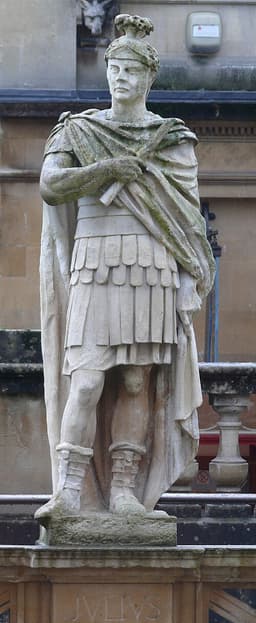
Gnaeus Julius Agricola
General · Ancient
52.5Total

Julius Caesar
General · Ancient
82.8Total
Basic Information
Born
40
-100
Died
93
-44
Era
Ancient
Ancient
Nationality
Roman Empire
Roman Republic
Occupation
General
General
Civilization
Western
Western
Score Comparison
Military (10%)
72.0
88.0
Political (20%)
35.1
78.0
Influence (20%)
54.1
85.0
Legacy (20%)
47.5
82.0
Leadership (15%)
61.1
80.0
Strategy (15%)
55.0
85.0
TOTAL
52.5
82.8
Gnaeus Julius Agricola — Complete Timeline
74 AD
Governorship of AquitaniaPolitical Action
Agricola was appointed governor of Aquitania, a Roman province in Gaul. He administered the province for three years, focusing on legal and financial reforms. This post prepared him for higher command and demonstrated his administrative skills.
Provincial AdministrationGaulCareer
Impact: regionalconstructive
78 AD
Conquest of the OrdovicesWar◆ Major
As governor of Britain, Agricola launched a campaign against the Ordovices tribe in northern Wales. He defeated them and then conquered the island of Anglesey, a stronghold of Druids and resistance, completing the Roman subjugation of Wales.
Roman BritainWalesMilitary Campaign
Impact: regional
83 AD
Battle of Mons GraupiusWar◆ Major
Agricola's army defeated a large Caledonian force led by Calgacus at Mons Graupius in northern Scotland. The Roman victory was decisive, but Agricola did not pursue the defeated tribes into the Highlands, leaving the conquest of Scotland incomplete.
BattleScotlandCaledonia
Impact: regional
Circumnavigation of BritainOther
Agricola ordered a Roman fleet to circumnavigate Britain, proving it was an island. The fleet sailed around the northern coast, encountering the Orkney Islands. This exploration provided valuable geographical knowledge and demonstrated Roman naval power.
ExplorationNavyGeography
Impact: regionalconstructive
Julius Caesar — Complete Timeline
58 BC
Gallic WarsWar◆ Major
Caesar, as proconsul of Gaul, launched a series of campaigns that conquered all of Gaul (modern France, Belgium, and parts of Switzerland). He fought numerous battles, including against the Helvetii, the Belgae, and the Gallic chieftain Vercingetorix. The wars brought immense wealth and a loyal army to Caesar.
Gallic WarsConquestRoman Expansion
Impact: regional
49 BC
Crossing the RubiconPolitical Action◆ Major
Caesar led Legio XIII across the Rubicon River into Italy, defying the Roman Senate's order to disband his army. This act triggered a civil war against Pompey and the Optimates, ultimately leading to Caesar's dictatorship and the end of the Roman Republic.
Roman Civil WarEnd of RepublicPower Struggle
Impact: global
48 BC
Battle of PharsalusWar◆ Major
Caesar's outnumbered army defeated the larger forces of Pompey the Great at Pharsalus in Greece. Caesar's tactical use of a reserve line to counter Pompey's cavalry charge proved decisive. Pompey fled to Egypt, where he was assassinated, leaving Caesar as the undisputed master of the Roman world.
Roman Civil WarBattleDecisive Victory
Impact: regional
44 BC
Appointment as Dictator for LifePolitical Action◆ Major
The Roman Senate appointed Caesar dictator perpetuo (dictator for life), granting him unprecedented personal power. This move concentrated military, legislative, and judicial authority in one person, effectively ending the Roman Republic's traditional system of checks and balances and alarming many senators.
DictatorshipEnd of RepublicPower Consolidation
Impact: regionaldestructive
Assassination on the Ides of MarchPolitical Action◆ Major
A group of Roman senators, led by Marcus Junius Brutus and Gaius Cassius Longinus, stabbed Caesar to death at a meeting of the Senate in the Theatre of Pompey. The assassination was intended to restore the Republic, but instead triggered another civil war that led to the rise of the Roman Empire.
AssassinationRoman PoliticsEnd of Republic
Impact: globaldestructive
Expert Analysis
gnaeus-julius-agricola-vs-julius-caesar
# The General and the Governor
On a raw January morning in 49 BCE, Julius Caesar stood at the banks of the Rubicon River, a small stream that marked the boundary between his province and Italy proper. To cross with an army was treason. To hesitate was to lose everything. He made his choice, and the world tilted on its axis. Fifty-three years later, another Roman general, Gnaeus Julius Agricola, stood on the misty hills of northern Britain, watching Caledonian warriors mass before him at Mons Graupius. He too had a decision to make. But where Caesar crossed his Rubicon into immortality, Agricola crossed his into obscurity. Why did one man remake the world while the other merely served it?
Origins
Caesar was born into the chaos of a dying republic. His family, the Julii, claimed descent from Venus herself, but their political fortunes had faded. The Rome of his youth was a place of civil wars, street violence, and senatorial corruption. Young Caesar learned early that survival meant outmaneuvering men who would kill without hesitation. He was a patrician born into an age when patrician blood meant little without gold or swords.
Agricola came of age in a very different Rome. Born in 40 CE, he entered a world already transformed by Augustus and his successors. The Republic was a memory; the Empire was a fact. His family from Gallia Narbonensis were of the equestrian class, prosperous but not noble. His father was executed by Caligula—a reminder that even stability had its costs. But Agricola grew up knowing the rules of the game, and the rules were now set by one man.
Rise to Power
Caesar clawed his way upward through every available channel. He borrowed fortunes to bribe his way into the priesthood of Jupiter. He won military glory in Spain, then political fame as consul. He formed the First Triumvirate with Pompey and Crassus, an alliance of ambition disguised as friendship. His appointment to govern Gaul gave him the army he needed—and the wealth to buy loyalty.
Agricola’s path was quieter. He served his military tribunate in Britain under Suetonius Paulinus, then held a series of administrative posts. His governorship of Aquitania in 74 CE was competent, not spectacular. When he became governor of Britain in 78 CE, it was because he had done nothing to offend the emperor Domitian—and everything to prove his reliability. Where Caesar seized his opportunities, Agricola received his.
Leadership & Governance
Caesar governed through audacity and personal magnetism. In Gaul, he fought eight campaigns across a territory larger than Italy, defeating hundreds of tribes, crossing the Rhine, and landing in Britain. He wrote his own commentaries to shape public opinion. As dictator, he reformed the calendar, granted citizenship to provincials, and centralized power in ways that made the empire possible. His military genius lay in speed and surprise—he often attacked in winter, when enemies expected rest.
Agricola governed through method and moderation. In Britain, he first crushed the Ordovices in northern Wales in 78 CE, then systematically extended Roman control northward. His great achievement came in 83 CE at Mons Graupius, where he defeated a Caledonian army led by Calgacus. Tacitus records Calgacus’s bitter speech: “They make a desert and call it peace.” Agricola also ordered a fleet to circumnavigate Britain, proving it was an island. But he never pushed further. Where Caesar would have invaded Ireland or pressed into the Highlands, Agricola stopped. He had his orders.
Triumph & Tragedy
Caesar’s greatest triumph was Gaul—the conquest of a million people, the capture of eight hundred cities. His tragedy was the civil war that followed, ending with his assassination on the Ides of March, 44 BCE. He fell at the feet of Pompey’s statue, stabbed by men he had pardoned. His last act was to pull his toga over his face, so no one would see him die.
Agricola’s triumph was Mons Graupius, a victory so complete that the Caledonians did not reform for generations. His tragedy was that it meant nothing. Domitian, jealous of his success, recalled him to Rome. Agricola returned quietly, refused a governorship of Syria, and died in 93 CE, possibly poisoned. He was given a state funeral, but his conquests were abandoned. Rome pulled back from northern Britain, building Hadrian’s Wall instead.
Character & Destiny
Caesar was reckless, generous, and utterly convinced of his own destiny. He forgave enemies, seduced allies, and gambled everything on the belief that his luck would hold. It did—until it didn’t. His character was the engine of his age.
Agricola was dutiful, competent, and cautious. Tacitus, his son-in-law and biographer, portrays him as the ideal Roman: loyal to the state, moderate in victory, obedient to authority. But that very obedience was his limitation. He served an emperor who feared success more than failure. Agricola could have crossed his own Rubicon—but he was raised in an empire that no longer allowed such things.
Legacy
Caesar’s legacy is the Roman Empire itself. Every emperor after him took his name—Caesar became a title. His reforms outlived him, his calendar lasted sixteen centuries, and his writings survive as classics. He is remembered as the man who destroyed the Republic and created the world that followed.
Agricola’s legacy is small and fragile. We know him only because Tacitus wrote his biography, a book that is really about the loss of freedom under tyranny. The wall that bears his name was actually built by Hadrian. His conquests were undone. He is remembered not for what he did, but for what he represented—the last good man in an empire that no longer wanted good men.
Conclusion
Caesar and Agricola both served Rome, but they served different Romes. Caesar lived when a man could still remake the world through will and war. Agricola lived when the world had already been remade, and the only choice was to serve or be destroyed. One crossed his Rubicon and changed history. The other did his duty and was forgotten. The difference between them is not talent or courage—it is the age they were born into. Caesar’s Rome needed a tyrant. Agricola’s Rome needed a servant. And history, as always, remembered the one who broke the rules.
Rankings
🥇
Julius CaesarLeader
Mil: 88.0Pol: 78.0Inf: 85.0
82.8
🥈
Gnaeus Julius Agricola
Mil: 72.0Pol: 35.1Inf: 54.1
52.5
+30.3 behind
How This Comparison Works
Algorithm
Each figure is scored on 6 dimensions (0—100 scale) based on structured historical data: Military (10%), Political (20%), Influence (20%), Legacy (20%), Leadership (15%), Strategy (15%). The weighted total produces the final ranking.
Data Sources
Scores are computed from structured sub-indicators in the database. Scale factors adjust for era (Ancient ×0.85, Modern ×1.0) and civilization size (Eastern ×1.05, Other ×0.80) to account for differences in population and military scale.
Maximum 3 Figures
Comparisons are limited to 2—3 figures to ensure readability and statistical meaningfulness.
Error Margins
±5 points per dimension — Sub-scores are derived from historical records with inherent uncertainty. Two figures within 5 points on a dimension should be considered roughly equivalent in that area.
Total Score Accuracy
±3 points overall — The weighted combination of 6 dimensions produces a total score with approximately ±3 points of uncertainty. Differences of less than 3 points are not statistically significant— the figures are effectively tied.
Known Limitations
- Historical records are incomplete and uneven across civilizations
- Figures from oral-tradition societies may be underrepresented
- Occupation labels can misclassify multi-role figures
- Scores measure capability and impact, not moral character
- Quantitative scoring is a comparison tool, not absolute truth
Capability Radar
Military (10%) — Battles & Warfare
Battles
65
95
Win Rate
70
92
Expansion
75
97
Political (20%) — Governance & Reform
Reform
45
90
Diplomacy
50
85
Economy
40
82
Influence (20%) — Cultural & Global Reach
Cultural
35
88
Global
30
94
Legacy (20%) — Historical Impact
Historical
55
95
Longevity
40
96
Leadership (15%) — Power & Stability
Tenure
55
75
Stability
50
60
Strategy (15%) — Tactics & Innovation
Strategy
72
94
Tactics
68
96
Reform
30
88
Similar Comparisons
Comments & Discussion
AgricolaRebuttal6/17/2026
Anyone who puts Agricola in Caesar’s league hasn’t read Tacitus closely. Agricola’s “conquest” of Britain was a police action—governors before and after him accomplished the same with less fanfare. Caesar conquered Gaul, invaded Britain twice, crossed the Rhine, and wrote history that shaped Western thought. Agricola obediently governed and got recalled. One changed the world; the other changed the weather forecast for Scotland. Don’t confuse competence with greatness.
边关破落派6/17/2026
说阿格里科拉和凯撒能比?你让塔西佗的棺材板都压不住。凯撒在高卢杀了上百万人,镇压了维钦托利的全民起义,把罗马的边疆推到了莱茵河。阿格里科拉呢?在苏格兰打了一场“蒙特格拉皮乌斯战役”,然后被召回。他那点“征服”连喀里多尼亚的酋长都没搞定。这不是同一种人,这是神话和背景板的区别。
DataGate6/17/2026
Let’s talk numbers: Caesar fought 50+ pitched battles, conquered 300+ tribes, and took 1 million prisoners in Gaul alone (according to his own numbers, yes, but still). Agricola’s entire British campaign involved one major battle at Mons Graupius—10,000 Caledonians dead. Impressive for a Tuesday. Caesar built a bridge over the Rhine in 10 days and wrote a civil war commentary that’s still read. Agricola built a few forts in Wales. No comparison.
历史双面镜6/17/2026
凯撒是那个改写罗马宪法的人,他跨过卢比孔河,把共和国撕成了碎片。阿格里科拉只是个忠诚的行省总督,他没有野心,也没有能力推翻系统。阿格里科拉的儿子呢?叫塔西佗,一个历史学家——这就是为什么我们还记得他。凯撒的儿子是奥古斯都,一个皇帝。家世决定了天花板。阿格里科拉的悲剧不是他不行,是他生对了罗马但生错了年代。
RubiconOrTweed6/17/2026
Agricola’s greatest legacy isn’t his conquest—it’s his son-in-law Tacitus writing a biography to make him look heroic. Caesar’s legacy is the Roman Empire’s blueprint for autocracy. Agricola followed orders; Caesar gave them. If you want a Roman general who actually rivaled Caesar’s ambition, look at Sulla or Marius. Agricola was a competent bureaucrat with good PR. That’s it.