Loading...
Gnaeus Julius Agricola vs Li Guangli
Gnaeus Julius Agricola leads by 7.1 pts · 2 figures compared
…
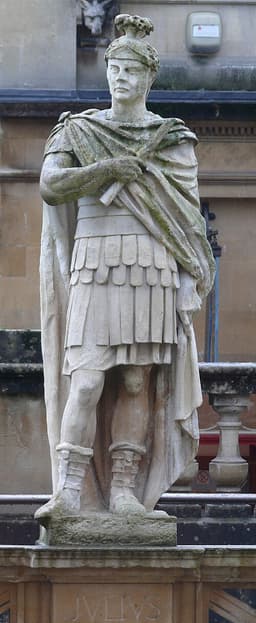
Gnaeus Julius Agricola
General · Ancient
52.5Total

Li Guangli
General · Ancient
45.4Total
Basic Information
Born
40
-140
Died
93
-88
Era
Ancient
Ancient
Nationality
Roman Empire
China
Occupation
General
General
Civilization
Western
Eastern
Score Comparison
Military (10%)
72.0
61.7
Political (20%)
35.1
35.0
Influence (20%)
54.1
51.0
Legacy (20%)
47.5
40.8
Leadership (15%)
61.1
33.5
Strategy (15%)
55.0
60.0
TOTAL
52.5
45.4
Gnaeus Julius Agricola — Complete Timeline
74 AD
Governorship of AquitaniaPolitical Action
Agricola was appointed governor of Aquitania, a Roman province in Gaul. He administered the province for three years, focusing on legal and financial reforms. This post prepared him for higher command and demonstrated his administrative skills.
Provincial AdministrationGaulCareer
Impact: regionalconstructive
78 AD
Conquest of the OrdovicesWar◆ Major
As governor of Britain, Agricola launched a campaign against the Ordovices tribe in northern Wales. He defeated them and then conquered the island of Anglesey, a stronghold of Druids and resistance, completing the Roman subjugation of Wales.
Roman BritainWalesMilitary Campaign
Impact: regional
83 AD
Battle of Mons GraupiusWar◆ Major
Agricola's army defeated a large Caledonian force led by Calgacus at Mons Graupius in northern Scotland. The Roman victory was decisive, but Agricola did not pursue the defeated tribes into the Highlands, leaving the conquest of Scotland incomplete.
BattleScotlandCaledonia
Impact: regional
Circumnavigation of BritainOther
Agricola ordered a Roman fleet to circumnavigate Britain, proving it was an island. The fleet sailed around the northern coast, encountering the Orkney Islands. This exploration provided valuable geographical knowledge and demonstrated Roman naval power.
ExplorationNavyGeography
Impact: regionalconstructive
Li Guangli — Complete Timeline
104 BC
Campaigned in Ferghana for heavenly horsesWar◆ Major
Li Guangli led a Han army of 60,000 men to conquer the city-state of Dayuan (Ferghana) to obtain prized 'heavenly horses'. After a two-year siege, Dayuan submitted and provided horses, but the campaign cost tens of thousands of lives.
Military CampaignFerghanaHan Dynasty
Impact: regionaldestructive
99 BC
Defeated by the Xiongnu at the Battle of MobeiWar◆ Major
Li Guangli led a Han army against the Xiongnu but was defeated and captured. His surrender to the Xiongnu was seen as a disgrace, and he later served as a military advisor to the Xiongnu chanyu.
DefeatXiongnuSurrender
Impact: regionaltragic
88 BC
Executed by the XiongnuOther
After a failed plot to assassinate the Xiongnu chanyu, Li Guangli was executed by the Xiongnu. His death ended a controversial career marked by both military ambition and ultimate failure.
ExecutionXiongnuDeath
Impact: regionaltragic
Expert Analysis
Origins
Gnaeus Julius Agricola was born in 40 AD in the Roman colony of Forum Julii (modern Fréjus, France). His father was a senator, and his mother was from a wealthy provincial family. Agricola was educated in Massilia (Marseille) and later in Rome, where he studied philosophy and law. He began his military career as a tribune in Britain under Governor Suetonius Paulinus, gaining firsthand experience in the island's conquest.
Li Guangli was born around 130 BC in China during the Western Han dynasty. His family was of modest origins, but his sister became a consort of Emperor Wu of Han, elevating the family's status. Little is known about his early education, but he rose through military ranks due to imperial favor. His early career included minor posts before being entrusted with major campaigns.
Rise to Power
Agricola's rise was gradual and meritocratic. He served as quaestor in Asia under the governor Salvius Titianus, then as tribune of the plebs and praetor in Rome. His big break came in 77 AD when Emperor Vespasian appointed him governor of Britain, a province where he had prior experience. He consolidated Roman control over Wales and northern England, earning a reputation for effective administration and military skill.
Li Guangli's rise was tied to his sister's influence and Emperor Wu's ambition. In 104 BC, Wu appointed him to lead an expedition to Ferghana (Dayuan) to obtain 'heavenly horses'. After an initial failure, he was given massive resources for a second campaign, which succeeded in 101 BC. This victory made him a favored general, though his later defeats would tarnish his reputation.
Leadership & Governance
Agricola's leadership combined military prowess with administrative reform. In Britain, he built forts, roads, and towns, promoting Romanization. He integrated local elites into Roman governance and encouraged education. His military strategy emphasized disciplined legionary tactics and logistics. At the Battle of Mons Graupius in 83 AD, he deployed 20,000 troops against 30,000 Caledonians, using auxiliary forces and cavalry to secure a decisive victory. His leadership score is 61.1, reflecting his ability to command respect and achieve objectives.
Li Guangli led large armies but often relied on brute force rather than subtlety. His campaign in Ferghana involved a 60,000-man army besieging a city for two years. He succeeded by cutting off water supplies but suffered heavy losses. His governance of conquered territories was harsh, and he failed to secure lasting alliances. His leadership score of 33.5 indicates poor morale and strategic missteps, such as his defeat by the Xiongnu at Mobei in 90 BC, where he was captured after a flawed retreat.
Triumph & Tragedy
Agricola's greatest triumph was the conquest of northern Britain and the decisive victory at Mons Graupius, which opened the Scottish Highlands to Roman influence. He also ordered the first circumnavigation of Britain, proving it was an island. His tragedy was that his achievements were not fully consolidated; after his recall in 84 AD, Emperor Domitian halted further expansion, and much of Scotland was abandoned. Agricola died in 93 AD, possibly poisoned by the emperor.
Li Guangli's triumph was the capture of Ferghana and acquisition of heavenly horses, which boosted Han prestige and secured trade routes. However, his tragedy was his capture by the Xiongnu at Mobei, where he surrendered and later served the enemy. He attempted a plot to assassinate the Xiongnu chanyu but failed and was executed. His military score of 61.7 is undermined by his poor judgment and ultimate disgrace.
Character & Destiny
Agricola was disciplined, tactful, and loyal to Rome. He avoided political intrigue and focused on his duties. His character earned him respect from troops and superiors alike. His destiny was to be a successful governor who expanded Roman territory, but his achievements were limited by imperial politics.
Li Guangli was ambitious but reckless, relying on imperial favor rather than personal merit. His surrender to the Xiongnu was a deep dishonor in Chinese culture, and his execution ended a career marked by both glory and shame. His character led to a tragic fall from grace.
Legacy
Agricola's legacy is enduring. His campaigns laid the foundation for Roman Britain, and his biography by Tacitus provides a model of Roman virtue. He is remembered as a competent general and administrator. His influence score of 54.1 reflects his impact on Roman historiography and British history.
Li Guangli's legacy is mixed. His Ferghana campaign opened Central Asia to Han influence, but his defeat and betrayal tainted his memory. Chinese historians often criticize him as a symbol of imperial overreach. His legacy score of 40.8 is lower due to his ultimate failure.
Conclusion
Agricola had greater impact than Li Guangli. His military score of 72.0 versus Li's 61.7, and leadership score of 61.1 versus 33.5, reflect his superior command and strategic consistency. Agricola's conquests were durable and integrated into the Roman Empire, while Li Guangli's gains were temporary and overshadowed by his disgrace. Agricola's total score of 52.5 exceeds Li's 45.4, and his legacy is more positive and lasting. Thus, Agricola stands as the more effective and influential general.
Rankings
🥇
Gnaeus Julius AgricolaLeader
Mil: 72.0Pol: 35.1Inf: 54.1
52.5
🥈
Li Guangli
Mil: 61.7Pol: 35.0Inf: 51.0
45.4
+7.1 behind
How This Comparison Works
Algorithm
Each figure is scored on 6 dimensions (0—100 scale) based on structured historical data: Military (10%), Political (20%), Influence (20%), Legacy (20%), Leadership (15%), Strategy (15%). The weighted total produces the final ranking.
Data Sources
Scores are computed from structured sub-indicators in the database. Scale factors adjust for era (Ancient ×0.85, Modern ×1.0) and civilization size (Eastern ×1.05, Other ×0.80) to account for differences in population and military scale.
Maximum 3 Figures
Comparisons are limited to 2—3 figures to ensure readability and statistical meaningfulness.
Error Margins
±5 points per dimension — Sub-scores are derived from historical records with inherent uncertainty. Two figures within 5 points on a dimension should be considered roughly equivalent in that area.
Total Score Accuracy
±3 points overall — The weighted combination of 6 dimensions produces a total score with approximately ±3 points of uncertainty. Differences of less than 3 points are not statistically significant— the figures are effectively tied.
Known Limitations
- Historical records are incomplete and uneven across civilizations
- Figures from oral-tradition societies may be underrepresented
- Occupation labels can misclassify multi-role figures
- Scores measure capability and impact, not moral character
- Quantitative scoring is a comparison tool, not absolute truth
Capability Radar
Military (10%) — Battles & Warfare
Battles
65
55
Win Rate
70
40
Expansion
75
60
Political (20%) — Governance & Reform
Reform
45
10
Diplomacy
50
30
Economy
40
20
Influence (20%) — Cultural & Global Reach
Cultural
35
30
Global
30
25
Legacy (20%) — Historical Impact
Historical
55
35
Longevity
40
20
Leadership (15%) — Power & Stability
Tenure
55
40
Stability
50
25
Strategy (15%) — Tactics & Innovation
Strategy
72
50
Tactics
68
45
Reform
30
10
Similar Comparisons
Comments & Discussion
No comments yet. Be the first to share your thoughts!