Loading...
Gia Long vs Madho Rao Scindia
Gia Long leads by 15.0 pts · 2 figures compared
…
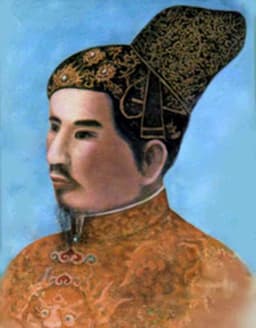
Gia Long
Emperor · Modern
65.4Total

Madho Rao Scindia
Emperor · Modern
50.4Total
Basic Information
Born
1762
1876
Died
1820
1925
Era
Modern
Modern
Nationality
Vietnam
India
Occupation
Emperor
Emperor
Civilization
Eastern
Indian
Score Comparison
Military (10%)
78.0
20.0
Political (20%)
70.3
59.3
Influence (20%)
61.0
53.3
Legacy (20%)
54.0
44.2
Leadership (15%)
78.0
72.0
Strategy (15%)
66.3
43.7
TOTAL
65.4
50.4
Gia Long — Complete Timeline
1787 AD
Treaty of Versailles with FrancePolitical Action◆ Major
Nguyen Anh signed the Treaty of Versailles with King Louis XVI, securing French military and financial support in exchange for trade concessions and the cession of Da Nang and Poulo Condore. This treaty marked the beginning of French involvement in Vietnam.
French ColonialismTreatyNguyen Dynasty
Impact: regional
1788 AD
Capture of SaigonWar◆ Major
Nguyen Anh (later Gia Long) captured Saigon from the Tay Son forces with the help of French military advisors. This victory established his base of power in the Mekong Delta region.
Tay Son WarNguyen DynastyFrench Support
Impact: regional
1801 AD
Battle of Thien MuWar◆ Major
Nguyen Anh's forces, supported by French-built ships and artillery, defeated the Tay Son navy at Thien Mu. This naval victory allowed him to capture Hue, the Tay Son capital.
Tay Son WarNaval BattleFrench Support
Impact: national
1802 AD
Founding of the Nguyen DynastyPolitical Action
Nguyen Anh ascended the throne as Emperor Gia Long, founding the Nguyen dynasty. He unified Vietnam from the Red River Delta to the Mekong Delta, establishing the country's modern borders.
Nguyen DynastyUnificationVietnamese History
Impact: regionalconstructive
1804 AD
Construction of the Hue CitadelCultural◆ Major
Emperor Gia Long ordered the construction of the Hue Citadel, a massive fortified palace complex modeled on the Forbidden City in Beijing. The citadel served as the imperial capital of the Nguyen dynasty until 1945.
ArchitectureHueImperial Capital
Impact: nationalconstructive
Madho Rao Scindia — Complete Timeline
1886 AD
Accession to Gwalior ThronePolitical Action
Madho Rao Scindia became Maharaja of Gwalior at age 10 after the death of his father, Jayajirao Scindia. His reign was marked by progressive reforms and modernization.
GwaliorSuccession
1897 AD
Establishment of Scindia SchoolReform◆ Major
Madho Rao Scindia founded the Scindia School in Gwalior, a residential school for boys based on the British public school model. The school aimed to provide modern education to the Indian elite and became a prestigious institution.
GwaliorEducation
Impact: regionalconstructive
1900 AD
Introduction of Land Revenue ReformsReform
Madho Rao Scindia implemented land revenue reforms in Gwalior state, including the settlement of land taxes and reduction of burdens on peasants. These reforms improved agricultural productivity and state revenues.
GwaliorAgriculture
constructive
1904 AD
Construction of Gwalior Light RailwayReform
Madho Rao Scindia oversaw the construction of the Gwalior Light Railway, a narrow-gauge line connecting Gwalior to Sheopur. This improved transportation and trade within the state, boosting economic development.
GwaliorInfrastructure
constructive
Expert Analysis
Origins
**Gia Long** (born Nguyễn Phúc Ánh, 1762) was a member of the Nguyễn lords who ruled southern Vietnam. After the Tây Sơn rebellion overthrew the Nguyễn in 1777, he spent years in hiding and exile. His early life was marked by constant flight and rebuilding alliances, including seeking aid from French missionaries and the Siamese court.
**Madho Rao Scindia** (born 1876) became Maharaja of Gwalior at age 10 after his father Jayajirao Scindia's death. He was educated under British tutelage and later attended Mayo College. His upbringing was shaped by the princely state system under British suzerainty, with access to modern education and administrative training.
Rise to Power
Gia Long's rise began in 1788 when he recaptured Saigon with French military support, formalized by the Treaty of Versailles (1787). He used French-built ships and artillery to defeat the Tây Sơn navy at the Battle of Thien Mu (1792). By 1802, he captured Hanoi and unified Vietnam, ascending as Emperor Gia Long, founding the Nguyễn dynasty.
Madho Rao Scindia ascended the Gwalior throne in 1886 after a brief regency. His rise was smooth due to hereditary succession under British oversight. He focused on internal reforms rather than military expansion, as the British curtailed princely military power. His early rule emphasized education and infrastructure.
Leadership & Governance
Gia Long's leadership was autocratic and militaristic. He centralized power by abolishing feudal privileges, standardizing laws with the Hoàng Việt luật lệ (1812), and promoting Confucian orthodoxy. He built the Hue Citadel (1804-1833) as a symbol of legitimacy, but his rule was conservative, rejecting Westernization despite using French aid.
Madho Rao Scindia's governance was progressive and reformist. He introduced land revenue reforms (1890s) that stabilized taxes and reduced peasant burdens. He founded the Scindia School (1897) to modernize education and built the Gwalior Light Railway (1899) to boost trade. His leadership score of 72.0 reflects his administrative focus, but his political score of 59.3 shows limited autonomy under British paramountcy.
Triumph & Tragedy
Gia Long's greatest triumph was unifying Vietnam after centuries of division, a feat with a military score of 78.0. However, his tragedy was the suppression of Catholicism and isolationist policies, which sowed resentment and weakened the dynasty. His reliance on French aid later justified French colonial claims.
Madho Rao Scindia's success lay in modernizing Gwalior without conflict. His land reforms and educational initiatives improved life for many. His tragedy was his inability to challenge British dominance; his influence score of 53.3 reflects his constrained legacy. He died in 1925, leaving a state still dependent on the Raj.
Character & Destiny
Gia Long was pragmatic and ruthless, using foreign help but rejecting its culture. His strategic score of 66.3 shows careful planning, but his political score of 70.3 indicates he failed to build lasting institutions. His destiny was to unify, then stagnate.
Madho Rao Scindia was enlightened but cautious. His leadership score of 72.0 shows effective administration, but his strategy score of 43.7 reveals a lack of long-term vision beyond reforms. His destiny was to be a model prince within an imperial system.
Legacy
Gia Long's legacy is the Nguyễn dynasty, which ruled until 1945. The Hue Citadel remains a UNESCO site. However, his unification did not prevent French colonization; his influence score of 61.0 reflects mixed impact.
Madho Rao Scindia's legacy includes the Scindia School, still elite, and railway infrastructure. His reforms influenced later Indian princely states. His legacy score of 44.2 is lower due to limited scope.
Conclusion
Gia Long had greater historical impact with a total score of 65.4 versus Madho Rao Scindia's 50.4. Gia Long's unification of Vietnam reshaped a nation, while Madho Rao's reforms, though progressive, operated within colonial constraints. Gia Long's military and political achievements outweigh Madho Rao's administrative successes. The 15.0-point gap reflects the scale of their influence: one created a country, the other modernized a state.
Rankings
🥇
Gia LongLeader
Mil: 78.0Pol: 70.3Inf: 61.0
65.4
🥈
Madho Rao Scindia
Mil: 20.0Pol: 59.3Inf: 53.3
50.4
+15.0 behind
How This Comparison Works
Algorithm
Each figure is scored on 6 dimensions (0—100 scale) based on structured historical data: Military (10%), Political (20%), Influence (20%), Legacy (20%), Leadership (15%), Strategy (15%). The weighted total produces the final ranking.
Data Sources
Scores are computed from structured sub-indicators in the database. Scale factors adjust for era (Ancient ×0.85, Modern ×1.0) and civilization size (Eastern ×1.05, Other ×0.80) to account for differences in population and military scale.
Maximum 3 Figures
Comparisons are limited to 2—3 figures to ensure readability and statistical meaningfulness.
Error Margins
±5 points per dimension — Sub-scores are derived from historical records with inherent uncertainty. Two figures within 5 points on a dimension should be considered roughly equivalent in that area.
Total Score Accuracy
±3 points overall — The weighted combination of 6 dimensions produces a total score with approximately ±3 points of uncertainty. Differences of less than 3 points are not statistically significant— the figures are effectively tied.
Known Limitations
- Historical records are incomplete and uneven across civilizations
- Figures from oral-tradition societies may be underrepresented
- Occupation labels can misclassify multi-role figures
- Scores measure capability and impact, not moral character
- Quantitative scoring is a comparison tool, not absolute truth
Capability Radar
Military (10%) — Battles & Warfare
Battles
75
10
Win Rate
80
10
Expansion
80
5
Political (20%) — Governance & Reform
Reform
75
75
Diplomacy
70
65
Economy
65
70
Influence (20%) — Cultural & Global Reach
Cultural
55
40
Global
40
20
Legacy (20%) — Historical Impact
Historical
60
45
Longevity
55
30
Leadership (15%) — Power & Stability
Tenure
70
60
Stability
60
65
Strategy (15%) — Tactics & Innovation
Strategy
85
15
Tactics
70
15
Reform
75
40
Similar Comparisons
Comments & Discussion
No comments yet. Be the first to share your thoughts!