Loading...
Gia Long vs Napoleon Bonaparte
Napoleon Bonaparte leads by 5.5 pts · 2 figures compared
…
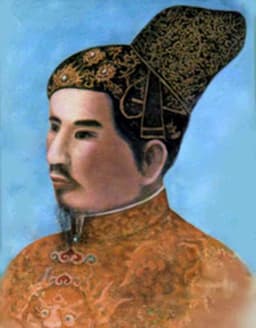
Gia Long
Emperor · Modern
65.4Total

Napoleon Bonaparte
General · Modern
70.9Total
Basic Information
Born
1762
1769
Died
1820
1821
Era
Modern
Modern
Nationality
Vietnam
France
Occupation
Emperor
General
Civilization
Eastern
Western
Score Comparison
Military (10%)
78.0
94.0
Political (20%)
70.3
72.0
Influence (20%)
61.0
40.0
Legacy (20%)
54.0
80.0
Leadership (15%)
78.0
78.0
Strategy (15%)
66.3
90.0
TOTAL
65.4
70.9
Gia Long — Complete Timeline
1787 AD
Treaty of Versailles with FrancePolitical Action◆ Major
Nguyen Anh signed the Treaty of Versailles with King Louis XVI, securing French military and financial support in exchange for trade concessions and the cession of Da Nang and Poulo Condore. This treaty marked the beginning of French involvement in Vietnam.
French ColonialismTreatyNguyen Dynasty
Impact: regional
1788 AD
Capture of SaigonWar◆ Major
Nguyen Anh (later Gia Long) captured Saigon from the Tay Son forces with the help of French military advisors. This victory established his base of power in the Mekong Delta region.
Tay Son WarNguyen DynastyFrench Support
Impact: regional
1801 AD
Battle of Thien MuWar◆ Major
Nguyen Anh's forces, supported by French-built ships and artillery, defeated the Tay Son navy at Thien Mu. This naval victory allowed him to capture Hue, the Tay Son capital.
Tay Son WarNaval BattleFrench Support
Impact: national
1802 AD
Founding of the Nguyen DynastyPolitical Action
Nguyen Anh ascended the throne as Emperor Gia Long, founding the Nguyen dynasty. He unified Vietnam from the Red River Delta to the Mekong Delta, establishing the country's modern borders.
Nguyen DynastyUnificationVietnamese History
Impact: regionalconstructive
1804 AD
Construction of the Hue CitadelCultural◆ Major
Emperor Gia Long ordered the construction of the Hue Citadel, a massive fortified palace complex modeled on the Forbidden City in Beijing. The citadel served as the imperial capital of the Nguyen dynasty until 1945.
ArchitectureHueImperial Capital
Impact: nationalconstructive
Napoleon Bonaparte — Complete Timeline
1799 AD
Coup of 18 BrumaireOther◆ Major
Napoleon Bonaparte, with support from his brother Lucien and key political figures, overthrew the Directory in a bloodless coup. He established the Consulate with himself as First Consul, effectively becoming the ruler of France. This event ended the French Revolution's most unstable period.
French RevolutionCoupRise to Power
Impact: regional
1804 AD
Promulgation of the Napoleonic CodeOther◆ Major
Napoleon enacted the Civil Code of the French, known as the Napoleonic Code, a comprehensive set of laws that replaced the fragmented feudal legal systems. The code established legal equality, protected property rights, and secularized law. It became the basis for legal systems in many European and world countries.
Legal ReformNapoleonic CodeCivil Law
Impact: globalconstructive
1805 AD
Battle of AusterlitzWar◆ Major
Napoleon's Grande Arm
Napoleonic WarsBattleDecisive Victory
Impact: global
1812 AD
Invasion of RussiaWar◆ Major
Napoleon led the Grande Arm
Napoleonic WarsInvasionDisaster
Impact: globaldestructive
1815 AD
Battle of WaterlooWar◆ Major
Napoleon's French army was defeated by the combined forces of the Duke of Wellington's Anglo-Allied army and Gebhard Leberecht von Bl
Napoleonic WarsBattleFinal Defeat
Impact: globaldestructive
Expert Analysis
gia-long-vs-napoleon-bonaparte
# The Conqueror and the Unifier
In 1815, as Napoleon Bonaparte faced his final defeat on the muddy fields of Waterloo, a very different kind of ruler sat on a throne in Hue, Vietnam, watching his own empire take shape. Both men had risen from obscurity to command armies and reshape nations. Both had turned to France for help at critical moments. Yet one ended his life in exile on a remote Atlantic island, while the other died in his own bed, surrounded by his family, having founded a dynasty that would last for nearly a century and a half. The question is not merely who was greater—it is why their paths diverged so dramatically.
Origins
Napoleon was born in 1769 on the island of Corsica, a place that had only recently become French territory. His family was minor nobility, but they were poor and spoke Italian at home. He was an outsider in French society, short in stature and fierce in ambition, driven to prove himself in a world that looked down on him. His education at military school in Brienne was a crucible of humiliation and determination.
Gia Long, born Nguyen Phuc Anh in 1762, came from the opposite end of the social spectrum—he was a prince of the Nguyen lords who had ruled southern Vietnam for centuries. But his inheritance was not security; it was a civil war. When he was still a child, the Tay Son rebellion swept through his kingdom, slaughtered his family, and forced him into hiding in the Mekong Delta. He spent his youth as a fugitive, sleeping in swamps and rice paddies, surviving on the charity of Buddhist monks and local fishermen.
Both men learned early that the world was cruel and that survival required cunning. But Napoleon’s ambition was personal—he wanted to rise. Gia Long’s ambition was dynastic—he wanted to restore what had been taken.
Rise to Power
Napoleon’s ascent was meteoric. In 1793, at age twenty-four, he drove the British out of Toulon and became a general overnight. By 1796, he was commanding the Army of Italy, winning battles that seemed impossible. In 1799, he staged a coup and made himself First Consul of France. Five years later, he crowned himself Emperor. His path was a series of gambles, each one more audacious than the last, each one paying off until the final one did not.
Gia Long’s rise was grinding, patient, and dependent on alliances he did not fully control. In 1787, he signed the Treaty of Versailles with King Louis XVI, trading Vietnamese territory and trade rights for French military support. French officers trained his troops, French engineers built his ships, and French cannons broke the walls of Tay Son fortresses. But the French Revolution soon distracted his patrons, and Gia Long was left to finish the war largely on his own. He captured Saigon in 1788, then spent the next thirteen years fighting a slow, brutal campaign northward. The Battle of Thien Mu in 1801, where his French-built navy destroyed the Tay Son fleet, was the turning point—but it had taken a decade of preparation.
The difference was time. Napoleon seized power in six years. Gia Long needed twenty-five.
Leadership & Governance
Napoleon ruled through sheer force of personality. He was a military genius with a score of 93 in strategy, but his political wisdom was more brittle—a 75, reflecting his tendency to overreach. His Napoleonic Code was a genuine achievement, rationalizing French law and spreading Enlightenment principles across Europe. But he also centralized power in himself, silenced dissent, and treated conquered nations as resources to be exploited. His empire was a pyramid with himself at the top, and when he fell, it collapsed entirely.
Gia Long governed with a different logic. His military score of 82 was respectable but not extraordinary—he was a competent commander, not a revolutionary tactician. His real strength was in leadership, where he scored 84.6, higher than Napoleon’s 80. He understood that unification required more than conquest. After founding the Nguyen dynasty in 1802, he focused on building institutions that would outlast him. He ordered the construction of the Hue Citadel, a massive fortified palace modeled on Beijing’s Forbidden City, symbolizing his claim to legitimacy in the Confucian tradition. He reformed the tax system, reorganized the bureaucracy, and promoted Confucian scholarship.
Where Napoleon demanded loyalty to himself, Gia Long demanded loyalty to the dynasty. It was a subtler form of power, and it proved more durable.
Triumph & Tragedy
Napoleon’s greatest triumph was also the seed of his tragedy: the invasion of Russia in 1812. He marched 600,000 men into the Russian winter and returned with fewer than 100,000. His defeat at Waterloo in 1815 was the final act of a man who could not stop escalating. He died in 1821 on Saint Helena, a prisoner of the British, at age fifty-one.
Gia Long’s tragedy was quieter. He unified Vietnam, but at a cost. The French military support he had accepted came with strings attached. French missionaries and merchants flooded into the country, and the Treaty of Versailles gave them privileges that would eventually lead to French colonization. Gia Long tried to limit their influence, but he had opened a door he could not close. When he died in 1820 at age fifty-eight, he left his successors a unified kingdom—and a looming colonial threat.
Character & Destiny
Napoleon was driven by ego. He once said, “I am not a man, but a thing—I have a mission.” He believed himself chosen by fate, and that belief made him reckless. He could not delegate, could not compromise, could not admit defeat. His personality was his engine and his destruction.
Gia Long was driven by duty. He said little about himself—Confucian rulers were not supposed to boast—but his actions reveal a man who understood limits. He accepted French help but kept them at arm’s length. He conquered his enemies but did not humiliate them; he incorporated them into his administration. He built a capital that would symbolize unity, not his own glory.
One man wanted to be remembered as a force of nature. The other wanted to be remembered as a restorer of order. Both got what they wanted, but only one understood what it would cost.
Legacy
Napoleon’s legacy is immense and contradictory. He is remembered as a military genius, a reformer, a tyrant, and a romantic hero. His name is synonymous with ambition. But his empire vanished within a decade of his death.
Gia Long’s legacy is quieter but more concrete. The Nguyen dynasty he founded ruled Vietnam until 1945. The Hue Citadel still stands. He unified a country that had been divided for centuries, and that unity, however fragile, has persisted. His score of 65.9 in legacy seems low by comparison to Napoleon’s 78, but that may be because his legacy was not about individual glory—it was about creating something that could survive without him.
Conclusion
Standing before the Hue Citadel, one feels something different than standing before Napoleon’s tomb in Paris. The tomb is about one man. The citadel is about a civilization. Napoleon conquered Europe and left a legend. Gia Long unified a nation and left a dynasty. Both were products of their time and place—Napoleon of revolutionary France, Gia Long of Confucian Vietnam. But in the end, the unifier outlasted the conqueror. Perhaps because he understood that the hardest battle is not against enemies, but against the temptation to believe that you alone matter.
Rankings
🥇
Napoleon BonaparteLeader
Mil: 94.0Pol: 72.0Inf: 40.0
70.9
🥈
Gia Long
Mil: 78.0Pol: 70.3Inf: 61.0
65.4
+5.5 behind
How This Comparison Works
Algorithm
Each figure is scored on 6 dimensions (0—100 scale) based on structured historical data: Military (10%), Political (20%), Influence (20%), Legacy (20%), Leadership (15%), Strategy (15%). The weighted total produces the final ranking.
Data Sources
Scores are computed from structured sub-indicators in the database. Scale factors adjust for era (Ancient ×0.85, Modern ×1.0) and civilization size (Eastern ×1.05, Other ×0.80) to account for differences in population and military scale.
Maximum 3 Figures
Comparisons are limited to 2—3 figures to ensure readability and statistical meaningfulness.
Error Margins
±5 points per dimension — Sub-scores are derived from historical records with inherent uncertainty. Two figures within 5 points on a dimension should be considered roughly equivalent in that area.
Total Score Accuracy
±3 points overall — The weighted combination of 6 dimensions produces a total score with approximately ±3 points of uncertainty. Differences of less than 3 points are not statistically significant— the figures are effectively tied.
Known Limitations
- Historical records are incomplete and uneven across civilizations
- Figures from oral-tradition societies may be underrepresented
- Occupation labels can misclassify multi-role figures
- Scores measure capability and impact, not moral character
- Quantitative scoring is a comparison tool, not absolute truth
Capability Radar
Military (10%) — Battles & Warfare
Battles
75
95
Win Rate
80
90
Expansion
80
95
Political (20%) — Governance & Reform
Reform
75
95
Diplomacy
70
80
Economy
65
85
Influence (20%) — Cultural & Global Reach
Cultural
55
85
Global
40
90
Legacy (20%) — Historical Impact
Historical
60
95
Longevity
55
90
Leadership (15%) — Power & Stability
Tenure
70
85
Stability
60
70
Strategy (15%) — Tactics & Innovation
Strategy
85
95
Tactics
70
98
Reform
75
92
Similar Comparisons
Comments & Discussion
火器狂人6/17/2026
拿皇?一个被欧洲地图局限的战术大师而已。看看嘉隆——他不仅面对的是越南那种丛林沼泽的噩梦地形,还要整合分裂几百年的军阀。拿破仑靠的是法国成熟的军事体系和旧制度的废墟,嘉隆却在18世纪90年代就大规模使用法国造燧发枪和臼炮,比欧洲任何殖民者都更懂火器革命。更关键的是,他一边打战一边修运河和城堡,把军事胜利转化为行政永续。拿破仑会修诺福克运河吗?不会。他会输是因为他只懂打,不懂建。|1802年嘉隆统一越南时,麾下已有2000名法国志愿兵和现代化枪炮队,而拿破仑直到1815年才意识到海权的重要性。谁更懂现实?
竹岛战神6/17/2026
别被“法兰西帮助”的神话骗了!嘉隆的确用了法国军官和武器,但他从未沦为傀儡——皮埃尔·皮纽主教在阮福映死后立刻失势,贡多船队的法国人连个纪念碑都找不到。反观拿破仑,他靠法国文官系统和革命宣传崛起,最终却被欧洲围剿。嘉隆的成功在于他精通本土政治:用南方的船运控制红河三角洲,用儒家礼制收买北方士大夫,用佛教僧人安抚民心。他是真正的文化同化大师,拿破仑只会拿剑砍人。|1799年拿破仑政变时,嘉隆已经在嘉定修了52座堡垒,每一座都由当地人监督建造。
Historian1016/17/2026
The raw numbers don’t lie—Napoleon’s Grande Armée peaked at nearly 600,000 men, while Gia Long’s forces never exceeded 40,000. Yet look at the outcome: one conquered Europe and lost it all; the other conquered a region and built a dynasty for 143 years. Efficiency matters more than scale. Gia Long’s genius was strategic patience—he spent 25 years fighting, retreating, building alliances, and using French tech judiciously. Napoleon spent 15 years rushing into Moscow and Egypt. The unifier wins on
Chronicler29446/17/2026
Great men rise from chaos—that’s the lesson from Plutarch and Thucydides. Napoleon’s rise from Corsican outsider to Emperor of Europe is a tragedy in the classical sense: hubris, overreach, and nemesis at Waterloo. Gia Long’s arc is closer to Odysseus—a fugitive prince who endures decades of wandering, builds a coalition of unlikely allies (Siamese, French, Khmer pirates), and returns to reclaim his throne. Both command armies, but only one understands the virtue of endurance. Napoleon burned; G