Loading...
Gerald Ford vs Julius Caesar
Julius Caesar leads by 31.6 pts · 2 figures compared
…
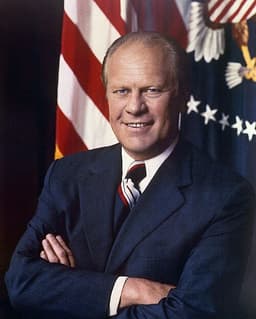
Gerald Ford
Politician · Modern
51.2Total

Julius Caesar
General · Ancient
82.8Total
Basic Information
Born
1913
-100
Died
2006
-44
Era
Modern
Ancient
Nationality
United States
Roman Republic
Occupation
Politician
General
Civilization
Western
Western
Score Comparison
Military (10%)
49.2
88.0
Political (20%)
48.0
78.0
Influence (20%)
54.1
85.0
Legacy (20%)
45.0
82.0
Leadership (15%)
68.0
80.0
Strategy (15%)
41.4
85.0
TOTAL
51.2
82.8
Gerald Ford — Complete Timeline
1973 AD
Appointed Vice PresidentPolitical Action◆ Major
Ford was appointed Vice President under the 25th Amendment after Spiro Agnew's resignation. He became the first person to hold the office without being elected to it.
Vice PresidencyConstitutional
Impact: national
1974 AD
Assumed Presidency after Nixon's ResignationPolitical Action
Ford became President after Richard Nixon resigned due to the Watergate scandal. He stated, 'Our long national nightmare is over,' aiming to restore trust in government.
PresidencyWatergate
Impact: national
Pardoned Richard NixonPolitical Action
Ford granted a full pardon to Richard Nixon for any crimes committed during his presidency. The pardon was highly controversial and is widely believed to have cost Ford the 1976 election.
PardonWatergate
Impact: national
1976 AD
Lost 1976 Presidential ElectionPolitical Action◆ Major
Ford lost the 1976 presidential election to Jimmy Carter. The narrow defeat was attributed to the Nixon pardon and economic issues, ending his brief presidency.
ElectionDefeat
Impact: nationaldestructive
Julius Caesar — Complete Timeline
58 BC
Gallic WarsWar◆ Major
Caesar, as proconsul of Gaul, launched a series of campaigns that conquered all of Gaul (modern France, Belgium, and parts of Switzerland). He fought numerous battles, including against the Helvetii, the Belgae, and the Gallic chieftain Vercingetorix. The wars brought immense wealth and a loyal army to Caesar.
Gallic WarsConquestRoman Expansion
Impact: regional
49 BC
Crossing the RubiconPolitical Action◆ Major
Caesar led Legio XIII across the Rubicon River into Italy, defying the Roman Senate's order to disband his army. This act triggered a civil war against Pompey and the Optimates, ultimately leading to Caesar's dictatorship and the end of the Roman Republic.
Roman Civil WarEnd of RepublicPower Struggle
Impact: global
48 BC
Battle of PharsalusWar◆ Major
Caesar's outnumbered army defeated the larger forces of Pompey the Great at Pharsalus in Greece. Caesar's tactical use of a reserve line to counter Pompey's cavalry charge proved decisive. Pompey fled to Egypt, where he was assassinated, leaving Caesar as the undisputed master of the Roman world.
Roman Civil WarBattleDecisive Victory
Impact: regional
44 BC
Appointment as Dictator for LifePolitical Action◆ Major
The Roman Senate appointed Caesar dictator perpetuo (dictator for life), granting him unprecedented personal power. This move concentrated military, legislative, and judicial authority in one person, effectively ending the Roman Republic's traditional system of checks and balances and alarming many senators.
DictatorshipEnd of RepublicPower Consolidation
Impact: regionaldestructive
Assassination on the Ides of MarchPolitical Action◆ Major
A group of Roman senators, led by Marcus Junius Brutus and Gaius Cassius Longinus, stabbed Caesar to death at a meeting of the Senate in the Theatre of Pompey. The assassination was intended to restore the Republic, but instead triggered another civil war that led to the rise of the Roman Empire.
AssassinationRoman PoliticsEnd of Republic
Impact: globaldestructive
Expert Analysis
gerald-ford-vs-julius-caesar
# The General and the Healer: Two Men Who Stepped Into History's Void
On a gray January morning in 1974, Gerald Ford stood in the East Room of the White House and raised his right hand. He had never sought the presidency. He had never been elected to it. Yet here he was, inheriting a nation shattered by Watergate, a republic in crisis. Across two millennia, on a January morning in 49 BCE, another man stood at the banks of a small river in northern Italy. The Rubicon. Julius Caesar paused, weighed the fate of the Roman Republic, and crossed. Two men, separated by two thousand years, each stepping into a void of authority. One would heal a wounded nation; the other would destroy a republic to build an empire. Why did their paths diverge so completely?
Origins
Caesar was born into the twilight of the Roman Republic, a world of senatorial intrigue, civil wars, and crumbling traditions. His family, the Julii, claimed descent from the goddess Venus, but their political fortunes had faded. Young Caesar learned early that in Rome, prestige meant nothing without power—and power required audacity. He grew up amid the dictatorship of Sulla, who had proscribed his enemies, and the revolt of Spartacus, which exposed the Republic's inability to manage its own ambitions. The lesson was clear: the old order was dying, and a man of genius could seize what the system could no longer hold.
Ford was born in Omaha, Nebraska, in 1913, into a world of stability and promise. His parents divorced when he was young, and his mother remarried a paint salesman who gave the boy his name. Ford grew up in Grand Rapids, Michigan, a Midwestern heartland of hard work and modest expectations. He was a star football player at the University of Michigan, a lawyer, a Navy officer in World War II. His world was one of institutions—Congress, the Republican Party, the rule of law. He had no divine ancestry, no burning ambition to remake the world. He simply wanted to serve.
Rise to Power
Caesar's path was a ladder of calculated risks. He borrowed fortunes to buy popularity, threw lavish games, forged alliances with the richest men in Rome. He served as governor of a backwater province, then used his military command in Gaul to build a loyal army—and a legend. When his political enemies demanded he disband his legions and return to Rome as a private citizen, Caesar refused. The Rubicon crossing was not a rebellion; it was a negotiation backed by steel. Within five years, he was dictator for life.
Ford's rise was almost accidental. He spent twenty-five years in the House of Representatives, never seeking higher office. He was a loyal party man, a consensus builder. In 1973, when Vice President Spiro Agnew resigned in disgrace, President Nixon needed a replacement who could be confirmed by a Democratic Congress. Ford was the obvious choice—safe, honest, unthreatening. Nine months later, Nixon himself resigned. Ford became president not by conquest but by default. He had never won a single national election.
Leadership & Governance
Caesar governed as he conquered: decisively, ruthlessly, brilliantly. He reformed the calendar, granted citizenship to provincials, redistributed land to veterans, and centralized power in his own hands. He was a military genius who personally led his troops in battle, a politician who understood that the Republic's institutions were hollow and that only a strong man could hold it together. But his reforms were also weapons. He packed the Senate with his supporters, minted coins with his image, and accepted the title "dictator for life." He did not destroy the Republic; he replaced it.
Ford governed as he had lived: cautiously, decently, pragmatically. His first act was to tell the nation, "Our long national nightmare is over." He tried to heal the wounds of Watergate by pardoning Nixon—a decision that destroyed his political future but may have saved the country from years of recrimination. He fought inflation, vetoed spending bills, and tried to restore trust in government. He was no military leader; his strategic score of 35.3 reflects a man who never commanded armies. His leadership score of 78.4, however, reflects something rarer: moral courage.
Triumph & Tragedy
Caesar's triumph was Gaul—eight years of conquest that made him the richest and most famous man in the Roman world. His Commentaries, written in the third person, turned military campaigns into literature. His tragedy was the Ides of March. On that day in 44 BCE, sixty senators stabbed him to death in the Senate chamber. He fell at the feet of a statue of his rival, Pompey. His last words, according to tradition, were, "Et tu, Brute?" He had trusted his friends, and they killed him.
Ford's triumph was his presidency itself—a peaceful transfer of power in the midst of a constitutional crisis. He restored dignity to the White House. His tragedy was the pardon. He knew it would cost him the 1976 election, and it did. He lost narrowly to Jimmy Carter, a peanut farmer from Georgia. But in later years, even his critics admitted the pardon was the right thing. Ford died in 2006, the longest-lived president in American history, at age 93.
Character & Destiny
Caesar was a gambler with an iron will. He believed that history belonged to those who seized it. His personality—arrogant, generous, ruthless, charming—shaped every decision. He pardoned his enemies but never forgot them. He loved power but also glory. His destiny was to be the bridge between Republic and Empire, a role he embraced fully. He was murdered because he could not imagine that anyone would dare.
Ford was a healer with a steady hand. He believed that institutions mattered more than individuals. His personality—modest, honest, unpretentious—shaped his presidency. He did not pardon Nixon for political gain; he did it because he thought it was right. His destiny was to be a caretaker in a time of crisis, a man who stepped aside when his work was done. He was defeated because he put the country before himself.
Legacy
Caesar's legacy is the Roman Empire. His adopted son, Octavian, became Augustus, the first emperor. The title "Caesar" became synonymous with imperial power, used by rulers from Rome to Russia to Germany. His reforms outlasted the Republic. His calendar, with minor adjustments, is still used today. He is remembered as a genius, a tyrant, and a martyr—depending on who tells the story.
Ford's legacy is more modest but no less important. He restored faith in American government at a moment when it could have collapsed. He proved that the Constitution could survive a criminal president. His pardon remains controversial, but it also remains a precedent for putting national unity above personal ambition. He is remembered as a decent man who did an unpopular thing because it was right.
Conclusion
Two men, two voids. Caesar stepped into the void of a dying republic and built an empire. Ford stepped into the void of a wounded republic and healed it. Caesar's ambition changed the world; Ford's humility saved it. One was assassinated by his friends; the other was rejected by his countrymen. Both, in their own ways, did what they believed was necessary. History does not judge them by their intentions, but by their consequences. And perhaps that is the only lesson: that power reveals character, and character determines destiny. The general and the healer—each, in his own time, gave his nation what it needed, and what it could not give itself.
Rankings
🥇
Julius CaesarLeader
Mil: 88.0Pol: 78.0Inf: 85.0
82.8
🥈
Gerald Ford
Mil: 49.2Pol: 48.0Inf: 54.1
51.2
+31.6 behind
How This Comparison Works
Algorithm
Each figure is scored on 6 dimensions (0—100 scale) based on structured historical data: Military (10%), Political (20%), Influence (20%), Legacy (20%), Leadership (15%), Strategy (15%). The weighted total produces the final ranking.
Data Sources
Scores are computed from structured sub-indicators in the database. Scale factors adjust for era (Ancient ×0.85, Modern ×1.0) and civilization size (Eastern ×1.05, Other ×0.80) to account for differences in population and military scale.
Maximum 3 Figures
Comparisons are limited to 2—3 figures to ensure readability and statistical meaningfulness.
Error Margins
±5 points per dimension — Sub-scores are derived from historical records with inherent uncertainty. Two figures within 5 points on a dimension should be considered roughly equivalent in that area.
Total Score Accuracy
±3 points overall — The weighted combination of 6 dimensions produces a total score with approximately ±3 points of uncertainty. Differences of less than 3 points are not statistically significant— the figures are effectively tied.
Known Limitations
- Historical records are incomplete and uneven across civilizations
- Figures from oral-tradition societies may be underrepresented
- Occupation labels can misclassify multi-role figures
- Scores measure capability and impact, not moral character
- Quantitative scoring is a comparison tool, not absolute truth
Capability Radar
Military (10%) — Battles & Warfare
Battles
27
95
Win Rate
35
92
Expansion
36
97
Political (20%) — Governance & Reform
Reform
40
90
Diplomacy
45
85
Economy
35
82
Influence (20%) — Cultural & Global Reach
Cultural
30
88
Global
35
94
Legacy (20%) — Historical Impact
Historical
40
95
Longevity
30
96
Leadership (15%) — Power & Stability
Tenure
55
75
Stability
50
60
Strategy (15%) — Tactics & Innovation
Strategy
36
94
Tactics
39
96
Reform
44
88
Similar Comparisons
Comments & Discussion
No comments yet. Be the first to share your thoughts!